
Tackling inequality, forging an inclusive society key to S’pore’s future: President Halimah
SINGAPORE — Stressing the need to tackle inequality, President Halimah Yacob warned on Monday (May 7) that income disparity and social stratification — which have broken the social compact in many countries — could cause politics in Singapore to turn vicious, society to fracture, and the nation to wither.
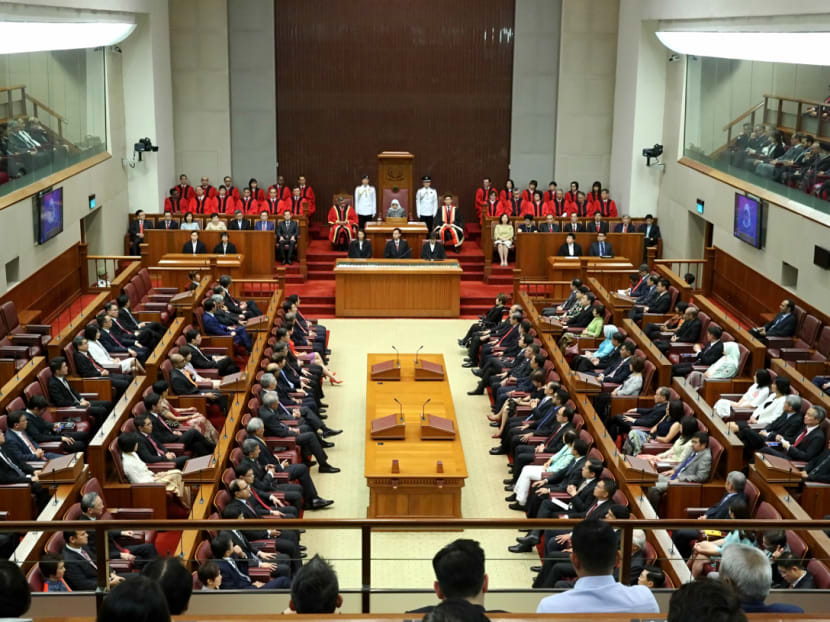
President Halimah Yacob delivers her speech during the opening of the Second Session of the Thirteenth Parliament on Monday, May 7, 2018, at the Parliament House.



SINGAPORE — Stressing the need to tackle inequality, President Halimah Yacob warned on Monday (May 7) that income disparity and social stratification — which have broken the social compact in many countries — could cause politics in Singapore to turn vicious, society to fracture, and the nation to wither.
In her maiden President's Address which kicked off the second session of Parliament, Madam Halimah singled out the "increasingly dissimilar starting points of children from different family backgrounds", which she said had to be addressed before the problem becomes entrenched in Singapore society.
Singapore must also not succumb to growing divisive forces such as religious polarisation, xenophobia and extreme nationalism, said Madam Halimah. She also warned of the use of cyber space to spread falsehoods and misinformation, and to "sow distrust within societies".
Highlighting these domestic challenges in her speech, Madam Halimah laid out four key areas of focus to tackle these issues. They include preparing the city's infrastructure for future generations, creating more opportunities for workers amid economic restructuring, tackling inequality "vigorously", and nurturing a Singaporean identity.
NATION BUILDING WORK 'WILL INTENSIFY'
While these priorities are not new, the work "will intensify" from the second half of the Government's term as the 4G leaders undertake the next phase of nation building, she noted.
In order to tackle inequality, the right additional support has to be given to those in need, in areas such as housing, education, skills training and employment so that meritocracy will work well, added Madam Halimah. More "progression pathways" should be available to Singaporeans, and each child should be given a good start in life, regardless of his or her family circumstances. This can be achieved by continuing to raise the quality of pre-schools and doing more for children at risk, she said.
"Only then can everyone do well through hard work, talent and skills, regardless of their backgrounds," added Madam Halimah.
The Government will also have to pay "special attention" to the growing elderly population, and help older workers "stay employed, earn fair wages and save more, so they can age with dignity and purpose", she said.
New housing options for the elderly will be considered, while the Government aims to keep healthcare affordable through subsidies such as MediShield Life, MediFund and enhancements to ElderShield.
Turning her focus to the working population, Madam Halimah said heavy investments will continue to be poured into building an economy that places "less emphasis on academic grades, and more on skills and the ability to adapt to a dynamic external environment" through government initiatives such as SkillsFuture, and Adapt and Grow.
This comes as Singapore's investment in research and development bears fruit, generating an innovation ecosystem to support entrepreneurship, and further develop the start-up scene in areas such as artificial intelligence, financial technology, advanced manufacturing, and bioscience.
New business centres will also come up in the Jurong Lake District, Punggol Digital District, and Woodlands North Coast, noted Madam Halimah.
METROPOLIS OF THE FUTURE
Madam Halimah called for "bold thinking" as Singapore strives to "create a metropolis that embraces the future". To keep Singapore one of the best connected cities in Asia, the Government will invest in infrastructure such as the Changi Airport Terminal 5, new Tuas Port, the Kuala Lumpur-Singapore High Speed Rail, and Johor Bahru-Singapore Rapid Transit System Link.
Singapore's cityscape is also set for a big transformation, said Madam Halimah, with the Greater Southern Waterfront project to be built on land three times the size of Marina Bay at the current site of the city ports. The Central Business District will double its size when the ports move to Tuas, and "the possibilities in this new area… are immense, and limited only by our imagination", she added.
The Paya Lebar Air Base, which sits on 800 hectare of land – an area larger than Ang Mo Kio – will also be redeveloped. This was first announced by Prime Minister Lee Hsien Loong in his National Day Rally speech in 2013, and the relocation of the base to Changi from 2030 will see the land used to build new homes, offices, factories, and parks.
Acknowledging that Singaporeans "want to feel a strong sense of nationhood" amid all the changes, Madam Halimah said next year's Singapore Bicentennial – which will mark 200 years since Sir Stamford Raffles landed in Singapore – is an occasion for Singaporeans to "trace our roots, and draw inspiration for the journey ahead".
"We did not expect this on 8 August 1965, but we have succeeded in nurturing a distinct Singapore identity, a sense of common destiny transcending our individual racial and religious identities.
"This is still a work in progress, but we have come far."
Stay in the know. Anytime. Anywhere.

Subscribe to our newsletter for the top features, insights and must reads delivered straight to your inbox.
By clicking subscribe, I agree for my personal data to be used to send me TODAY newsletters, promotional offers and for research and analysis.