
Tekong-bound: All recruits from army combat units get basic training at BMTC
SINGAPORE — Basic military training (BMT) for nearly all combat-fit full-time national servicemen (NSFs) has been shifted to Pulau Tekong, in a bid to raise training effectiveness and forge stronger camaraderie among Singapore Armed Forces (SAF) recruits.
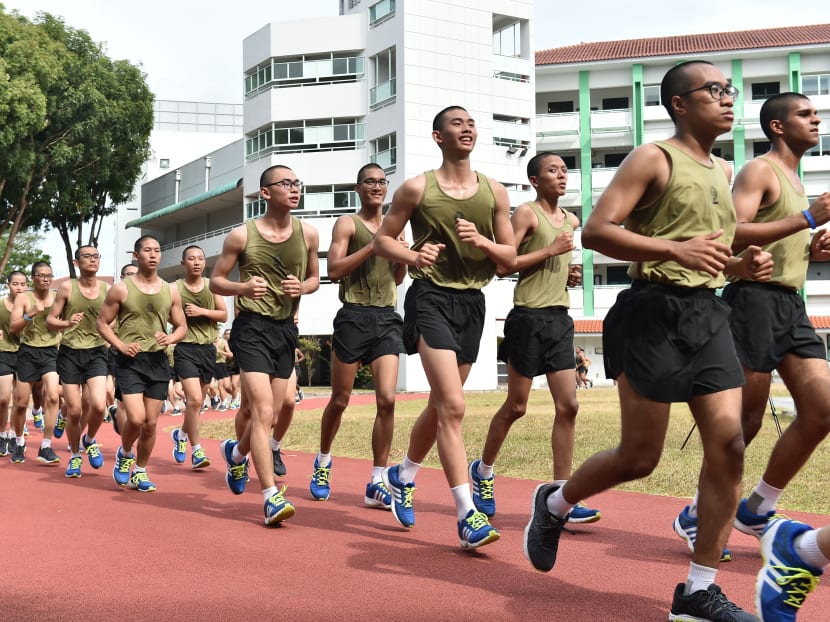
Since November, all NSFs assigned to Army combats units have been undergoing BMT on Pulau Tekong.



SINGAPORE — Basic military training (BMT) for nearly all combat-fit full-time national servicemen (NSFs) has been shifted to Pulau Tekong, in a bid to raise training effectiveness and forge stronger camaraderie among Singapore Armed Forces (SAF) recruits.
This shift to the new "One-BMT" programme, which has been underway since November, was announced by Second Defence Minister Ong Ye Kung on Friday (March 2) during the debate on the Defence Ministry's budget.
Previously, many NSFs underwent BMT in the camps of their own units — commonly known as "mono-intake" units. For instance, recruits from the 3rd Battalion, Singapore Infantry Regiment (3 SIR) used to complete basic training at Selarang Camp near Loyang. Slightly over half of the NSFs had attended BMT on Pulau Tekong.
The bulk of combat-fit recruits, however, will now train at the Basic Military Training Centre (BMTC) on Pulau Tekong. The only exceptions would be those training to be commandos and naval divers, or who are placed into support vocations.
"These NSFs will benefit from the BMTC's dedicated training experience, their infrastructure and their use of technology," said Mr Ong. "Most importantly, they will share a common experience within the unit as well as within the larger SAF tribe."
As part of this change, several thousand more recruits will train on the island each year, allowing them to use the BMTC's infrastructure and smart devices such as LEARNet electronic tablets.
Having all recruits under one roof also raises training effectiveness with the "consolidation of training expertise and knowledge management" within the centre, Mindef said.
A trial to carry out BMT for army combat units on Pulau Tekong began in August 2016. Since then, more than 2,500 NSFs have gone through the programme there.
The BMTC was set up in 1987 on the island, which lies off the north-eastern coast of Singapore. BMT there has since become a rite of passage for many young men.
Servicemen complete a common nine-week BMT programme. Those who fail to attain the minimum requirements under the pre-enlistee individual physical proficiency test undergo an extra eight weeks of physical training.
As part of the One-BMT programme, there is a higher chance that servicemen picked to be commanders during BMT would return to their One-BMT unit after Command School. This will "further strengthen small-unit leadership and morale", Mindef said.
‘UNIT IDENTITY’
Second Lieutenant (2LT) Syahir Ally Sa’ari, a platoon commander with 3 SIR, was among the first to take part in the One-BMT programme as a recruit in August 2016. He said that there was a larger focus on unit identity during BMT. For instance, instead of donning the usual green physical training vest worn by most recruits, those from his unit sported the blue vest of the 6th Singapore Division, of which 3 SIR is a part. “It gave us a sense of pride to be in 3 SIR,” he said.
During meal-time on the first day, other recruits had asked them why their attire was different. “We needed to explain to them that we’re from One-BMT, we’re different from them, (and) already in an infantry unit,” 2LT Syahir said.
Another bonus was that the facilities designed for BMT were just in “your backyard”, he added. In the past, 3 SIR recruits had to travel from Selarang Camp to Pulau Tekong or other camps to use facilities, such as the Battle Inoculation Course.
Recruits who have gone through One-BMT also mentioned that there is a sharing of resources. Platoon commanders are from BMTC, while some of the section commanders are from the combat units, and they get to learn from both groups of commanders.
Recruit Liew Yong Quan, 22, a trainee from the 1st Battalion, Singapore Guards now doing BMT, said: “They mix both commanders from BMTC and our own 1 Guards commanders. The centre’s trainers are experienced — they brief us on every part of our training before they let us go (out to train).”
For new recruits, there is the advantage of gathering more information on where they may be posted.
Second Sergeant K Dinessh Raaj, 22, an assistant platoon sergeant at 3 SIR, had enlisted in October 2016. He attended a “mini open-house” for recruits on Pulau Tekong in the second month of his BMT, giving them a peek into life in the infantry unit. He found out about the different facets of the unit’s support company, where he now serves.
“At that point in time, as recruits, we did not know if we would go into the support company or the rifle companies, so it was a good opportunity for us to learn what it was like.”
More flexibility in vocation deployment
Aided by technology, more full-time national servicemen have been allowed to carry out roles previously done only by those who met the strictest physical standards, Second Defence Minister Ong Ye Kung said on Friday (March 2).
Since last year, the Singapore Armed Forces (SAF) has placed more than 600 servicemen into vocations they used to be ineligible for, as part of a review of the vocation deployment criteria.
These vocations include technical assignments in areas such as maintenance, the Defence Ministry (Mindef) said. The changes to the criteria are being carried out in phases until next year.
This year, the SAF expects to deploy 1,500 more servicemen to a wider range of vocations.
"With technology, you can no longer draw a firm line between being combat-fit and non-combat-fit. For example, personnel operating an autonomous system in the control room are in combat, even though they are not physically exerting," said Mr Ong.
Meanwhile, the first batch of 4,000 full-time national servicemen will have their vocation interests considered when they finish basic military training later this month. Since would-be soldiers were allowed to indicate their preferences in 2016, some 32,000 pre-enlistees have done so.
They can choose from a list of 33 National Service (NS) vocations across the SAF, police and Singapore Civil Defence Force. Amid a heightened threat environment, island defence was one of the top choices, Mindef said.
There was also strong interest in tough combat vocations such as guards and infantry.
Recruit Dineru Priyalal Premasinghe, 19, was one of those who indicated an interest in island defence. His history of childhood asthma would previously have made it impossible for him to serve as a security trooper, but the review of the deployment criteria means he is now eligible.
"I am keen to serve in island defence so that I can contribute to Singapore in the area of homeland security ... It's very uplifting for me," said the full-time national serviceman.
Stay in the know. Anytime. Anywhere.

Subscribe to our newsletter for the top features, insights and must reads delivered straight to your inbox.
By clicking subscribe, I agree for my personal data to be used to send me TODAY newsletters, promotional offers and for research and analysis.






