
Tele-rehabilitation to give stroke patients more home therapy options
SINGAPORE — A team of researchers from the National University of Singapore (NUS) has started clinical trials to determine whether tele-rehabilitation, which allows therapists to monitor their patients’ progress and exercises remotely, is an effective means to help stroke patients recover at home.
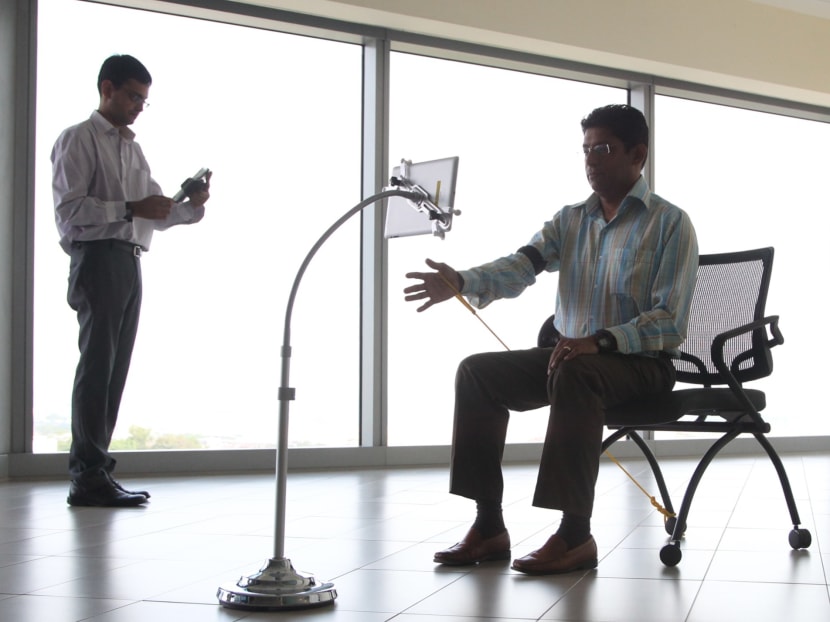
A demonstration showing a recovering "patient" using an iPad installed with a proprietary app to enable rehabilitation exercises to be carried out away from the hospital. Footage of the "patient's" workout is then viewed and corrected by a therapist from a hospital, March 31, 2014. Photo: Don Wong

SINGAPORE — A team of researchers from the National University of Singapore (NUS) has started clinical trials to determine whether tele-rehabilitation, which allows therapists to monitor their patients’ progress and exercises remotely, is an effective means to help stroke patients recover at home.
The first three to six months after a person suffers a stroke is crucial for rehabilitation, as this is the period when most of the patient’s functional improvements occur. However, many face problems in continuing with rehabilitation — such as the inconvenience of going to rehabilitation centres and having caregivers take time off work to accompany them. In fact, only a third of patients go for therapy at day rehabilitation centres after their discharge from hospital.
Hence, the researchers hope that tele-rehabilitation could help boost the number of patients who continue with therapy. “With home-based tele-rehabilitation, patients do not need to face physical barriers, their caregivers do not need to accompany them to the rehabilitation centre and their therapists do not need to visit them at home to provide rehabilitation,” said the study’s principal investigator, Dr Gerald Koh, who is Associate Professor and Director of Medical Undergraduate Education at Saw Swee Hock School of Public Health at NUS.
In the clinical trials, the first of which started in December with 13 patients, iPads are used as a tool to guide patients through exercises via videos, with data captured on motion sensors for therapists to review, as well as for weekly video conferencing between therapist and patient. Caretakers will have to be present during the tele-rehabilitation.
The NUS team is also hopeful that tele-rehabilitation could be more cost-effective in the long term. Dr Koh estimated that tele-rehabilitation costs about S$100 a week. While twice as expensive as rehabilitation at centres, it is still more affordable than home visits by therapists, which costs between S$150 and S$250 each week.
The 13 patients in the first trial were recruited from Ang Mo Kio-Thye Hua Kwan Hospital and the Singapore General Hospital. Each trial lasts three months and start as and when patients come on board the study. The team hopes to have 100 patients complete the trials within two years, with half acting as control subjects who will receive therapy at centres or during home visits by therapists.
The effectiveness of tele-rehabilitation will be measured by comparing the progress made by those on the remote therapy programme with those on the normal therapy programmes, in terms of functional ability, balance, speed, quality of life and cost-effectiveness.
Stay in the know. Anytime. Anywhere.

Subscribe to our newsletter for the top features, insights and must reads delivered straight to your inbox.
By clicking subscribe, I agree for my personal data to be used to send me TODAY newsletters, promotional offers and for research and analysis.






