
Twelve Cupcakes co-founder Jaime Teo fined S$65,000 for underpaying foreign employees over 3 years
SINGAPORE — Former actress Jaime Teo, one of the founders of homegrown bakery chain Twelve Cupcakes, was fined S$65,000 on Tuesday (March 9) for her role in underpaying seven foreign employees for more than three years.
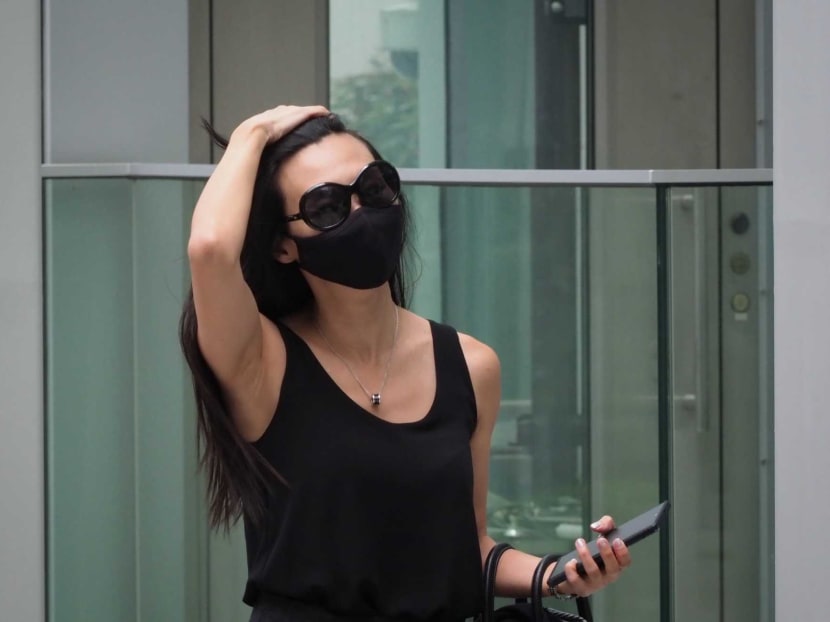
Former actress Jaime Teo arriving at the State Courts on March 9, 2021.



- Former actress Jaime Teo was charged alongside her ex-husband Daniel Ong, whose case is pending
- Last month, she pleaded guilty to 10 charges of underpaying foreign workers
- The seven employees who were underpaid are still owed S$98,900 in salaries
- Some of the employees continued getting lower wages under Twelve Cupcakes’ new owner
SINGAPORE — Former actress Jaime Teo, one of the founders of homegrown bakery chain Twelve Cupcakes, was fined S$65,000 on Tuesday (March 9) for her role in underpaying seven foreign employees for more than three years.
The 43-year-old was charged alongside her ex-husband and former radio deejay Daniel Ong Ming Ru. His court case is still pending.
The couple, who divorced in 2016 after nine years of marriage, started Twelve Cupcakes in 2011 before selling it in 2017 to Indian tea company Dhunseri Group for S$2.5 million.
Last month, the firm was fined S$119,500 for underpaying eight foreign employees from 2017 to 2019.
Some of the workers who were underpaid on Teo’s and Ong’s watch continued to be underpaid under the bakery’s new owner.
Teo, who was crowned Miss Singapore Universe in 2001, pleaded guilty last month to 10 charges of flouting rules under the Employment of Foreign Manpower Act, including failing to pay their foreign employees on time.
She argued through her lawyers that she handled only product development and marketing, and did not deal with operations, human resources or administrative matters.
Even so, District Judge Adam Nakhoda, who considered 14 other similar charges in sentencing Teo, said that she ought to have paid more attention to the company’s human resource matters.
While she did not personally benefit from the offences, this did not mean that she did not enjoy indirect benefits, the judge said. The employees are still owed S$98,900 in salary arrears and no reimbursement has been made.
District Judge Nakhoda also noted that the offences were difficult to detect and the practices had “persisted for a significant period of time”.
A MAIN DECISION-MAKER
As one of the directors and main decision-makers of the firm, Teo committed the crimes over the space of three years and two months — between September 2012 and December 2016.
She and Ong were responsible for their employees’ salaries and were signatories of the company’s account.
The couple jointly decided in 2012 to hire foreign employees to expand their family-owned business and agreed on the relevant salary ranges.
The underpaid employees were supposed to be paid between S$2,000 and S$2,600 a month, but consistently received less than that. Four of them were customer service executives, two were sales executives and one was a pastry chef.
One of the sales executives was supposed to be paid S$2,600 every month, but received either S$1,200 or S$1,400 over about a year.
All of them held S Passes, which are given by the Ministry of Manpower (MOM) to mid-level and skilled foreign workers who earn at least S$2,500 a month.
Teo failed to prevent the underpayment.
'DIFFICULT TO DETECT'
MOM's prosecutor Maximilian Chew earlier sought a fine of S$80,000, while Teo’s lawyers Sunil Sudheesan and Diana Ngiam asked for a lower fine of S$20,000.
Mr Sudheesan argued that the offences happened because they were difficult to detect, which meant that Teo did not notice and intervene.
Mr Chew disagreed, saying that Teo had agreed on the employees’ salary range, which was “significantly below” the minimum S Pass salary requirement.
She could have checked the work-pass declaration forms or carried out a quick Internet search, the prosecutor added.
He also objected to the lawyers’ argument that the employees did not complain about receiving lower salaries.
He said that there was a “clear unequal bargaining power” between companies and rank-and-file workers “seeking employment in a foreign land”.
“Many foreign employees, in a bid to land employment, are left with no choice but to agree to salaries dictated by unscrupulous employers. They may be from impoverished backgrounds,” Mr Chew said.
In response, Mr Sudheesan said that there have been no victim impact statements filed in court and that District Judge Nakhoda should be careful in evaluating such an argument.
As for Mr Chew’s argument that Teo lacked remorse, Mr Sudheesan said that she intended to plead guilty from the day she was charged.
“She has learnt her lesson and does not want to be a director in any company anymore after this bitter experience,” he said.
For each charge of breaching foreign work-pass rules, Teo could have been fined up to S$10,000 or jailed up to a year, or both.
Related topics
Twelve Cupcakes underpaying court crime foreign workersStay in the know. Anytime. Anywhere.

Subscribe to our newsletter for the top features, insights and must reads delivered straight to your inbox.
By clicking subscribe, I agree for my personal data to be used to send me TODAY newsletters, promotional offers and for research and analysis.






