
#trending: 'Why punish the parents?' — netizens question move to fine students caught for first-time vaping offences
SINGAPORE — As the Government clamps down on increasingly rampant vaping among the young, its recent decision to introduce fines for first-time student offenders is stirring up sentiment online.


This audio is AI-generated.
- The Government's recent decision to introduce fines for students caught for first-time vaping offences has been met with some scrutiny online
- People remarked that students would not have the money to pay such fines, thus letting the financial burden fall on their parents
- Critics felt that student offenders should be made to put in community work hours instead
- Supporters of the move, however, felt that parents should indeed be "punished"
- This is because it is first and foremost their responsibility to educate their children and keep them from vaping


SINGAPORE — As the Government clamps down on increasingly rampant vaping among the young, its recent decision to introduce fines for first-time student offenders is stirring up sentiment online.
The Ministry of Health and the Health Sciences Authority (HSA) announced on Tuesday (April 9) that first-time offenders in schools and institutes of higher learning caught buying, using or possessing e-vaporisers, or vapes, can now be fined up to S$2,000.
However, the announcement was met with some scrutiny online as people remarked that students would not have the money to pay such fines, thus letting the financial burden fall on their parents.
TikTok user "garygaryocp", for instance, posted a screenshot of a news article on the announcement on the short-form video platform on Wednesday, commenting: "Seriously... if like that... (are) they punishing the parents or the vaping students?"
In just one day, the post has already garnered 128,300 views, 1,800 likes and 340 comments, with many viewers agreeing with the user and called the decision to fine students "meaningless".
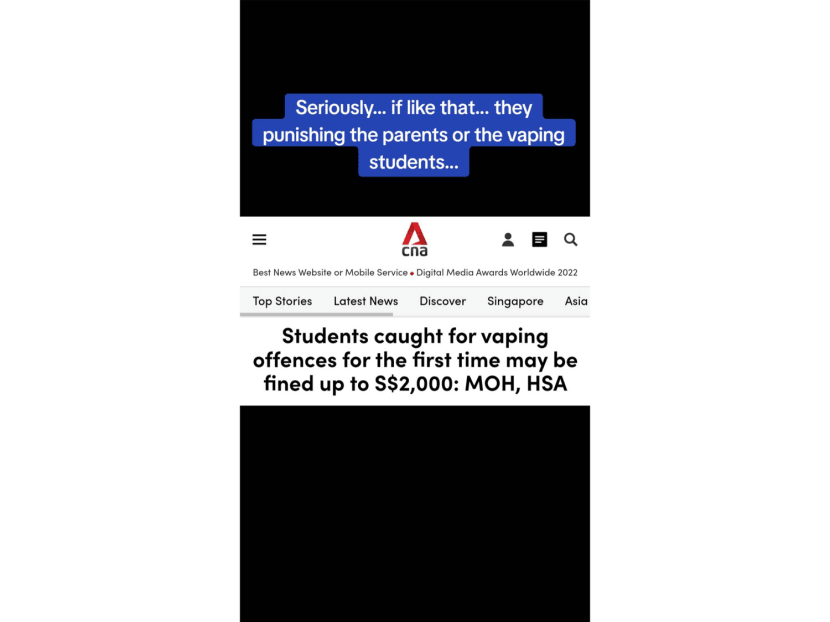
Critics argued that the students should be made to put in community work hours instead, because imposing fines would have no direct impact on the child and would just be "another way to take money away from (parents)".
Others questioned why there is no fine for being caught smoking cigarettes for the first time and suggested that the fine is in place for vapes because they are banned and cannot be taxed.
However, some people pointed out that a fine can be imposed only after a student is referred to HSA, which is not likely to happen for first-time offenders.
Before the announcement, the Ministry of Education (MOE) said in December last year that students caught for vaping offences will have their vapes confiscated, their parents informed, and disciplinary actions such as suspension or caning for male students implemented.
They may also be referred to student health advisers or placed on programmes to quit vaping that are run by the Health Promotion Board (HPB). Repeat offenders may be referred to HSA, which may issue a fine, MOE said at that time.
On the other hand, those who agreed with the move felt that parents should indeed be "punished" because it is first and foremost their responsibility to educate their children and keep them from vaping.
One TikTok user advised: "Pay more attention to your kid and start educating them before they start vaping, (If they) get caught, pay the fine so (you) can get involved and play (your) role."
Responding to the negative comments, another user wrote: "How is (the fine) stupid? Parents will not take action until it affects their bank accounts."
In April last year, young people interviewed by TODAY said that they would still continue vaping even if the authorities were to tighten enforcement.
Related topics
trending vapingStay in the know. Anytime. Anywhere.

Subscribe to our newsletter for the top features, insights and must reads delivered straight to your inbox.
By clicking subscribe, I agree for my personal data to be used to send me TODAY newsletters, promotional offers and for research and analysis.





