
Wah — there is Singlish in the Oxford English Dictionary
SINGAPORE — Is “lepak” a word that can be accepted when used in an English sentence? Yes, it is. That and several others words and phrases commonly used in Singapore English, sometimes termed “Singlish”, have been included in the Oxford English Dictionary (OED).
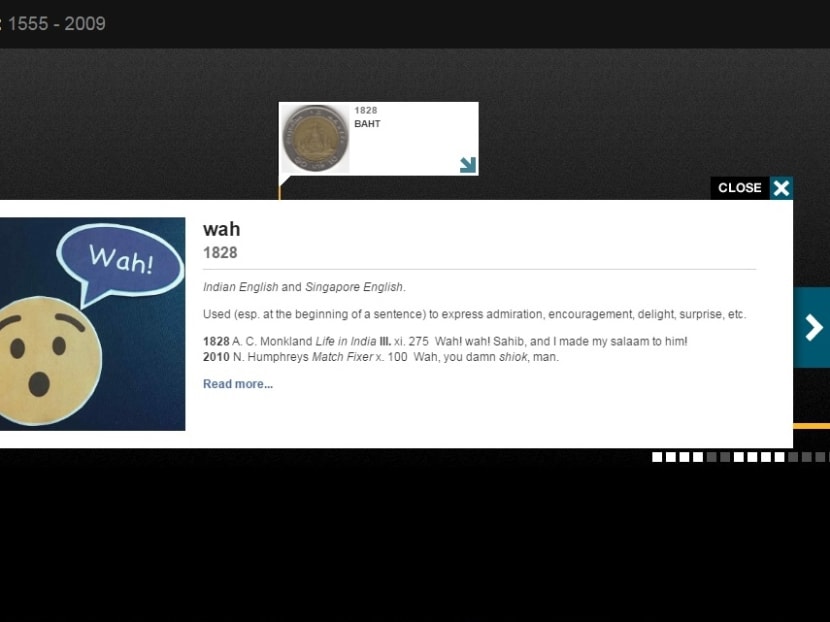
Singapore English phrases such as 'wah' and 'lepak' have been added to the Oxford English Dictionary. Photo: Screenshot from the Oxford English Dictionary website



SINGAPORE — Is “lepak” a word that can be accepted when used in an English sentence? Yes, it is. That and several others words and phrases commonly used in Singapore English, sometimes termed “Singlish”, have been included in the Oxford English Dictionary (OED).
In a media statement released on Wednesday (May 11), the OED stated that it had added a number of words and phrases from Singapore English into its lexicon in its March 2016 update.
These words include “char siu”, which the OED has defined as “In Cantonese cookery, roast pork marinated in a sweet and savoury sauce, typically served sliced into thin strips. Also used in char siu bun, char siu pork, char siew rice”; hawker centre, a term first used in 1966 to denote “a food market at which individual vendors sell cooked food from small stalls, with a shared seating area for customers); and killer litter, defined as “objects thrown or falling from high-rise buildings, endangering people below”, which was first coined in 1984.
Along with these are words that offer new senses of common English words, such as “blur”, meaning “slow in understanding; unaware, ignorant, confused”; loanwords from Chinese, such as ang moh (“a light-skinned person, esp. of Western origin or descent; a Caucasian”); loanwords from Malay, such as shiok (“cool, great; delicious, superb”); and formations in English that are only used in Singapore, such as sabo (“to harm, inconvenience, or make trouble for (a person); to trick, play a prank on”) and HDB (“a public housing estate”).
And of course, wah — “used (esp. at the beginning of a sentence) to express admiration, encouragement, delight, surprise, etc” — and lepak, which has been defined as a verb meaning “to loiter aimlessly or idly; to loaf, relax, hang out”. (Incidentally, this word was first used in an English sentence in 1993.)
Apart from including these words and phrases, the OED is also asking for the public to help trace the history of two Singapore English words in this update (sabo and shiok) through OED Appeals, a dedicated community space on the OED website (http://public.oed.com/appeals/).
The dictionary’s editors are soliciting help to unearth new information about the history and usage of these words and have asked the public to post evidence online, in order to foster a collective effort to record the unique contributions of Singapore to the evolving vocabulary of English.
The appeal will remain open until June 10.
Here is the list of all new Singapore English items in the OED in the March update (you can view the definitions here):
ang moh
blur
char siu
chilli crab
Chinese helicopter
hawker centre
HDB
killer litter
lepak (as a noun)
lepak (verb)
lepaking
shiok
sabo (noun)
sabo (verb)
sabo king
sotong
teh tarik
wah
wet market
Stay in the know. Anytime. Anywhere.

Subscribe to our newsletter for the top features, insights and must reads delivered straight to your inbox.
By clicking subscribe, I agree for my personal data to be used to send me TODAY newsletters, promotional offers and for research and analysis.






