
To rescue falling profits, wholesalers go direct to consumers amid Covid-19 outbreak
SINGAPORE — With his profits slashed by half during the circuit breaker period when many activities around the country were restricted, Mr Joe Chua, director of vegetable wholesaler CCL Impex, knew that he had to rethink his business model to cater to a new normal.
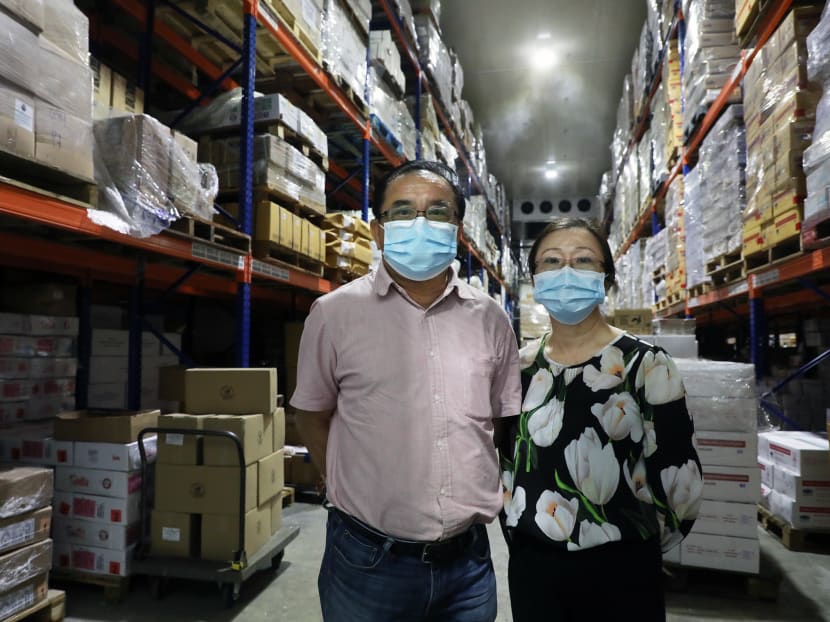
Mr Tia Tang Chye (left), owner of frozen food wholesaler New Multi, and finance head Nellie Tia (right) decided to branch out to selling to consumers directly.



SINGAPORE — With his profits slashed by half during the circuit breaker period when many activities around the country were restricted, Mr Joe Chua, director of vegetable wholesaler CCL Impex, knew that he had to rethink his business model to cater to a new normal.
After spending more than 20 years selling produce to restaurants and catering companies, he decided to reach out to consumers directly, even investing S$60,000 in packaging and packing equipment to facilitate the change.
His relationship with businesses had always been by word-of-mouth so there was never a need for an online presence before the new decision to do direct sales.
“Everyone was setting up online shops… So we rushed ours as well and had it (up and running) within a week,” the 40-year-old said.
CCL Impex is one of many food wholesalers reaching out directly to consumers to make up for the loss of demand from hotels, restaurants and catering companies during the Covid-19 pandemic.
“We can offer them (vegetables) at a cheaper price because we bring in high volumes of produce daily. They’re also fresher because it goes straight from our farms to the customers’ homes,” Mr Chua said.
Likewise, Ms Nellie Tia, who manages the finances for frozen food wholesaler New Multi, said that the company has seen many returning customers after it adapted a business-to-consumer model during the circuit breaker period in April and May.
Wholesalers who spoke to TODAY said that reaching out to consumers online has boosted business, with most of them fulfilling an average of 100 deliveries a day.
To appeal to consumers though, the wholesalers said that they have had to adapt their practices.
For example, while their buyers such as restaurants were prepared to get items in large packs or by the cartons, consumers generally prefer much smaller quantities and want them delivered as soon as possible.
Mr Jordan Koh, director of fresh produce and frozen food wholesaler Godirect.biz, said: “When adapting to direct consumers, our individual purchasable units have to be lowered to smaller quantities as perishables can’t be stored for too long.”
He added that most consumers do not have space to store a lot of products at once.
Godirect has lowered its minimum amount for free delivery and even sells vegetables by "bundles" — where they pack small quantities of different vegetables — to customers.
Mr Motomu Yoshida, director of S Foods Singapore, the biggest supplier of wagyu (Japanese beef) to the food-and-beverage industry here, said that there is also a big difference logistically when it comes to serving consumers and businesses.
There are stipulated timings when delivering goods to businesses whereas more coordination and planning is needed for direct consumer sales, he said.
To deal with this, many of them have arranged for private-hire drivers to make deliveries.
Angliss Singapore, which offers premium products such as Korean marinated meat and chilli crab, said that consumers also have added expectations in terms of packaging.
The company’s managing director, Ms Angel Ding, said that as it marketed its products to be ready-to-cook, it had to pack pre-marinated meat and sauces into small kits. This makes them presentable and convenient for customers.
Mr Yoshida said that his company is considering upgrading to a more premium packaging with better designs. At the moment, items are placed in simple vacuum packaging.
Customer service is another area that wholesalers have had to organise to deal with consumers directly.
“Consumers, in general, have higher expectations as compared to businesses,” Mr Chua said.
While the majority of the wholesalers who were interviewed see this as a new business model for them and are looking to continue the service, some are undecided, especially since sales have been declining after the circuit breaker was lifted on June 2.
Mr Chua said that since then, private-hire drivers who handle deliveries are now busier with workers going back to offices.
He has adjusted delivery timings to the drivers’ non-peak periods from 10.30am to 3pm for now, but is unsure how this will work out when the economy fully opens up.
Smaller supermarket owners told TODAY that they are not worried about the increased competition from wholesalers.
Mr Kelvin Tan, owner of New Econ Mini supermarket, acknowledged that while customers may prefer to buy some products at a cheaper price from wholesalers, the range of items available to them are still limited.
“Let’s say they want to bake cookies. They will still go to supermarkets to get the ingredients they need because they can find everything from wholesalers there,” he said.
Consumers, however, hope that wholesalers will continue to deal with them directly and do not see it as a stop-gap measure just for this pandemic.
Mr Joshua Lim, 32, for example, started buying products from wholesalers after he got frustrated waiting for a delivery slot for his order from an online supermarket.
“It’s much cheaper than buying in your average supermarket and the delivery time is way faster. The one I ordered from even did same-day delivery.
“The best part is... everything is cleaned and packed nicely so it’s convenient for someone like me, who is living alone,” the accountant said.
Another consumer, Ms Lina Wang, 45, said that some wholesalers also sell pre-mix items, which makes it easy for a novice cook like her.
The mother of one, whose work is in artificial intelligence, said that this has helped cut the time she spends in the kitchen after a long work day.
Ms Wang also enjoys looking for premium items online — especially the ones used in hotels and five-star restaurants — to send to her mother to try cooking.
“Some premium items like Korean pork or the pre-mix chilli crab sauce can be a little more expensive but they’re clean, seasoned and packed nicely. So I think what I’m paying is reasonable, ” she said.
Related topics
business model wholesale logistics Covid-19 coronavirusStay in the know. Anytime. Anywhere.

Subscribe to our newsletter for the top features, insights and must reads delivered straight to your inbox.
By clicking subscribe, I agree for my personal data to be used to send me TODAY newsletters, promotional offers and for research and analysis.






