
WP slams exemption of Govt from being sued for falsehoods under enhanced anti-harassment laws
SINGAPORE — The Workers’ Party (WP) has criticised the exemption of public agencies from being sued for peddling falsehoods under enhanced harassment protection laws passed in Parliament on Tuesday (May 7).
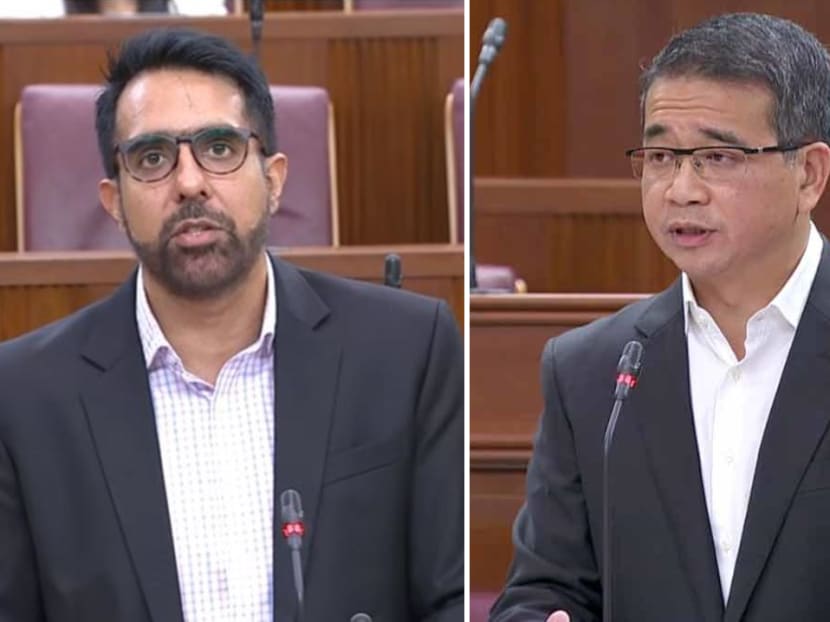
Workers' Party chief Pritam Singh (left) and Senior Minister of State for Law Edwin Tong (right).



SINGAPORE — The Workers’ Party (WP) has criticised the exemption of public agencies from being sued for peddling falsehoods under enhanced harassment protection laws passed in Parliament on Tuesday (May 7).
The opposition party’s leader, Mr Pritam Singh, called it “a glaring omission” and a “lost opportunity at winning the trust of the public”.
“More fundamentally, it does not conform to the principle that the rule of law applies equally to all,” said the WP secretary-general.
Responding, Senior Minister of State for Law Edwin Tong said that the general position is that the Government is not bound by legislation unless “it expressly provides for that to be so”.
“As to how government officers can be held accountable, that can always be done in a usual forum, like Parliament,” he said.
“The Government has taken a view that it will not avail itself of remedies under the Protection from Harassment Act (Poha), and likewise, it will not be subject to provisions under Poha.”
The latest changes to Poha — which was enacted in 2014 — include making it a crime for online vigilantes to publish individuals’ personal information with the intent of harassing, threatening or inciting violence against them. This is a practice known as “doxxing”.
A bulk of the changes focus on making it easier for victims of intimate-partner violence — both married and unmarried — to seek protection.
These include making breaches of protection orders an arrestable offence.
The courts will also be given an expanded scope of orders when it comes to falsehoods. Victims can apply for interim orders if they want false statements about them to be taken down urgently.
Under the expanded powers, the courts can issue general correction orders, similar to those drawn up under Singapore’s draft fake-news laws, which were debated on Tuesday.
These orders can be made against individuals and corporate entities, but not against the Government. Likewise, the Government also does not have recourse under Poha when it comes to falsehoods.
Mr Singh said that this means individuals or companies cannot apply to the courts when the Government makes false statements about them.
There are enough examples of governments globally that have communicated falsehoods and misleading information, he said.
“Why shouldn’t the public receive protection provided by this Bill?” he asked.
The WP raised other concerns and questions over the changes to the legislation.
INTERPRETATION OF MISLEADING STATEMENT
Mr Singh said that the changes define a false statement as one that is false or misleading.
He asked how the courts are expected to interpret the boundaries of a misleading statement in the context of new remedies provided by the Bill.
Mr Tong had earlier said that a statement omitting material facts is misleading if a “reasonable person” deems it as such because of the omission.
But this may not be without controversy, Mr Singh said.
He cited the hypothetical example of someone who mounts a viral online campaign with the headline “People who listen to black-metal music may commit violence in the real world”, and accompanies the post with images of people with heavily tattooed faces.
This person encourages others to boycott a black-metal band a fortnight before it is due to perform, leading to poor ticket sales and revenue loss.
Mr Singh said that the statement may be misleading because all sorts of people — not just black-metal listeners — may commit violence. He asked what remedies would be available to the band under the amended laws.
Mr Tong replied that the statement made by the commentator who mounted the online campaign was an opinion and not a false statement of fact.
False and misleading statements of fact do not cover opinions, commentary or criticism, he reiterated.
When pressed further by Mr Singh, Mr Tong said that the statement would fall outside the realm of the amended laws.
“What this Bill seeks to do is to look at statements of fact that are directly and positively false,” he said, adding that an entity economically affected or an individual defamed by a statement can seek civil remedies.
NOT QUITE DOXXING?
Under the law, someone commits doxxing if he publishes the identity of someone else with the intent to harass, alarm or distress, and to facilitate unlawful violence against the victim, for instance.
However, Mr Singh said that there may be “borderline” cases where the intent of individuals releasing identity information does not cohere neatly with the offence set out in the law.
For instance, an online commentator could post a link to an individual’s identity information that may already be on the Web with a comment such as: “This person is a lawyer and yet he behaves in such a way.”
The hyperlink reveals other personal information such as workplace and contact numbers. Mr Singh asked if the commentator would be guilty of doxxing.
Mr Tong replied that this would not be deemed a case of doxxing because the commentator merely raised questions about the lawyer’s conduct, but did not intend to cause harassment.
He noted that the law’s provisions do not distinguish between the original publisher and someone who re-posts the publication, but rather, examine the intention of the person who published the information or the knowledge that he had when he made the information public.
“The key factor is the intention behind the publication, whether original or the re-publication, and each case will have to be considered on its own facts,” he said.
THIRD-PARTY WEB PAGES
Mr Singh asked if moderators of popular third-party Facebook pages where anonymous users carry out doxxing would be guilty of the offence even if there was no intent by the moderators to harass.
These practices require active moderation to combat, which moderators may not have the capacity to perform, said Mr Singh.
Mr Tong replied that moderators of social-media groups and platforms would not be liable for doxxing, since they neither published the information nor intended to harass.
DO PERSONS IN SAME-SEX RELATIONSHIPS HAVE RECOURSE FOR INTIMATE-PARTNER VIOLENCE?
Mr Singh asked if the remedies against offenders who commit violence against their intimate partners applied to unmarried individuals in same-sex relationships.
Mr Tong replied that all victims, married or unmarried, and regardless of their gender, will be protected under Poha.
Stay in the know. Anytime. Anywhere.

Subscribe to our newsletter for the top features, insights and must reads delivered straight to your inbox.
By clicking subscribe, I agree for my personal data to be used to send me TODAY newsletters, promotional offers and for research and analysis.






