
As coronavirus infects economy, one bank slashes Singapore’s 2020 growth forecast
SINGAPORE — At least one bank has downgraded Singapore's economic growth for the full year as the city-state battles the novel coronavirus, while others have flagged the virus as a severe downside risk on Singapore's economy.
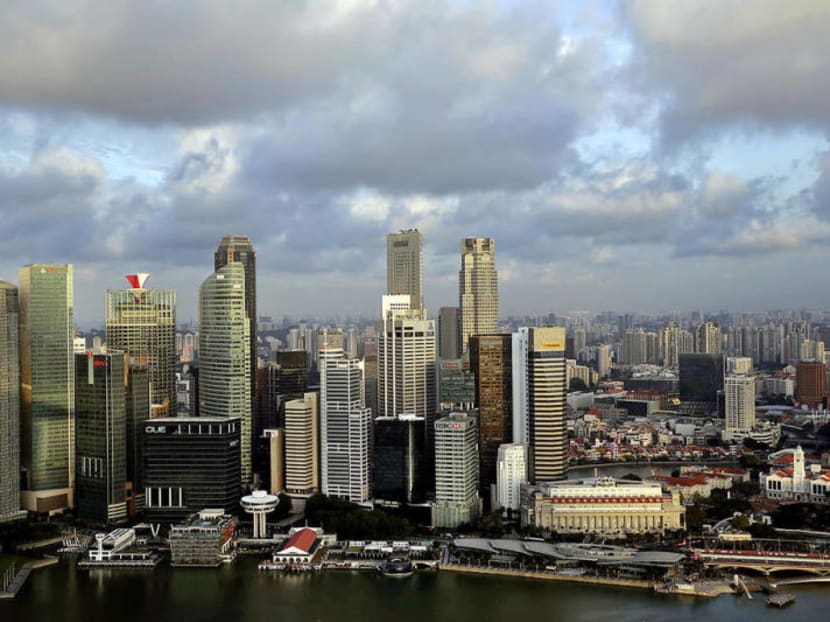
Maybank Kim Eng economists said that the novel coronavirus is likely to impact Singapore differently in 2020 compared with the Sars pandemic in 2003.



SINGAPORE — At least one bank has downgraded Singapore's economic growth for the full year as the city-state battles the novel coronavirus, while others have flagged the virus as a severe downside risk on the Singapore economy.
Although the start of 2020 appeared promising for Singapore, with a de-escalating trade war between China and the United States, the virus threatens to erase any hope of recovery from an already battered 2019, economists said.
In a report on Wednesday (Feb 5), Maybank Kim Eng economists Chua Hak Bin and Lee Ju Ye said that the bank is slashing its 2020 growth forecast for Singapore to 1.1 per cent, a sharp drop from 1.8 per cent previously, as border control measures as well as the viral outbreak itself affect the hospitality, travel and retail sectors.
A key reason for the downgrade, the Maybank economists said, was the imposition of new restrictions on travellers from mainland China last week. “The Singapore Government has taken drastic measures to contain the outbreak, which may hurt growth in the near term,” they said.
The downgrade is still within the Government’s forecast range of 0.5 per cent to 2.5 per cent, though at the lower half of the range. Growth from January to March this year will also likely contract by 1 per cent compared with the same period last year, with “sharp falls” expected in the hospitality, transport and retail sectors.
The dour mood is not expected to last for a long time, however. “We expect the negative impact to be short-lived, with growth rebounding from the second quarter onwards,” the report said, adding that a technical recession — occurring when there are two consecutive quarters of quarter-on-quarter contraction — is unlikely.
Other banks have said that it is still too early to determine the impact of the coronavirus on Singapore’s economy, though it would be a drag on the economy if the virus situation worsens or persists for the long term.
Based on the severe acute respiratory syndrome (Sars) episode as a reference point, OCBC bank's head of research and strategy Selena Ling and economist Howie Lee said last week that Singapore’s gross domestic product (GDP) growth could potentially be shaved off by up to 0.5 to 1 percentage point from the baseline of 1 to 2 per cent growth. That is if the current epidemic lasts more than three to six months, affects business and consumer confidence, restricts travel, and impacts productivity.
IMPACT POSSIBLY BIGGER THAN SARS?
However, the economists said that the novel coronavirus outbreak which started in Wuhan, China, is likely to impact Singapore differently in 2020 compared with the Sars pandemic in 2003.
Back then, Singapore’s services sector was hit hard, especially in accommodation and food services, which plunged by 27 per cent in the quarter when Sars first appeared, and transportation and storage segments (11 per cent fall).
The Maybank report noted that since 2003, visitors from China to Singapore have grown in importance, accounting for 19 per cent of visitor arrivals in 2019, compared with 9.3 per cent in 2003. China tourists make up the largest share of visitor arrivals to Singapore today.
Moreover, the coronavirus will likely have an adverse impact on manufacturing in Singapore, which had been en-route to recovery towards the end of last year. Disruptions in China, including shuttered factories, would likely have negative spillovers on Singapore’s manufacturing and exports, the Maybank report said.
It also noted that like tourism, Singapore’s dependence on China for exports has also grown significantly since the Sars crisis. China’s market share of non-oil domestic exports has surged to 17 per cent in 2019, up from 7 per cent in 2003.
“While the latest PMI (Purchasing Managers' Index) numbers for January showed further improvement for both headline and electronics, we expect the Singapore PMI to revert to contraction territory in February and March,” the Maybank economists said. PMI is a barometer of sentiment in the manufacturing sector.
Mr Song Seng Wun, an economist with CIMB Private Banking, said that one example of where significant headwinds could be felt beyond Chinese arrivals is the business travel industry and the meetings, incentive travel, conferences and exhibitions (Mice) sector.
Business travellers, as well as those here to attend business events, made up around 15 per cent of all visitors to Singapore in 2018 and contributed around S$2.2 billion or 22 per cent of total tourism receipts that year, the latest data showed.
Speaking to TODAY at Grand Hyatt Singapore, the Scotts Road hotel which has been identified as the site of a possible coronavirus cluster of human-to-human transmission last month, Mr Song said that Singapore is much more globalised today compared with what it was in 2003.
“This here is one example where a loss of business and investor confidence in Singapore could affect business adversely, which is why we should not irrationally avoid places like this,” he said, referring to the hotel, which had hosted a business meeting linked to two confirmed cases in South Korea and one in Malaysia so far.
An impact on business confidence will have knock-on effects on the rest of the economy, he added.
“Right now, confidence depends on whether the outbreak can be contained here, otherwise the impact on vulnerable sectors like travel and retail will spill over to all other sectors.”
While he believes it is still premature to tell what the economic impact of the coronavirus may be, Mr Song said that Singapore’s first-quarter performance will give a clearer estimation of the overall impact for the whole year.
“What I can safely say is that, unlike in previous years when we had more meat on the GDP bone, last year’s growth was barely 1 per cent and the slowest in a decade. Given the developing situation, the worst case for Singapore will be zero growth in the first quarter of 2020,” he said, adding that this is assuming the paused trade war between the US and China remains on the backburner.
ROBUST FISCAL RESPONSE NEEDED
What may mitigate the impact is a robust response from the Government, economists said, noting that the upcoming Budget on Feb 18 is likely to be expansionary and could even run into a record deficit.
The Monetary Authority of Singapore has also said on Wednesday (Feb 5) that there is “sufficient room” to adjust its stance at the next policy meeting in April as a counter to the weakening conditions caused by the coronavirus outbreak, which caused the Singdollar to fall to a four-month low on the same day.
UOB economist Barnabas Gan said in a report last week: “Even as the novel coronavirus is relatively contained in Singapore, we believe that policymakers will likely adopt a pre-emptive approach in the upcoming Budget.
“There could be some mention of an ‘anti-epidemic’ fund to be introduced to pre-emptively stem a potential slump in Singapore’s tourism sector. Beyond that, there could be additional measures, similar to 2003 during the Sars outbreak, if the issue escalates in the subsequent weeks."
Mr Gan noted that in 2003, the Government rolled out an off-Budget package amounting to S$230 million of reliefs, consisting of measures to help affected industries, including property tax rebates for hotels and commercial properties, fee rebates for airlines and cruise operators, and diesel tax rebates for taxis.
Mr Irvin Seah, senior economist with DBS bank, said on Tuesday that an overall deficit of about S$7.9 billion, or about 1.6 per cent of nominal GDP, is expected for Budget 2020. This could be the largest budget deficit in a decade.
“Indeed, this will be the highest Budget allocation since the 2009 financial year, during the Global Financial Crisis period, in which a deficit of S$8.7 billion was originally planned for,” Mr Seah said.
Even then, the current term of Government has likely accumulated a surplus of around S$17.9 billion over the past four financial years, going by DBS’ estimates.
“Economic outlook is supposed to improve amid the de-escalation in the trade war, but the latest coronavirus outbreak has thrown a spanner in the works. Couple that with an impending General Election here and the massive accrued surpluses, expectation for the budget is naturally high.
“Yet, Budget 2020 will remain calibrated and balanced. Short-term concerns will be addressed without neglecting longer-term issues. Policymakers will aim to strike a balance between meeting up to the high expectations and ensuring fiscal sustainability,” Mr Seah said.
Related topics
economy coronavirus Wuhan virus SARS Budget 2020Stay in the know. Anytime. Anywhere.

Subscribe to our newsletter for the top features, insights and must reads delivered straight to your inbox.
By clicking subscribe, I agree for my personal data to be used to send me TODAY newsletters, promotional offers and for research and analysis.






