
In Atletico Madrid’s ramshackle home, an underdog’s spirit thrived
MADRID — On a warm spring day outside Estadio Vicente Calderon, home of Atletico Madrid, a couple of workmen in fluorescent yellow vests are attending to a large steel door. One has the easier job, languorously holding the door in place as his colleague strains to tighten a dozen studded bolts in turn. After a few minutes of grunting and heaving, the two men swing it open and shut to test that it is firmly fastened.
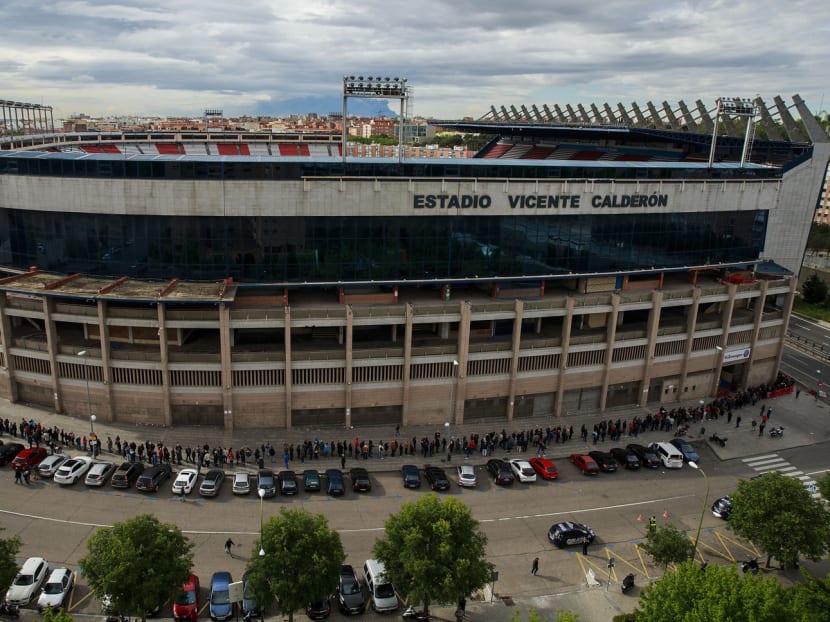
Atletico Madrid fans queuing for tickets outside the Estadio Vicente Calderon. Atletico will play their final league game here on May 21, and a week
later, after a showpiece exhibition game, the stadium will be closed for good. Two skyscrapers will rise in its place alongside a public park. Photo: Getty Images
MADRID — On a warm spring day outside Estadio Vicente Calderon, home of Atletico Madrid, a couple of workmen in fluorescent yellow vests are attending to a large steel door. One has the easier job, languorously holding the door in place as his colleague strains to tighten a dozen studded bolts in turn. After a few minutes of grunting and heaving, the two men swing it open and shut to test that it is firmly fastened.
It feels fitting, somehow, that just a few weeks before that door closes for good — along with all of the others in this peeling, patchwork concrete bowl a gentle 15-minute walk south of downtown — there is still work to be done. The Calderon has always had the air of a place that would be wonderful, if only they could finish it.
Time, though, has run out. The Calderon has long looked as if it is on its last legs; now it actually is. The next three weeks or so will act as one long goodbye, as this stadium, one of the most intimidating in European football, ticks off the milestones on its road to ruin.
On Thursday, the Calderon will host its final European game, the second leg of Atletico’s Champions League semifinal against Real Madrid. For a club that has long nursed an inferiority complex to its wealthier, more glamorous neighbour, the game is the perfect send-off: Real Madrid won the first leg, 3-0, ensuring that what should have been an evening of noise, passion and hope will almost certainly end in disappointment.
Atletico will play their final league game here on May 21, and a week later, after a showpiece exhibition game between a team of Atletico legends and another of some of the most famous players to grace the Calderon as visitors, the stadium will be closed to football for good. Eventually, two skyscrapers will rise in its place alongside a landscaped public park, part of a redevelopment plan. Sentiment cannot stand in the way of progress.
That, certainly, is the rationale behind Atletico’s decision to leave this place behind and look, unapologetically, to a brighter, bolder future.
A new home, to the east of the Spanish capital, awaits the club — starting this summer, Atletico will play in the 67,000-capacity Wanda Metropolitano.
“It will be the most advanced stadium in Europe,” said Pedro Sanchez Garrabe, the owner of El Doblete, a bar tucked into the side of the Calderon. “It will be fantastic.”
It will also be lucrative. The new stadium, designed by the architects Cruz y Ortiz, has already enabled Atletico to sell more season tickets than they ever did at the Calderon. The money-spinning corporate facilities are extensive. It is sponsored by Dalian Wanda, the Chinese property conglomerate that owns a chunk of the club. It meets all of Uefa’s five-star criteria, and is already slated to bid to host the 2019 Champions League final.
It is, in other words, a sleek, gleaming vision of the future, one in which Atletico are one of Europe’s superpowers, just a notch below Real Madrid, Barcelona and Bayern Munich. It is the sort of home befitting a team that has reached two of the past three Champions League finals and — though it would take a virtual miracle tomorrow — could theoretically appear in a third next month.
There is sadness at leaving, though, for all the promise of what tomorrow might bring.
“My life, my memories, are at the Calderon,” said Atletico striker Fernando Torres. “My greatest days as a fan and as a player are in this stadium. Coming here when the stadium is gone will be difficult.”
Atletico have not always played at the Calderon — they only moved from the original Metropolitano in 1966 —but those ramshackle stands hold memories. Not all of them are happy: That is not the Atletico way.
“It is a club that knows what it is to suffer,” said Raddy Antic, the coach who led the club to arguably the finest season in its history, when they won the Spanish league and the Copa del Rey in 1996.
Antic can take some credit for the magic that makes the Calderon special. Serbian by birth, he spent four years at Luton Town in England at the end of his playing career before embarking on a long, illustrious managerial career. When he arrived at Atletico in 1995, he suggested “a few changes from what I had seen in England” to make the stadium more atmospheric, and to entice fans to spend more time there after games.
Pushed for his favourite memory, though, he singled out the day he became “the only manager to fly over the stadium”.
With the field too dry to play, Antic suggested hiring a helicopter to water the grass. He decided to hitch a ride. “I saw the stadium from above, all of it,” he said. “That is really special to me.”
Atletico, though, have learned to cherish the lows, too, to wear them as badges of honour. Three years after Antic’s double, Atletico were relegated. The next year, “we had more season-ticket holders than we had in the first division,” said Carlos Garca Cantarero, their coach that season.
“Nowadays, when teams come out onto the pitch, they come out together,” he said. “But then, the visiting team used to go out first. We would always wait a few minutes before we joined them to let them see what it would be like to play there, with all of those fans.”
The club, of course, knows that it will take time to replicate that atmosphere at their new home, that these things cannot simply be packaged up and transplanted.
Atletico will soon have a stadium that rivals those of Real Madrid, Barcelona, Bayern and Manchester United, a stadium suited to a modern super club. The question is whether this is a club suited to a modern super stadium.
Atletico are not a commercial juggernaut, like Bayern, or a luxury brand, like United. Their identity is as the eternal underdog, forever punching above their weight. A stadium is just bricks and mortar and, in the case of the Calderon, a highway underpass tucked under one grandstand. But it can be an avatar, too.
That is what the Calderon is to Atletico: A manifestation of what the club is. The club has to move. Sentiment cannot stand in the way of progress. But there is always a risk that something is lost along the way. THE NEW YORK TIMES
Stay in the know. Anytime. Anywhere.

Subscribe to our newsletter for the top features, insights and must reads delivered straight to your inbox.
By clicking subscribe, I agree for my personal data to be used to send me TODAY newsletters, promotional offers and for research and analysis.






