
National Day Special 2016: In search of Singapore’s national sport
As Singapore prepares to celebrate its 51st birthday, 25 of the country’s top athletes are 15,000km away in Rio de Janeiro, looking to do the nation proud at the ongoing Olympic Games.
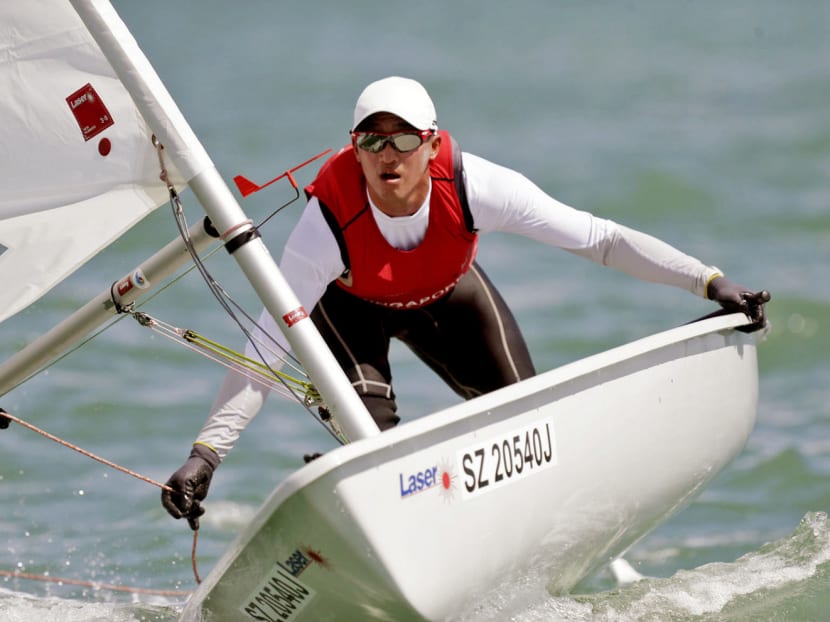
National sailor Colin Cheng was the top Asian sailor in the men’s laser standard class at his first Olympics in 2012 (15th out of 49th). Singapore, being an island state, should have a national sport that is linked to our geography and early livelihoods, says Singapore Sailing Federation president Ben Tan. Photo: Wee Teck Hian

As Singapore prepares to celebrate its 51st birthday, 25 of the country’s top athletes are 15,000km away in Rio de Janeiro, looking to do the nation proud at the ongoing Olympic Games.
It is the joint-second-largest contingent that Singapore has sent to the Games, after the 52-strong squad that went to the 1956 Melbourne Olympics, and hopes are high of Singapore winning a first-ever Olympic gold medal this year.
That Singaporeans dare to even dream of an Olympic gold medal is indicative of the progress that the sporting scene in Singapore has made in recent years.
This view is echoed by Singapore Rugby Union (SRU) president Low Teo Ping, who is also Team Singapore’s chef de mission for the Rio Games. “Sports in Singapore has definitely progressed, developed and evolved,” he told TODAY.
“Support here for athletes is much better now, and with the application of sports science and medicine, we are now producing athletes of a higher calibre, capable of challenging the best in the world.”
Low’s sentiments are backed by results. At last year’s SEA Games on home soil, Singapore secured a record 259 medals, including 84 golds.
But apart from doing well on the international stage, progress is also being made in sports participation at a recreational level, and spectatorship at sporting events.
The overall viewership for Mediacorp’s live telecast of the SEA Games was 3.3 million, while more than 500,000 spectators went to the 31 Games venues to watch the action.
And according to the 2014 National Sports Participation Survey (NSPS) of Singapore citizens and permanent residents who are at least 13 years old, 62 per cent of Singaporeans lead an active lifestyle and exercise up to twice a week, compared to 46 per cent in 2004.
But as Singapore edges towards its goal of becoming a sporting nation, the question arises: What is our national sport?
The first step to answering this would be to determine the factors that define the term “national sport”.
According to Low, “the word ‘national sport’ has to relate to something that has grown with you…and you end up being very much part of”.
Meanwhile, veteran sports administrator Annabel Pennefather said: “If we take “national’ to mean ‘relating to a nation as a whole’, or ‘a characteristic of a particular nation’, then a national sport would have to display such a distinguishing quality or attribute.”
For Singapore National Olympic Council vice-president Tan Eng Liang, a national sport is one that is “popular and has a wide following (in the country)”.
Ex-national rugby captain Terence Khoo, now the managing director of sports marketing firm Enterprise Sports Group (ESG), believes that a national sport should also result in “Singaporean athletes being part of various competitions, leagues or tournaments”.
Singapore Sports School principal Tan Teck Hock defined a national sport as “enjoyed by Singaporeans young and old, male and female, families, schools, institutions, corporates and the community. There must also be facilities spread wide across the country that allow for easy access and participation on different levels”.
Based on the criteria outlined above, there are a handful of contenders for the position of Singapore’s “national sport”.
Sailing: successful, but niche
With 10 local sailors in Rio, sailing is clearly Singapore’s most well-represented sport at the Olympics this year. It is also a sport that the Republic has been highly successful in.
Singapore’s sailors have won world titles at junior and senior levels, dominated regional events like the SEA and Asian Games, and clinched two golds at the 2014 Youth Olympics. As such, there is a strong case for sailing to be regarded as the national sport.
However, unlike both football and swimming, it is harder to get into the sport recreationally.
“It is not easy for people to pick up sailing,” said Tan.
“It’s quite niche and it’s hard for spectators to view the sport, so it suffers in terms of spectatorship and popularity.”
Khoo added: “The participation base or media interest (in sailing) is not wide enough. I think it is an important sport, but certainly not a national sport.”
Nonetheless, Singapore Sailing Federation president Ben Tan cited several factors that favour sailing’s claim to be considered a national sport.
“To qualify to be a national sport, it needs to be linked to the country’s origin, history, and culture,” said the 1996 Olympian.
“The indigenous people used sailboats to fish and trade, and early settlers crossed oceans and arrived on our shores in wind-powered vessels, while modern Singapore also started out as a port after all.
“Singapore, being an island state, should have a national sport that is linked to our geography and early livelihoods.
“Our sailors have also consistently delivered medals for the nation at various competitions.”
Tan also dispelled the notion that the sport was inaccessible and had low participation rates among Singaporeans.
“We see now that many young Singaporeans are exposed to sailing during their school years, and our inter-school regattas show healthy participation levels,” he said.
“With our sailors excelling on the world stage, many Singaporeans will be proud to associate themselves with the sport.”
Swimming: competitive at an international level, but are there enough spectatorS?
Another contender for the mantle of Singapore’s national sport is swimming, which has garnered great attention and success for the country over the decades, and which seems to have upped its game in recent years.
At last year’s SEA Games, Singapore won 23 gold medals in swimming, the highest total among the 36 sports that the country competed in. At the Rio Olympics, Singapore’s hopes of an Olympic gold rest on Joseph Schooling’s broad shoulders.
Also, 8.1 per cent of Singapore’s population swims recreationally, making it the third-highest-participated physical activity behind walking and running.
However, Khoo feels the lack of recognition for most of the meets Singapore’s swimmers compete in makes it hard for swimming to be considered a “national sport”.
“Swimming enjoys a massive participation base, but no local athletes participate in competitions on a regular or sustained basis,” explained Khoo, whose two daughters are national age-group swimmers.
“Their participation is too fleeting. The sport needs near-full-time athletes to compete in the FINA World Cup Series and other international competitions.
“If that can be achieved, I think swimming will start to capture the interest of the public, although the downside is that swim meets are not usually broadcast on local television unless it’s a major competition.”
But Singapore Swimming Association (SSA) secretary-general Oon Jin Teik reckons the conditions are right for Singapore swimming to push on to eventually become the national sport.
“Swimming continues to provide Singaporeans with a life skill, an effective overall exercise tool, a leisure activity in our hot weather, a platform for bonding and cheering, an aspiration for excellence, and an event for national pride,” said Oon.
“Singapore probably has the highest number of swimming pools per GDP in the world, including a world-class facility in the OCBC Aquatic Centre at the Singapore Sports Hub.
“While the global popularity of football will never be replaced, I believe Singapore swimming will (eventually) inspire Singaporeans and lead Team Singapore as the national sport, the way it did at the 2015 SEA Games.”
Football: popular but mediocre, underperforming national teams undermine its status
What is usually the first thing that comes to mind when asked about Singapore’s national sport? Football, of course.
Football enjoys near-unparalleled spectatorship not only in Singapore, but internationally, with an estimated 3.5 billion fans of the game worldwide.
On home soil, the fortunes of the national football team have always been closely followed by the locals, and the likes of Fandi Ahmad, V Sundramoorthy and Aleksandar Duric garnered cult status during their playing days.
Since 2012, however, there has been little for fans of Singapore football to celebrate. The Lions crashed out of the 2014 Asean Football Federation Suzuki Cup at the group stage, while their under-23 counterparts were also eliminated at the same point at last year’s SEA Games on home soil.
Just last month, the Lions were beaten thrice in four games, including defeats against a Japanese University side as well as their first loss in 44 years to the Cambodian national team.
Most of the national age-group teams have also fared poorly at regional tournaments in recent years. Just last month, the U-16 team won only one of its five matches in the AFF Championships, and conceded 16 goals.
The U-14s did not win any of their four matches at the AFC Festival of Football, letting in 27 goals.
The local S.League has also been suffering from subpar attendance and poor management by the Football Association of Singapore (FAS) in recent years. Indeed, crowd numbers picked up only this season after the signing of former Liverpool and Arsenal winger Jermaine Pennant by Tampines Rovers, and the return of national players to the local clubs after the LionsXII, an FAS club side formed to compete in the Malaysian domestic league, were booted out by the Football Association of Malaysia.
Football’s popularity also does not translate into active participation at a recreational level — the NSPS ranked football as the joint fifth-most-participated sport, with 3.1 per cent of the population playing the game.
Nonetheless, said Tan Eng Liang, based on popularity alone, football is undoubtedly the national sport.
“No other sport is as widely watched in Singapore as football,” he said. “Even if people don’t play football, they follow international competitions like the Premier League and World Cup very closely.”
Low agreed: “Football will always continue to be a national sport, because it is popular, easy to be involved in, and in everybody’s DNA. Not only in Singapore, but the world. You cannot get away from it.”
Oon also believes that football should be considered the national sport because of its ability to unite the nation.
“It’s the only sport that can fill the National Stadium with 55,000 screaming fans, and promote community togetherness and nation-building,” said the former Sport Singapore (then known as the Singapore Sports Council) chief executive.
“Singapore football might be going through a rough patch now. However, this can be turned around with the right leadership, right model of management, and right resourcing.”
A ‘rojak’ nation with multiple ‘national sports’?
Recently, US president Barack Obama likened Singapore to a dish of rojak — “different parts united in a harmonious whole”.
Perhaps this is the approach to take when considering what our national sport is.
Instead of focusing on just one sport, shouldn’t we celebrate the fact that there is a range of sports that Singaporeans associate with, and participate in?
As Pennefather said: “There are significant numbers of Singaporeans who participate in and support other sports judging from the number of registered sports associations that we have, and also new ones which are being formed.
“So rather than just one national sport, we should recognise our diversity of sporting interests and talents, which together can contribute to our continuing growth and recognition as a sporting nation.”
Stay in the know. Anytime. Anywhere.

Subscribe to our newsletter for the top features, insights and must reads delivered straight to your inbox.
By clicking subscribe, I agree for my personal data to be used to send me TODAY newsletters, promotional offers and for research and analysis.






