
TCM no longer a prickly issue in sports
SINGAPORE – Following Maria Sharapova’s admission to failing a doping test at the Australian Open – she was found guilty of taking the banned substance Meldonium – the spotlight has been thrown on the various ways athletes treat their health and injury issues.
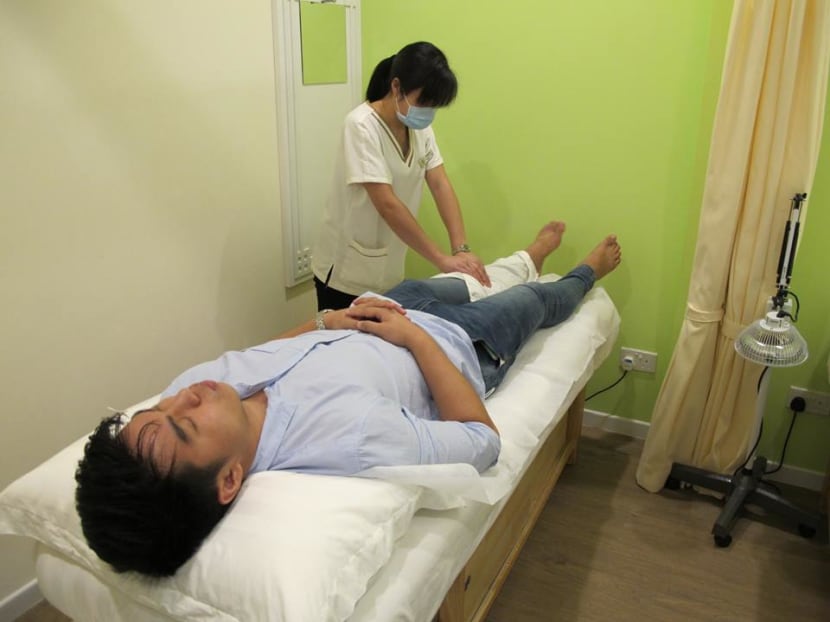
National basketball player Foo Ce Xian, 20, undergoing TCM treatment at local TCM firm Kin Teck Tong. Photo: Noah Tan/TODAY
SINGAPORE – Following Maria Sharapova’s admission to failing a doping test at the Australian Open – she was found guilty of taking the banned substance Meldonium – the spotlight has been thrown on the various ways athletes treat their health and injury issues.
As treatment options go, the subject of Traditional Chinese Medicine (TCM) has long been a sensitive and somewhat controversial one among health experts, as well as professional and recreational athletes.
After all, TCM practitioners often incorporate the use of herbal medicine and acupuncture to treat patients – there are generally no scientific approaches to these methods, with their roots being traced back to ancient Chinese cultural beliefs and practices.
LOCAL ATHLETES PUT TRUST IN TCM TREATMENTS
But with two National Sports Associations (NSAs) in Singapore Athletics (SA) and the Basketball Association of Singapore (BAS) signing sponsorship deals – totalling close to S$500,000 – with local TCM firm Kin Teck Tong (KTT) in the last four months, there seems to be a growing acceptance of the effectiveness of TCM techniques, such as acupuncture, cupping and massage, in managing sports injuries.
Increasingly, for national athletes, they have also become an alternative source of treatment to the Singapore Sports Institute’s (SSI’s) suite of medical services, which includes clinical assessment, diagnosis and treatment of sports-related injuries.
National marathoner Soh Rui Yong, who is currently gunning for a spot at the Rio Olympics, is one who stands by the merits of TCM treatments, having used it extensively to treat a persistent foot injury.
“I was battling plantar fasciitis in my left foot, and a doctor from KTT suggested that tuina (massage) would help improve circulation and aid my healing process,” said Soh, 24, who goes for treatment about twice a week when he is in Singapore.
“I’ve definitely seen noticeable improvements after treatment. It has helped me deal with my injury and has enabled me to balance training with recovery.
“But I also use western treatment from the SSI, because I think they complement each other and even overlap in some ways like their use of massage.”
National basketballer Foo Ce Xian, 20, is another who uses TCM treatments to manage injuries.
“I use TCM because it has a range of treatments,” he said.
“Unlike the western method, which I feel focuses on self-regeneration, TCM treatments help to pinpoint and target the affected areas, which greatly speeds up the recovery process.
“I have already seen noticeable improvement on my ankle injury after visiting Kin Teck Tong.”
Recreational and amateur sportsmen and women in Singapore are also not averse to utilising TCM treatments. KTT estimates that about 70 per cent of their patients visit them for sports-related injuries.
Amateur footballer Tay Wai Leong, 26, says he prefers to go to TCM clinics to treat his injuries – which include hamstring strains and ankle sprains – and has been doing so since during his teenage years.
“Going for TCM may hurt a lot in the short-term with the massage and acupuncture, but I find it helps to heal my injuries more quickly than if I use the Western style of treatment,” said Tay.
“Many of my friends also use TCM to treat their sports injuries as they find it more effective.”
GROWTH OF TCM IN SINGAPORE
Over the last few years, the number of TCM physicians in Singapore have been increasing, albeit at a slow but steady rate.
Since January 2004, all who practise TCM are required to be registered with the TCM Practitioners Board (TCMPB) and possess a valid practicing certificate.
There are currently three main establishments in Singapore which offer courses for TCM certification: Nanyang Technological University (NTU), the Singapore College of TCM and the Institute of Chinese Medical Studies.
According to the TCMPB’s 2014 annual report, there were 2,980 TCM registered practitioners in Singapore at the end of that year. In comparison, there were 2,873 practitioners in 2013, and 2,538 in 2012.
The number of registered TCM physicians is likely to grow annually. KTT physician Chao Wei Liang observes that unlike the previous generation, young Singaporeans are now more interested in learning about TCM.
“From my experience, I find that the younger generation are now very knowledgeable about TCM procedures,” said Chao.
“They are very good at finding information online and I’ve met many who learn things about TCM out of curiosity or their own interest. They’re much more open minded about the concept as compared to those in their 30s to 40s.”
ROLE OF TCM IN SPORTS AROUND THE WORLD
The increasing influence of TCM is not confined to local shores.
Last year, Chinese pharmaceutical chemist and educator Tu Youyou was awarded the Nobel Prize in medicine for extracting the anti-malarial drug, artemisinin, from sweet wormwood.
On the sporting front, athletes such Australian Olympic champion swimmer Daniel Kowalski and American high jumper Amy Acuff are known to use TCM to manage their injuries. Acuff is also a licensed acupuncturist in Austin, Texas.
Two-time Ironman world champion Chris McCormack is another fan of TCM.
The Australian, who currently runs the famed Thanyapura Sports & Leisure club in Phuket which counts international Olympics athletes among their clientele – says TCM-based treatments are a common sight at his sports centre.
“We utilise TCM treatments, such as acupuncture and aromatherapy and other alternative medicines, at our centre at Thanyapura,” said McCormack when he was in Singapore recently for the Tri-Factor Series.
“I’m a big believer in it, because I think the Chinese way of thinking is focused on preventative measures. Personally, I’ve done acupuncture and cupping many times before, and it has helped me 100 per cent.”
NTU Chinese Medicine Centre Physician Sean Lee added: “The use of the appropriate traditional Chinese medicine intervention, such as acupuncture, tuina and herbs, should provide relief to injuries and aid recovery.
“Performance may also be improved during the treatment process, as traditional Chinese medicine adopts a holistic approach when treating patients. This helps strengthen the body to perform better.”
However, former Singapore Sports Institute (SSI) medical director Dr Cormac O’Muircheartaigh – who currently runs specialist sports centre The Sports Medicine Lab – says there is no actual proof as yet that TCM can reduce the recovery time for injuries.
“There is no scientific evidence that TCM treatments such as tuina can assist in recovery or boost performance,” said O’Muircheartaigh, who has a post-graduate Diploma in Acupuncture awarded by the TCM College of Singapore.
“Acupuncture has been shown to improve certain specific conditions in relation to pain, but has not been shown to assist in tissue healing.”
O’Muircheartaigh also warned that athletes should think twice before consuming any Chinese herbs when undergoing TCM treatment, as this might lead them to run afoul of the World Anti-Doping Agency (WADA).
“Specifically in relation to TCM herbal substances, if there were any proven benefits with regards to performance, this would be in violation to the WADA Anti-Doping code,” O’Muircheartaigh added.
MIXING EAST AND WEST
While both TCM and western medicine may differ greatly from each other, it is possible for the two styles to go hand-in-hand in treating injuries or illnesses.
As at the end of 2014, there were 19 TCM physicians and 75 acupuncturists working in local hospitals and Western clinics such as Paragon Medical Centre and National University Hospital (NUH).
It is why Physician Chao believes there is a role for TCM treatments to play in western medicine, and vice versa.
“Western medicine is very useful because they things like do x-rays and MRIs, to reconfirm that there are no bone injuries,” said Chao. “They also have very effective painkillers.
“For TCM, it’s more about the regional area, so we use traditional methods to remove clot fluids such as water and blood.
“Before we do any treatment for sports injuries, we have to make sure that there are no fractures, and you can only find that out via X-rays. So in that sense, this is how the two disciplines complement each other.”
O’Muircheartaigh added that the ideal steps for injured athletes would be to seek help from western medicine, before considering TCM treatments.
“For elite level athletes, the first point of contact following a new injury should be with western medicine,” O’Muircheartaigh said. “This can be with an appropriately-trained Specialist Sports Physician, Orthopaedic Surgeon or Sports Physiotherapist.
“This is due to the fact that the risk of delayed diagnosis or treatment may affect that athlete’s long-term development or potential. “An accurate tissue and functional diagnosis will be made and an appropriate treatment programme planned.
“This will include a secondary prevention programme and a formal clearance for return to play. The rehabilitation programme may then include the input from a suitably trained TCM practitioner or other allied health practitioner.”
But Physician Lee cautioned that those who intend to utilise both treatment styles must ensure that the medications they consume do not contradict each other.
“Patients should look out for potential drug-herb interactions should both traditional Chinese medicine and Western medical practitioners prescribe medicine for consumption,” Lee explained.
“So they should inform the attending physician or doctor of the medication (if any) they are using at the time of seeking treatment.
“TCM practitioners attending to these patients should be aware of the conditions that are appropriate to be treated by them and what conditions should be referred to the western medicine counterparts so as not to delay treatment and recovery.”
Stay in the know. Anytime. Anywhere.

Subscribe to our newsletter for the top features, insights and must reads delivered straight to your inbox.
By clicking subscribe, I agree for my personal data to be used to send me TODAY newsletters, promotional offers and for research and analysis.






