
2015 SEA Games: The urgent need to stay ahead
SINGAPORE — Vietnam’s Nguyen Thi Anh Vien, Thailand’s Natthanan Junkrajang and Triady Fauzi Sidiq of Indonesia may not be familiar names to Singaporeans despite being swimming gold medallists at last December’s South-east Asian (SEA) Games in Myanmar.
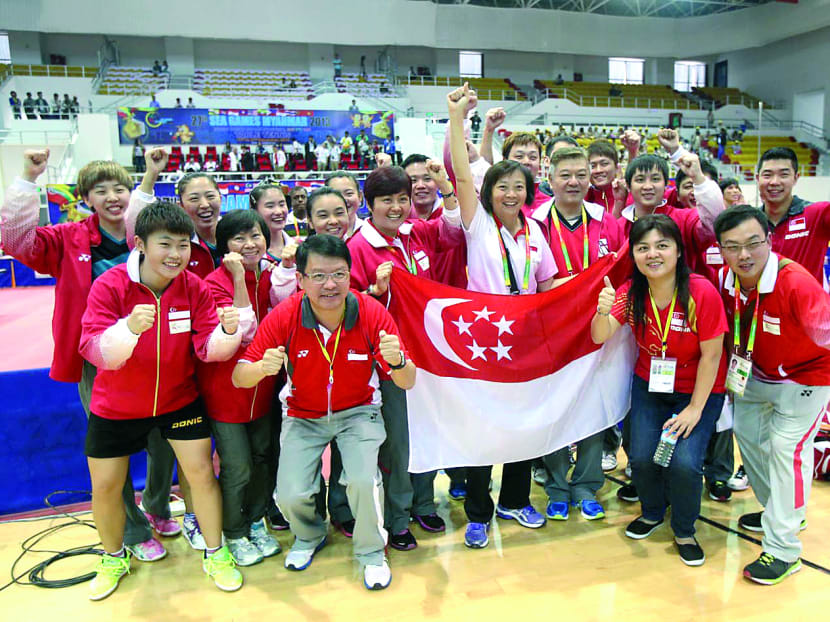
The national table tennis team celebrating their win at 27th Sea Games Myanmar. Other SEA nations are narrowing the gap in sports Singapore are traditionally strong in, such as table tennis, evident from last December’s SEA Games in Myanmar. TODAY FILE PHOTO
As hosts of the 2015 South-east Asian (SEA) Games, expectations will be high on Singapore’s athletes to deliver a strong performance on home soil. But other SEA nations are narrowing the gap in sports Singapore are traditionally strong in, evident from last December’s SEA Games in Myanmar, an assessment highlighted by Prime Minister Lee Hsien Loong at the Singapore Sports School’s 10th anniversary celebrations last month. TODAY correspondent Low Lin Fhoong (linfhoong [at] mediacorp.com.sg) takes a closer look at this issue, in particular swimming and table tennis — traditional strongholds of Singapore at the biennial regional meet — and what should be done to minimise the likelihood of party poopers at next year’s June 5 to 16 SEA Games, which are a build-up to Singapore’s 50th National Day celebrations on Aug 9.
SINGAPORE — Vietnam’s Nguyen Thi Anh Vien, Thailand’s Natthanan Junkrajang and Triady Fauzi Sidiq of Indonesia may not be familiar names to Singaporeans despite being swimming gold medallists at last December’s South-east Asian (SEA) Games in Myanmar.
But they and their countrymen plan to spoil Singapore’s party when the SEA Games rolls into town from June 5 to 16 next year as part of the build-up to the Republic’s 50th National Day celebrations on Aug 9.
Even though Singapore won the swimming competition at the Myanmar Games with 11 golds, ahead of Thailand (7) and Indonesia (5), the trio have provided ample warning with three golds each.
Singapore also continued their dominance in table tennis and men’s water polo, but the warning signs are palpable: Thailand and Indonesia both lost 8-5 to the Republic’s water polo team, but not before causing some anxious moments, while paddlers Gao Ning and Yang Zi exited the doubles semi-finals in 2009.
These are prime examples of how the region is catching up in sports that Singapore is traditionally strong in, an assessment highlighted by Prime Minister Lee Hsien Loong, who called for a strategic review of the Singapore Sports School at the institution’s 10th anniversary celebration dinner last month, noting that other South-east Asian countries “are investing significant resources to develop their athletes … they are closing the gap with us, even in sports where we traditionally do well”.
WHAT ARE SOME OF THE OTHER SOUTH-EAST ASIAN COUNTRIES DOING?
Vietnamese teenager Nguyen first stormed into the swimming scene aged 16 at the 2012 SEA Swimming Championships in Singapore where she won five gold medals. She then moved to Florida, United States, to train full-time with the Saint Augustine Swim Team under a special funding programme for Vietnam’s elite athletes.
At the Asian Youth Games in Nanjing last August, she won three gold medals and one silver before claiming a silver (200m backstroke) and bronze in the 400m individual medley at the Asian Championships in Dubai.
TODAY understands that the Thai and Indonesian swimmers also participate in training camps in China and Gold Coast, Australia, respectively.
The Indonesia Swimming Federation had undergone a period of rebuilding after a dismal outing at the 2007 SEA Games in Thailand that saw them finishing at the bottom of the six-nation table with five silver and two bronze medals. But with the trio of Triady, who was the first regional swimmer to go under 50sec in the 100m freestyle in a SEA Games record of 49.99s, backstroke champions Gede Siman Sudartawa and Ricky Anggawijaya on fire, the Indonesians finished third last year.
Indonesia Swimming Federation Chairman Sandiaga Salahuddin Uno believes they can challenge Singapore’s swimming supremacy in 2015.
“Our focus is to improve the performances of our athletes, especially female swimmers and clock new records in ASEAN or Asia,” he said. “If in 2015, our athletes can equal Singapore’s performance, it is due to the programmes and training. Last December, we held the National Swimming Club Competition and found new potential young athletes. Now, we are monitoring five to 10 athletes with the potential to become the backbone of our national swimming team.”
Thai swimmer Phiangkhwan Pawapotako, who won a silver and bronze in Myanmar, trains with the Singapore Sports School and the 18-year-old is going for gold next year.
“Yes, I think we can challenge Singapore in 2015 and we have some good swimmers in Thailand,” said Phiangkhwan, who is gunning for the 200m breaststroke and 200m IM titles next year. “I feel Singapore is not as strong as compared to last time as you don’t have young swimmers that are currently as good as Amanda (Lim), Tao Li and Mylene Ong.”
Although Singapore’s paddlers won all gold medals on offer in the last two editions of the Games, Singapore Table Tennis Association (STTA) High Performance Manager Eddy Tay warned of the threat from countries such as Vietnam, singling out their men’s singles silver medallist Tien Dat Le and female paddler Hoang My Trang Mai as ones to watch next year.
“Although the world rankings of our SEA competitors are far behind our players, the gap in technical capability has narrowed over the years,” said Tay. “Our neighbours are exposing more of their youths to more international events.
“Countries such as Myanmar and Laos have also improved significantly since 2007. Thailand has helped Laos by sending some of their coaches to coach the team, while Vietnam sent their teams to China for long periods of centralised training. Most of these countries also have full-time players, including Malaysia, Thailand and Vietnam.”
WHAT MUST SINGAPORE DO?
In the case of swimming, Singapore Swimming Association Technical Director and national coach Ian Turner and his team have identified beefing up the sports science support to athletes and the team’s strength in breaststroke, grooming young female swimmers and tackling the issue of compulsory National Service for the male athletes as key areas that must be addressed.
Not one to mince his words, Turner emphasised that sports science experts such as strength and conditioning coaches, physiotherapists, sports masseurs and physiologists were crucial to ensure Singapore’s success at the 2015 SEA Games.
“We are dreadfully short of strength and conditioning coaches, and short of physiotherapists and masseurs,” said the Briton, who believes Singapore’s regional rivals have managed to narrow the gap despite having less resources by focusing on a few top athletes.
“For us to stay in front, this is one area where we could make huge inroads. We have met with the Singapore Sports Institute to discuss this. The longer we avoid the issue, the less chance we have of being successful in 2015.”
STTA’s Tay also pointed to sports medicine and sports science (SMSS) support as an important component to Singapore’s continued success in table tennis at the regional level.
“Every detail, such as athletes, coaching, a comprehensive training and competition plan, sparring partners and SMSS support, are all important,” he said. “To stay at the top, Singapore must continuously attract young table tennis talents. We would also like to appeal for more funding to organise international tournaments in Singapore as neighbouring counties such as Thailand and Malaysia have been organising international tournaments to raise the profile and standards of table tennis in their country.”
But the STTA are hopeful local paddlers Clarence Chew and Isabelle Li can lead the charge for Singapore at the Games next year.
“With full-time training and a comprehensive training and competition plan, Clarence and Isabelle have improved tremendously over the past few years,” said Tay.
“Isabelle retained her silver medal in the SEA Games with a convincing 4-0 victory over Malaysia’s top player Beh Lee Wei. Clarence also upset the Thai’s top player in the group stage to win a bronze medal in the recent SEA Games. It shows that we are moving in the right direction in terms of youth development.”
The urgency for Singapore to get its act together was perhaps best summed up by Turner.
“There will be a determined effort by the visiting nations to make every effort to spoil Singapore’s party at the 2015 SEA Games,” he said.
“It will be naive of us to think that it won’t happen.”
Stay in the know. Anytime. Anywhere.

Subscribe to our newsletter for the top features, insights and must reads delivered straight to your inbox.
By clicking subscribe, I agree for my personal data to be used to send me TODAY newsletters, promotional offers and for research and analysis.






