
What will it take to produce another Olympic champion?
Colin and May Schooling had to find ways to fund their son Joseph's Olympic dream themselves.
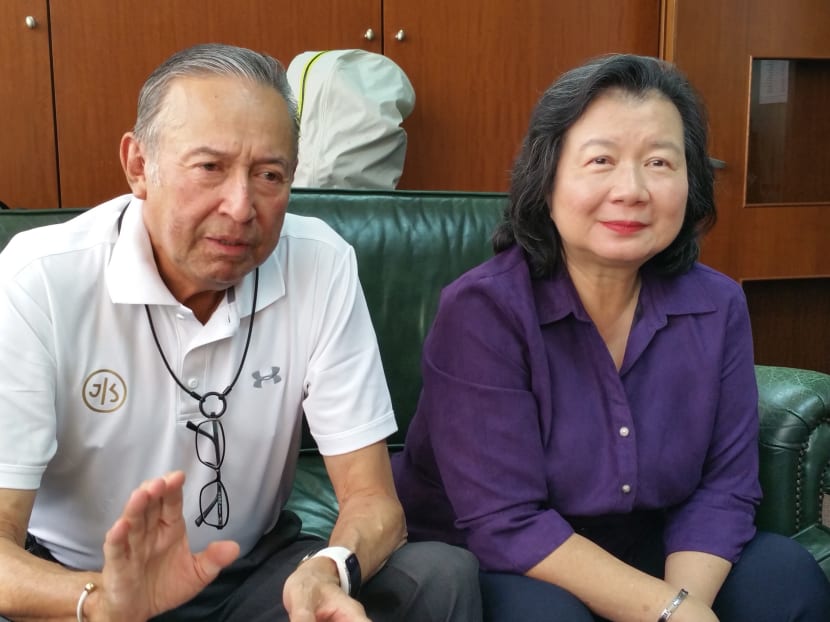
Colin and May Schooling. Photo: Low Lin Fhoong
SINGAPORE – The struggle to the top of the podium is often a long, lonely slog for athletes and their loved ones. Colin and May Schooling had to take out bank loans, sell their property in Australia, and keep driving their 30-year-old Mercedes station wagon just so that their son Joseph could chase his Olympic dream.
At the age of six, the budding swimmer decided he wanted to walk in his grand uncle Lloyd Valberg’s footsteps – the high jumper was Singapore’s first Olympian at the 1948 Games – and compete at the Olympic Games. In 2009, the Schoolings made the difficult decision to allow the Anglo-Chinese School (Independent) student to relocate to Florida to train and study at the Bolles School. Both parents also took turns spending six months at a time in Jacksonville to take care of him.
While Joseph eventually repaid their faith in him with his sensational gold-medal swim at the Rio 2016 Olympic Games, beating the world’s best including American Michael Phelps and Chad le Clos to claim top spot on the podium, the Schoolings’ tale is a familiar one that will resonate with families of sportsmen and women around the world.
Ahead of the 2012 London Games, American gymnast Gabby Douglas’s mother had to file for bankruptcy, while swimmer Ryan Lochte’s parents faced foreclosure on their Florida home.
A number of athletes also took to crowdfunding to finance their Olympic dreams, including Singaporean rower Saiyidah Aisyah Mohamed Rafa’ee who raise S$12,500 for her training stint in Australia ahead of her Rio Olympics qualification campaign.
Ahead of the Rio 2016 Games, it was widely reported that Joseph’s parents had come out with S$1 million from their own pockets to fund their son’s tuition, accommodation and transport expenses for his time at Bolles and then at the University of Texas - even though the swimmer has been a Sports Excellence (Spex) Scholar since 2013, and is ranked on the highest tier of athletes who receive up to S$90,000 annually.
And as Schooling-mania finally dies down after Joseph’s whirlwind five-day celebration tour last week, many Singaporeans have taken to TODAY’s voices page, internet forums and social media to ask: Where was the government and corporate support for the Schoolings during his formative years?
NO EASY SOLUTION
While the Republic boasts a world-class, state-of-the-art Sports Hub that costs S$1.33 billion, and plays host to some of the biggest and glitziest sports events in the world including the Formula 1 Singapore Grand Prix and the WTA Singapore Finals, the reality is that its sportsmen and women often struggle to get financial support and corporate sponsorships to keep going in their sport.
Joseph’s gold-medal victory – which will see him banking in some S$661,650 from the Multi-Million Dollar Awards Programme – may have kick-started debate on Singapore’s results-oriented system. But even Colin Schooling admits that there is no easy solution to the conundrum.
“I didn’t ask for money because I didn’t wish to be disappointed,” said the 68-year-old businessman in a recent interview with TODAY.
“But you can’t expect sports people to support you if you haven’t achieved anything. So you have to support yourself. You have to establish yourself to a certain level first.”
Added May: “It is a chicken and egg thing when it comes to sponsors. Companies like to sponsor winners, and how do you guarantee a winner? We need to educate corporates so they are willing to try and support sports. The mindset is not there.”
Theirs is a story that resonates with businessman Tang Siu Kan and Anita Tang, parents of local race driver Andrew Tang.
The family had financed Andrew’s racing career since he started competing in a go-kart at the age of eight, only to see his dreams shattered two years ago when the then-18-year-old – who was part of Formula 1 team McLaren’s young driver development programme – had to stop competing due to National Service.
Andrew is now racing in the 2016 Porsche Carrera Cup Asia after winning a contract and sponsorship of 1 million yuan (S$202,422) with the Porsche China Junior Programme, and the 21-year-old is currently placed third overall with three races left in the season.
Weighing in on the debate, Andrew’s father, Siu Kan, stressed that family support is a key factor in the success of any athlete. “Andrew has also chosen a route that is very much less taken, and it’s definitely not easy,” he said.
“The most successful sports people around the world come from a background of fully committed parents. Parents have to believe in their child’s potential to compete with the world.
“The sports culture in South-east Asia is non-existent. Funding is part of the infrastructure (for sports), and we need passionate people in the government. It takes 20 years to groom a world champion. If you believe and want someone to do great things, you have to invest the funds to groom them.”
HOW S’PORE’S SPORTS FUNDING COMPARES TO OTHER COUNTRIES
Funding for sports has gone up over the decades, rising from an annual S$8 million in 1994 to over S$62 million in 2012.
In a Singapore Budget 2013 report, the Ministry of Culture, Community and Youth said that a net government outlay of S$167.1 million and an estimated S$91.3 million from the Sporting Singapore Fund would be allocated to support sports initiatives in Financial Year 2013.
These included the expanding and upgrading of public sports facilities, the set-up of Super Sports Clubs for Singaporeans to play sports, as well as increased support for elite athletes.
Armed with a war chest of some S$40 million, the Spex Scholarship was introduced to help able-bodied and disabled athletes train and compete full time to achieve their sporting dreams.
Yet these numbers pale in comparison to what some of the bigger nations spend on their four-year Olympic cycle.
Britain spent some £350 million (S$624 million) – including £274 million from the National Lottery grant – on their athletes ahead of the Rio Olympic Games but reaped handsome rewards when it leapfrogged powerhouse China in the medal tally to finish second with a record 27-gold haul.
While China does not reveal financial figures for sports, its national athletes are groomed in its national and state-run sports systems from young, with training and living expenses paid for by the government.
Australia, which finished 10th with seven gold, invested a total of A$340 million (S$352 million) over the four years leading into the Games.
NO ONE-SIZE-FITS-ALL APPROACH TO SPORTS FUNDING
Local sports administrators say there is no one-size-fits-all approach to funding and support for elite sports.
“Our society gives rewards after you deliver the goods… it’s like working where you get the bonus after you’ve done the work,” said Singapore Sailing Federation president Benedict Tan, a former national sailor who won gold at the 1994 Asian Games and participated at the 1996 Atlanta Olympics.
“The risk is undertaken by society or the funding agency when you use the model which pre-pays athletes and hopes for a return on investment. You invest in 20 athletes and maybe one will deliver, and the cost of funding is very high… a lot of funding will go down the drain with injuries, attrition and other factors.
“The other model, which is cash on delivery, has a flaw: how do you expect to succeed when you don’t have the resources?”
Pointing out that many countries’ sports systems – including Singapore – are similar to the second model, Tan also said that over-funding athletes could cause them to lose their drive.
He added: “Unfortunately the reality is that there is a cost to sports, and there will be people who cannot afford it.
“But if you go with the China system, the taxpayers have to ask if they are willing to pay for it.
“If you use targeted funding and target a limited pool, you are more likely to succeed. What you want to do is create a bigger starting pool, and then have a weeding process at a higher level.”
Oon Jin Teik, secretary general of the Singapore Swimming Association, stressed that corporate sponsorship and support is a crucial part of the sports eco-system required for the development of elite athletes here.
“Government funding has been getting more generous…there is a system and a plan which are on-going, and the results are starting to come,” said the former national swimmer, who competed at the 1984 Olympic Games.
“Now it is about reviewing, enhancing, growing and accelerating, to do in-depth analysis. Resources are never enough, and high performance sports is very resource intensive.
“Now that people see results in Joseph Schooling and Quah Zheng Wen…the call to action to corporates is – please step up, please believe.”
WHAT’S NEXT FOR SINGAPORE SPORTS?
Local sports administrators agree that Singapore’s sports system will continue to evolve, and Chiang Hock Woon, deputy chief executive officer of Sport Singapore said in an email reply to TODAY’s queries: “After every major Games, like the Olympics, we conduct a review together with the athletes, coaches, high performance managers and national sports associations, to look at what went right and what needs improvement.
“Our High Performance Sports system has evolved over the years, in particular with the introduction of the spexScholarship among our other support programmes.
“High Performance in sport is a long and on-going process which we will continue to fine-tune along the way, so as to give our athletes every opportunity to succeed at the highest levels.”
Oon believes that the SSA’s National Training Centre (NTC) at the OCBC Aquatic Centre – which was set up to train and develop the nation’s junior and elite swimmers – is on the right track.
Quah, who impressed in Rio, his second Olympic outing, by qualifying for two semi-finals in the 100m and 200m fly, is a product of the NTC.
Oon also reckons that Joseph is not a one-off success story for Singapore, as he added: “The NTC is filled with all kinds of resources such as sports science that no swimming clubs can replicate.
“We can learn how to work better and allow more athletes to be successful. We have plenty of talent, the question is how do we grow them into something?
“The system has many variables, and with each variable, we look for the best practices, and look for external help if we don’t have it.
“Zheng Wen is bred in the local system. Last year’s SEA Games (success) was Singapore’s investment in high performance.
“We have been progressing the last 10 years and a conscious effort has been put in place.”
The National Youth Sports Institute (NYSI), which was set up last year to cater to high-performance youth athletes, will also play a key role as Singapore makes a big push for success at the international sporting stage.
Said its director Tan Wearn Haw: “NYSI is a part of the larger ecosystem, and specific to supporting youth athletes…We believe that having better clarity in the pathways for athletes to progress, and the creation of multiple pathways would generate more opportunities for Singapore’s athletes to reach their fullest potential in sports.
“It is perfectly fine for us to focus on and be good at developing strong youth athletes, and then setting them on the pathway towards the senior level, because thereafter, they would have access to scholarships like Spex Scholarship, Collegiate scholarships or even sports/academic scholarships from other universities worldwide.”
The ex-national sailor is also hopeful that Singapore will see another Olympic medallist like Joseph Schooling in the near future.
“We have more athletes across sports committing to the pursuit of excellence in sports, and have had breakthroughs at SEA, Commonwealth, Asian and now Olympic levels over the past 20 years,” he said.
“That is heartening progress, especially when we compare our population size and also investments in sports with many other countries. “I’m an eternal optimist and I would see it as a case of ‘when’ we see more Olympic champions, and not ‘if’ we would see them spring up!”
It is a belief that Colin also subscribes to, as the 68-year-old told TODAY that he plans to take a trip down to the Sports Hub at Kallang to see some of Singapore’s young swimmers in action at the OCBC Aquatic Centre.
He added: “I don’t know how long more it will take for Singapore to see (the next Joseph Schooling).
“But I know for certain that there is one. We have potential here, and I would like to see them for myself.”
Stay in the know. Anytime. Anywhere.

Subscribe to our newsletter for the top features, insights and must reads delivered straight to your inbox.
By clicking subscribe, I agree for my personal data to be used to send me TODAY newsletters, promotional offers and for research and analysis.






