
Wrestling with its future
SINGAPORE — The International Olympic Committee’s (IOC) decision earlier this month to axe wrestling from the 2020 Olympic Games has left the sport’s parent body in Singapore worried over its future here.
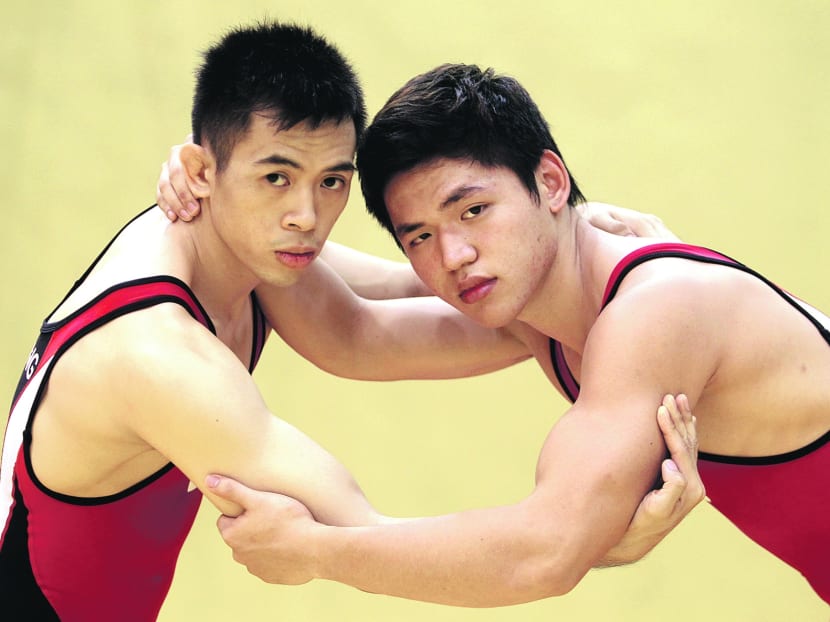
Wrestlers Gabriel Huang (left) and Toh Xin Ran now find it more difficult to market the sport to schools. Photo: Wee Teck Hian
SINGAPORE — The International Olympic Committee’s (IOC) decision earlier this month to axe wrestling from the 2020 Olympic Games has left the sport’s parent body in Singapore worried over its future here.
Although wrestling is still a very young sport in Singapore, the Wrestling Federation of Singapore (WFS) is concerned that its growth could bear the brunt of it.
“For Singapore wrestling, our goal now still remains as the 2015 South-east Asian Games,” said WFS Vice-President Jimmy Taenaka. “I only hope that the decision by the IOC does not affect the SEA Games (Organising) Committee in thinking that wrestling is an inferior sport.”
The WFS was set up in 2009 to help prepare Singapore wrestlers compete at the 2010 Youth Olympics, which Singapore also hosted. It receives up to S$199,000 in funding for the current fiscal year from the Singapore Sports Council (SSC).
And Taenaka, 48, admitted that the IOC’s decision may not help the WFS’ efforts to develop and commercialise the sport here. He said: “There are wrestling clubs in a few schools, but due to its specialised nature, it will be more difficult to introduce it to schools now as there may be even fewer resources available.”
National wrestler Gabriel Huang, 25, added: “Wrestling is not an official co-curricular activity in schools, and the recent decision may affect our bid to market the sport to schools.
“Our approach when schools contact us is to frame our sport as ‘Olympic wrestling’ and not wrestling for entertainment like the WWE. Hence, the word ‘Olympic’ in front of wrestling is very important. Without that, this misunderstanding will deepen.”
Huang’s team-mate Toh Xin Ran added that his attempts to start a wrestling club at his school, which he declined to name, were also more difficult with the IOC’s decision to drop the sport from the 2020 Olympics.
“They asked me why they should even bother with the time and effort to set up this new club since it has already been dropped from the Olympics,” said the 18-year-old.
Earlier this month, the IOC Executive Board voted to omit wrestling from the 2020 Olympics in a bid to keep the Games appealing. According to IOC documents obtained by AP, the sport ranked “low” at 5 on a scale of 10 in several of the technical data, including popularity. The IOC also noted that FILA, the sport’s world body, did not have any athletes on its decision-making bodies, and lacked a women’s commission.
Wrestling joins seven other sports bidding for a sole spot at the 2020 Olympics. The IOC will make a final decision at the 125th IOC Session in September.
Taenaka believes the IOC’s decision could be a “blessing in disguise”.
“There has been a lot of unity shown recently, especially from the three powerhouses in wrestling — USA, Russia and Iran,” he said. “Countries used to just keep to themselves in tournaments, but now they don’t anymore. It is a lot less politics, and a lot more respect.”
Stay in the know. Anytime. Anywhere.

Subscribe to our newsletter for the top features, insights and must reads delivered straight to your inbox.
By clicking subscribe, I agree for my personal data to be used to send me TODAY newsletters, promotional offers and for research and analysis.






