
Amazon Japan enticing shoppers from China
TOKYO — Just before the stores open in Tokyo’s Akihabara electronics district, buses pull up, unleashing Chinese tourists and their credit cards to snap up televisions, rice cookers and other gadgets. Walk into any department store and there they are, buying mascara, T-shirts and other merchandise.
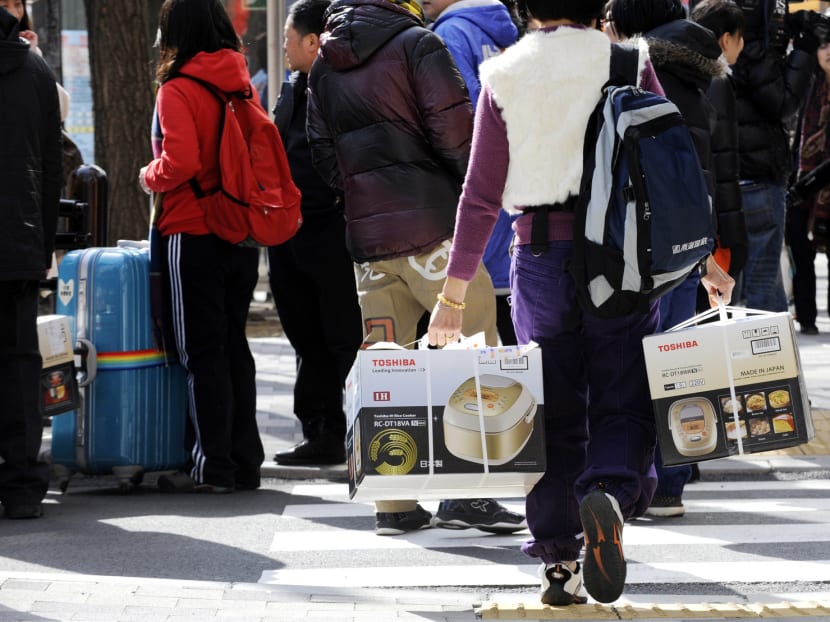
A Chinese tourist carrying rice cookers in Akihabara, Tokyo. China’s infatuation with Japanese products is discovering a new source of satisfaction: The Internet. PHOTO: AFP
TOKYO — Just before the stores open in Tokyo’s Akihabara electronics district, buses pull up, unleashing Chinese tourists and their credit cards to snap up televisions, rice cookers and other gadgets. Walk into any department store and there they are, buying mascara, T-shirts and other merchandise.
China’s infatuation with Japanese products is now discovering a new source of satisfaction: The Internet. And Amazon.co.jp is responding.
On June 30, the online retailer quietly rolled out a Chinese-language version of its shopping site in Japan, along with new, reduced shipping rates to mainland homes and businesses. It is another example of how Amazon.com is evolving in Asia to open up new streams of revenue and make up for the lack of a bigger presence in China, where Alibaba Group Holding dominates. Underscoring that potential, e-commerce demand from China to Japan is projected to almost triple to ¥2.34 trillion (S$30.5 billion) in 2019, according to Japan’s Ministry of Economy, Trade and Industry.
“The opportunity is huge,” said Mr Jasper Cheung, president of Amazon Japan. “We have already increased the selection that we can export by the millions over the last several weeks.”
Chinese shoppers are looking for authentic Made-in-Japan products, spooked by tainted baby milk and fake merchandise proffered on Web stores in China. While that is helping to drive an influx of shoppers to Japan — 3.08 million Chinese tourists have visited the archipelago so far this year, up 41 per cent — it is also boosting demand for Amazon.co.jp, Wandou and other online outlets featuring Japanese goods.
Rakuten, the Japanese online store, also lets people shop for stuff from Japan in Chinese, as well as in Korean and English. Amazon’s Japan website has been available in English for years.
The new iteration of Amazon Japan’s shopping portal, in simplified Chinese, offers millions of products with more coming, the company said. Consumers in Asia’s biggest economy are demanding access to authentic brands and quality, from clothing and cosmetics to baby products and health goods. That’s why Costco Wholesale has a shop on Alibaba’s Tmall.com, while Macy’s and other US retailers are tapping into China’s dominant online-payments system by accepting Alipay on their sites.
“Things in Japan are well made and high quality, and the packages are cute,” said Qian Jing, 31, an employee of an entertainment company in Wuhan who has bought comic books, Pilot pens and tea from Amazon Japan.
Most shipping rates to China from Japan are ¥500 to ¥600, about a third less than it costs to transport similar items to Australia, according to the website.
Regular delivery takes two to 18 days. Before hitting the buy button, Chinese shoppers can see a breakdown of the shipping, handling and customs costs, and pay in yuan.
“We used to have only one option for shipping to China, and we added a lower shipping cost to China as well,” Mr Cheung said.
Amazon debuted in Japan in 2000 as the company’s first website in Asia, and now offers Prime members in the country video, same-day shipping and other add-on services for an annual fee. While the Seattle-based company does not break out sales in Japan, international revenue made up 33 per cent of the total last year. A key priority for Amazon in the region now is India, where the company recently introduced its Prime programme and is going up against homegrown Web retailer Flipkart.
Amazon also operates an online store in China, featuring local products, and even opened a shop on Tmall.com last year to reach more Chinese shoppers. BLOOMBERG
Stay in the know. Anytime. Anywhere.

Subscribe to our newsletter for the top features, insights and must reads delivered straight to your inbox.
By clicking subscribe, I agree for my personal data to be used to send me TODAY newsletters, promotional offers and for research and analysis.






