
First-of-its-kind service allows callers to connect via a personalised URL
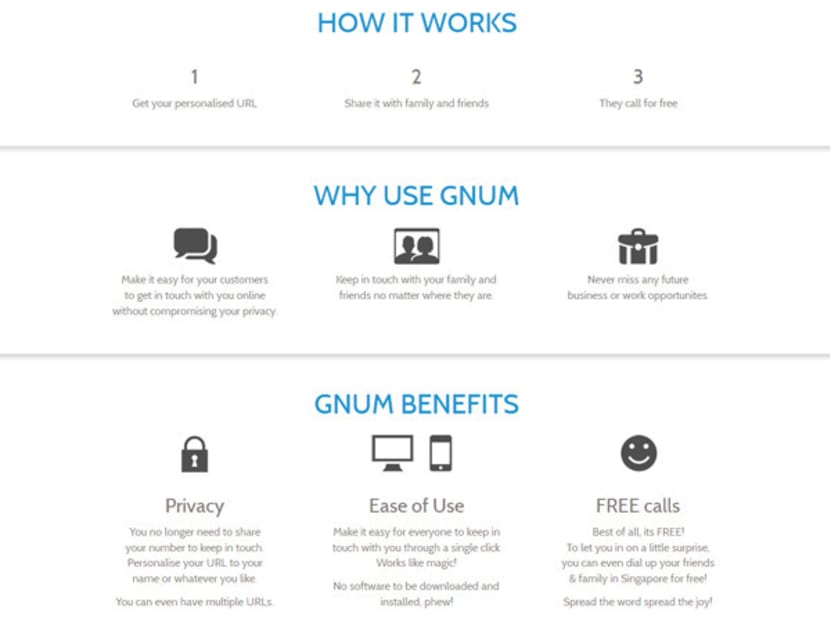

SINGAPORE — Imagine asking someone you just met to call you without giving them your mobile phone number. Imagine calling home from overseas without having to pay IDD rates or key in a string of numbers. Imagine “calling” someone by simply clicking a Web address instead of punching in numbers on a phone. Now how about receiving that call on your mobile phone without having to download an external chat application or even have a 3G or Wi-Fi connection?
All of that is now possible with the world’s first personalised URL-based calling service unveiled yesterday by local start-up GNum, which has secured S$7 million in seed funding from private equity firm Tembusu Partners.
The deal is said to be one of the largest first-round investments in a Singapore start-up, said a joint statement by Tembusu and GNum yesterday.
Talks are also under way between GNum and the three telcos here for a revenue-sharing formula that will see the service become a value-added feature for them, as they continue to face stiff competition from “free-riding” over-the-top (OTT) offerings, such as WhatsApp and Skype.
Analysts TODAY spoke to said such a tie-up would benefit the telcos as it would allow them to enhance their offerings to customers while making money off the value-added service.
GNum’s technology works by linking each registered user’s mobile phone number to a personalised URL — for example http://gnum.com/john.smith — which they can then give out to people who will then be able to “call” them by clicking on the web address through online devices such as a desktop, tablet or smartphone.
Speaking to TODAY, GNum’s chief executive officer, Mr Alexandre Yokoyama, said the service is the first to seamlessly bridge the gap between the Internet and mobile phone users. He added that SingTel, Starhub and M1 — which together have 8.4 million local mobile numbers — are quite keen on a partnership.
“The telcos do not want GNum to be that one more guy who’s trying to steal their lunch, so they are very excited to have us onboard as a new value-added service that can help them with monetisation and increasing revenue on existing customer base,” Mr Yokoyama said.
“The partnership is also a win-win for us as GNum can leverage on their network and user base to speed up and deepen penetration.”
Analysts TODAY spoke to agreed that partnering with GNum is a sound move by the telcos in response to OTT messaging and call services that cannibalise their revenue while free-riding off their networks.
Mr Praveen Sengar, Gartner’s principal research analyst, said: “Telcos here are worried because they can’t monetise their core data and voice services — they certainly need this partnership to enhance their offerings to customers.”
Reflecting that concern, SingTel’s chief executive officer Ms Chua Sock Koong in February called on regulators to allow telcos to charge OTT providers “to better match revenues to underlying use of our infrastructure”.
“So the collaboration with GNum is relevant to the telcos. But given how mature and saturated Singapore’s infocomm ecosystem already is, GNum’s growth will depend on whether it can identify itself with a specific niche of consumer needs, say, for example as a channel for health care or fast-food customer services,” Mr Sengar added.
“The service needs to gel with consumers and help them consume services much more effectively for it to be sustainable.”
However, Tembusu is very optimistic about the future of the start-up.
“For this project, we’re talking about eventually connecting everyone with a phone — smart or feature — and we’re talking about billions of people. To us, this is a billion-dollar opportunity,” said Tembusu partner Mr Chik Wai Chiew.
GNum is now in beta for Singapore users with a tentative price of S$15 per month, but registration comes with promotional 200 free minutes.
As the service grows, expansion into Malaysia, Thailand, Indonesia and the Philippines is also on the cards, Mr Yokoyama said.
Stay in the know. Anytime. Anywhere.

Subscribe to our newsletter for the top features, insights and must reads delivered straight to your inbox.
By clicking subscribe, I agree for my personal data to be used to send me TODAY newsletters, promotional offers and for research and analysis.






