
Thank you THQ, but it’s game over
SINGAPORE — Last Wednesday, gaming company THQ shut down its computers for the last time. Even though it had announced its bankruptcy on Dec 19, a letter from CEO Brian Ferrell on Jan 22 made the dissolution real. With its assets up for bids, companies such as Sega and Ubisoft swooped in to capture some of THQ’s best assets as the gaming industry mourned another of its fallen brethren. THQ had slumped from the heights of 2007 — where it had generated a revenue of over US$1 billion (S$1.24 billion) — to a net loss of US$23.9 milllion in 2011.
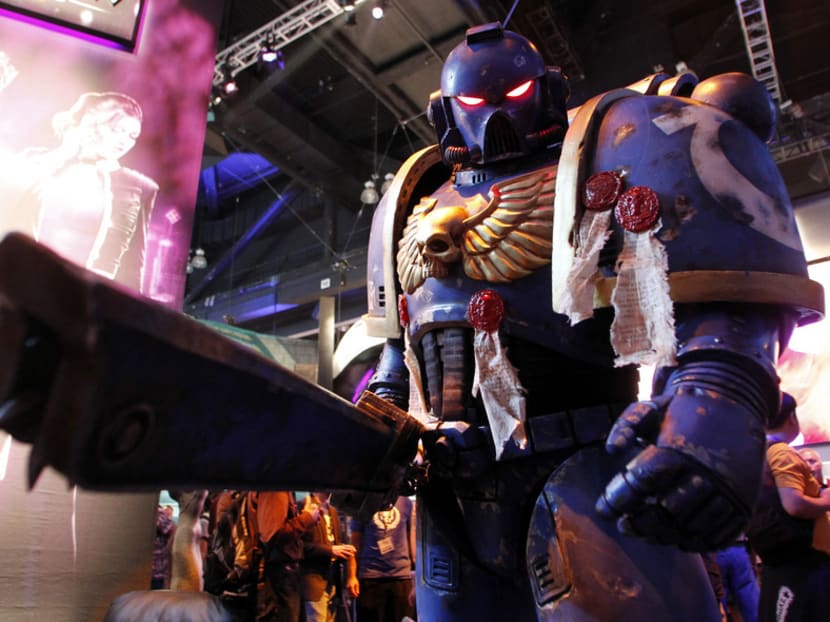
A character from the video game Warhammer 40,000: Space Marine published by THQ poses at Electronic Entertainment Expo (E3) 2011. Photo REUTERS


SINGAPORE — Last Wednesday, gaming company THQ shut down its computers for the last time. Even though it had announced its bankruptcy on Dec 19, a letter from CEO Brian Ferrell on Jan 22 made the dissolution real. With its assets up for bids, companies such as Sega and Ubisoft swooped in to capture some of THQ’s best assets as the gaming industry mourned another of its fallen brethren. THQ had slumped from the heights of 2007 — where it had generated a revenue of over US$1 billion (S$1.24 billion) — to a net loss of US$23.9 milllion in 2011.
But in an industry where the closure of a well-loved studio — Interplay is one that comes to mind, Atari just filed for bankruptcy, and Sega itself faced troubles in the early 2000s before reinventing itself as a software-only company — is becoming more frequent, can one be truly surprised by THQ’s demise?
The gaming industry has been seen of late as being overly dependent on sequels as a sure bet to ensure that their coffers get a healthy return. The NPD Group list of the top 10 games in the United States for 2012 showed that all 10 were sequels, and more importantly, most of these games — from Call Of Duty: Black Ops 2 to FIFA 13 — have gone past the hardcore gamer-sphere and entered the public consciousness.
THQ did not have a title on the list.
That’s not to say having a top-10 game is a sure-fire barometer of success, but the cut-throat gaming business doesn’t appreciate second place. To play with the big names means having triple-A games — big games with big budgets — and they have to translate to big sales.
THQ is best known for developing licensed products for Disney and Nickelodeon — not quite the blockbuster market. It had also sheltered subsidiaries such as Vigil Games, who did the Darksiders series, and Volition, who did the Saints Row and Red Faction series under its wings. While these are well-known and generally well-received titles in gaming circles, the fact that these were THQ’s marquee titles offers a hint to its demise.
Simply put, THQ never had a triple-A title to help its cause. All it had was a list of almost-there games: For every Saints Row, gamers opted for the next Grand Theft Auto, and for every Darksiders, gamers wanted God Of War. It’s not that these games were indistinguishable from each other, but in a crowded market, the need to stand out and have that X-factor remains all the more undeniable.
They are also not bad games by any definition; Saints Row: The Third scored a very respectable 84 on review aggregator Metacritic, but its competitor, Grand Theft Auto 4 scored 98. Darksiders scored an 84 too, but pales in comparison to God Of War III at 92.
Company Of Heroes might be THQ’s most well-received game — it’s still the highest rated strategy game on Metacritic yet with 93 average — but it is also about 7 years old, and the real-time strategy genre itself has definitely seen better days. Company Of Heroes’ sequel was due to come out this year, but sadly that is too little, too late for THQ.
It wasn’t for the lack of creativity that THQ went belly up — Darksiders was birthed from designer Joe Madueira, the very same comic artist that got me started on collecting comics again with Battle Chasers back in 1998 — but game production takes both creativity and execution, and a game scoring 84 on average just isn’t good enough these days.
Nonetheless, for the fans of each series — whether you love wrestling games like WWE’13, or strategy like Warhammer 40,000 — it’s still not the end of the world. Saints Row will likely continue under Koch Media, and the makers of the Dawn Of War and Company Of Heroes series, Relic Entertainment, has been bought over by Sega.
And the end of THQ could be good news for some — Relic Entertainment are the developers of Homeworld, one of the best the space simulations of all time. It has been 10 years since we’ve seen Homeworld 2, and with no real competitors for the space simulator throne these days, maybe some will look kindly upon the memories tied to the classic Homeworld, dust it off, and start a whole new legacy for the next generation of gamers. Homeworld fans teamPixel have even started a crowdfunding campaign to raise funds to buy the title over.
Still, it’s never fun to learn that hundreds of people have lost their jobs — and I hope to see their work under the more established studios — but it’s also far from the end of the world for gaming. And for a company that never truly had a blockbuster, maybe its demise, while tragic, might prove to be a blessing in disguise: That from its ashes something revitalised shall rise. ALVIN CHONG
Stay in the know. Anytime. Anywhere.

Subscribe to our newsletter for the top features, insights and must reads delivered straight to your inbox.
By clicking subscribe, I agree for my personal data to be used to send me TODAY newsletters, promotional offers and for research and analysis.






