
Robot dealers could be a game changer for casinos
HONG KONG — She has an hourglass figure, an unflappable manner and a friendly face. Meet “Min”, the robot whose creators say she could revolutionise card-dealing in the world’s casinos.
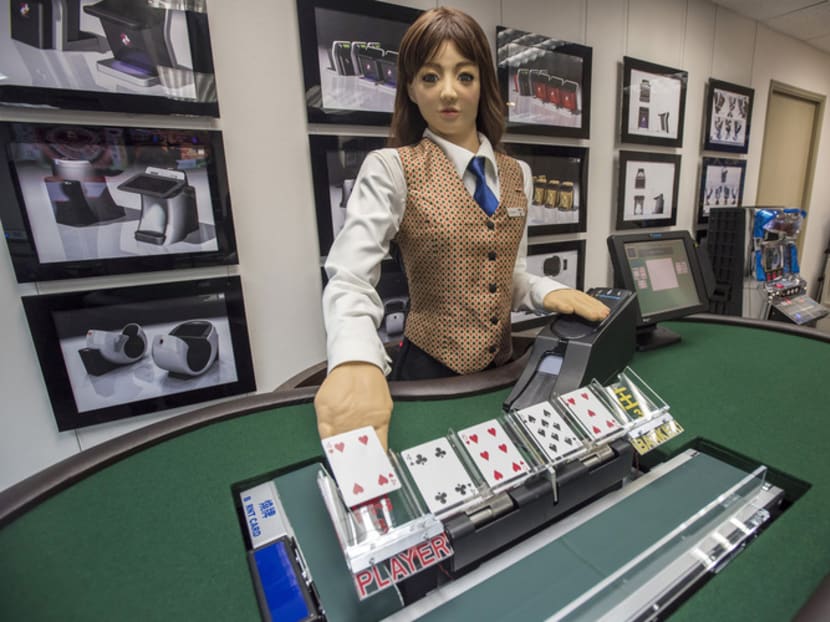
A robotic baccarat dealer deals a card during a demonstration at the headquarters of Paradise Entertainment Ltd., in Macau, China. Photo: Bloomberg
HONG KONG — She has an hourglass figure, an unflappable manner and a friendly face. Meet “Min”, the robot whose creators say she could revolutionise card-dealing in the world’s casinos.
The svelte brunette is a prototype of a human-like electronic croupier, which Paradise Entertainment, a Hong Kong-based gaming machine manufacturer and supplier, said could cut labour costs and open up new markets for casino operators. While her function is currently limited to dealing cards, planned enhancements could have her recognising customers’ faces and speaking to them in multiple languages, said chairman Jay Chun.
After debuting at a gaming show in Macau last month, Min and her clones will initially be introduced in the United States, where labour costs in casinos are proportionally higher than in Asia, and where humans, not machines, are prohibited in some states from working as croupiers.
Paradise is talking to potential overseas buyers, said Mr Chun, declining to say how much the robots will cost. “We are the first gambling equipment manufacturer in the world that produces human-like robotic dealers,” he said.
Besides potential advantages in security and hospitality, robots are more efficient at dealing cards, typically distributing 30 per cent more than a human in any given period, said Mr Chun.
Robots can be a good solution in gambling jurisdictions where real dealers are banned, said Mr Carlos Siu, an associate professor at the gaming teaching and research centre of the Macao Polytechnic Institute.
Genting Malaysia’s Resorts World Casino in New York state uses electronic table games to get around state gambling laws that bar human dealers, according to Mr Christopher Jones, an analyst with Union Gaming Group in New York.
In Macau, the world’s largest gambling hub, machines are less likely to appeal. Asian customers are more inclined to gamble in a noisy and crowded environment, preferring to banter with dealers and fellow gamblers than sit in front of a machine that provides little or no engagement, said Mr Siu.
“Gamblers often slam the table and shout loudly to pump up the mood,” he said. “I’m not sure if robotic dealers can tap into the gamblers’ psychology correctly and offer an appropriate response.”
On top of that, a slowdown in Macau’s gaming industry may result in an oversupply of croupiers in the territory, said Mr Siu.
Paradise would not comment on whether it plans to sell robot dealers to the city’s operators.
Hanson Robotics has sold a rival product “which is interactive and able to make facial expressions” to a Macau casino operator, said Ms Jeanne Lim, the Hong Kong-based company’s chief marketing officer.
Paradise Entertainment is working on making its robots more lifelike, said Mr Chun. Scanners located in card shoes enable the machines to recognise the cards that have been dealt. More advanced models will incorporate face-recognition capabilities so customers, especially important high-rollers, get more personalised service.
A couple of months ago, Kam Pek Paradise, an SJM Holdings-owned casino in Macau that is managed by Paradise Entertainment, began requesting VIP customers provide personal details and a portrait photograph so surveillance cameras will recognise them and alert floor managers of their arrival via an automatic text message, said Mr Chun.
Likewise, the technology can be used to scout for known troublemakers. BLOOMBERG
Stay in the know. Anytime. Anywhere.

Subscribe to our newsletter for the top features, insights and must reads delivered straight to your inbox.
By clicking subscribe, I agree for my personal data to be used to send me TODAY newsletters, promotional offers and for research and analysis.






