
The case for smoke-free HDB housing
With the “Smoke-free zone in Nee Soon South piloted” (Jan 6), I wish to present the case for smoke-free housing. Let me stress that smoke-free housing is not targeted at smokers, but at smoking in ways that harm other people.
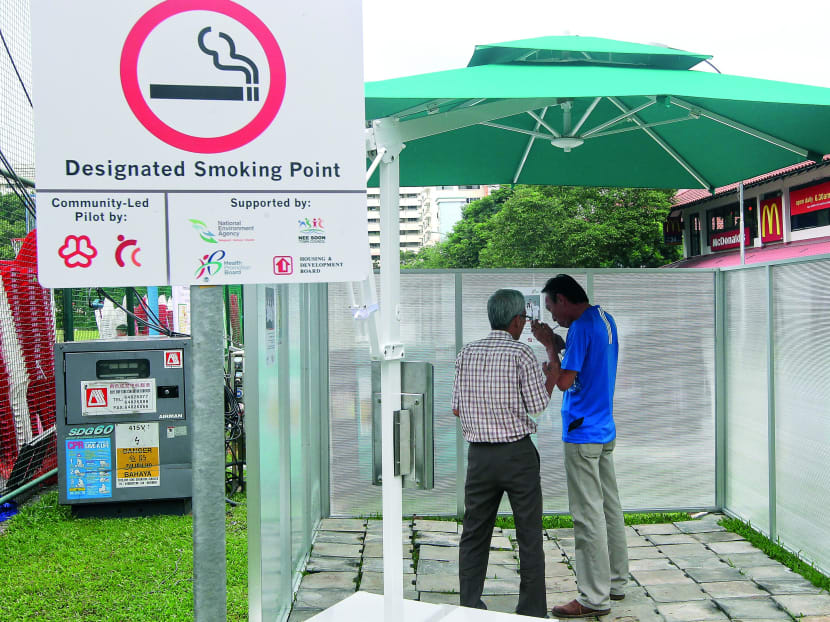
Smokers at one of the six designated smoking points installed at Nee Soon South. Smoke-free housing paves a way to harmonious living by minimising conflict between smoking and non-smoking neighbours. TODAY FILE PHOTO

With the “Smoke-free zone in Nee Soon South piloted” (Jan 6), I wish to present the case for smoke-free housing. Let me stress that smoke-free housing is not targeted at smokers, but at smoking in ways that harm other people.
More than 90 per cent of Singaporeans live in Housing and Development Board (HDB) flats and private apartments. Nearly one in four male Singaporeans aged 18 to 69 is a smoker and smoking rates are rising. It is hard not to be exposed to drifting second-hand smoke at home.
Can closing all doors and windows solve the problem, even if one is willing to pay hefty air-conditioning bills? Second-hand smoke can spread to a non-smoking area, even if the doors between two areas are closed.
Health physicist James Repace has advised that attempts to control the toxic and carcinogenic properties of second-hand smoke by ventilation are futile.
Comments from the United States Environmental Protection Agency offer little hope: “There are thousands of particulate and gaseous chemical compounds, including many known carcinogens, in tobacco smoke that cannot be removed effectively by air cleaning.”
Only a bungalow can provide a ring fence of protection from surrounding smokers. For the vast majority who cannot afford this, designated smoke-free housing could be a viable solution.
For a start, the HDB could offer separate smoking and smoke-free blocks for new housing projects. Smokers would be free to smoke at home in smoking blocks, but those who choose to live in smoke-free blocks would have to smoke in designated areas downstairs.
Singapore already has low birth rates; surely nothing is more important than safeguarding the health of our citizens?
Since smoking is legal, non-smokers must be protected from second-hand smoke infiltration at home. Smoke-free housing, available in countries such as the United States, paves a way to harmonious living by minimising conflict between smoking and non-smoking neighbours.
Regarding the argument that smoke-free laws violate smokers’ rights, such legislation does not say that smokers cannot smoke; it only limits where smoking is permissible to prevent harm to others.
There is a common legal understanding in the matter of civil liberties: All rights are bracketed by all other rights or, as American jurist Oliver Wendell Holmes, Jr said: “The right to swing my fist ends where the other man’s nose begins.”
The right of a smoking home owner ends where his neighbours are impacted significantly. And only smoke-free environments provide effective protection, as there is no safe level of exposure to second-hand smoke.
Otherwise, hapless non-smokers living among smoking neighbours have no way out and would become passive smokers within their homes.
Stay in the know. Anytime. Anywhere.

Subscribe to our newsletter for the top features, insights and must reads delivered straight to your inbox.
By clicking subscribe, I agree for my personal data to be used to send me TODAY newsletters, promotional offers and for research and analysis.






