
Is an education at a Singapore university not good enough?
Parents are always pushing their children to get good grades, go to better schools, and eventually, to top universities.
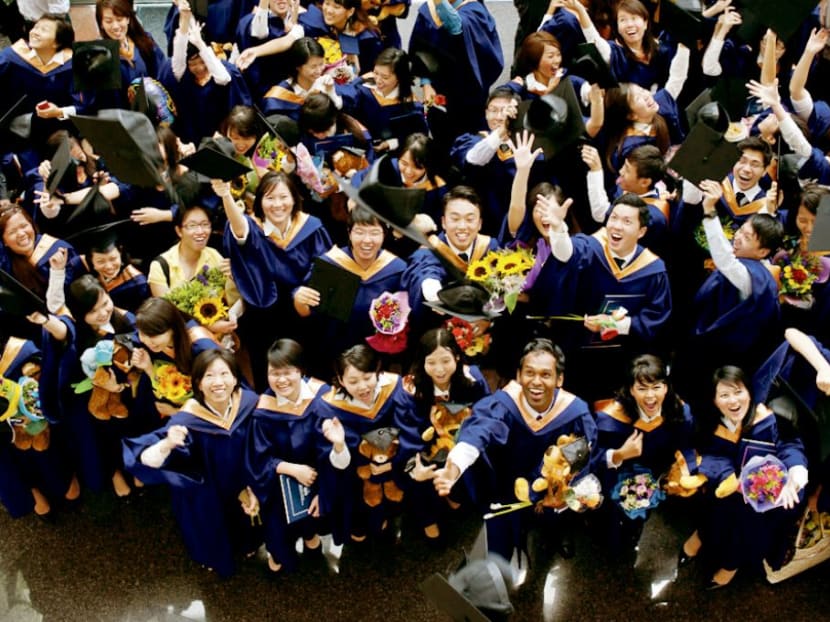

Parents are always pushing their children to get good grades, go to better schools, and eventually, to top universities.
A-list students may go to top universities in England and the United States, and some of these scholars end up heading our key government ministries.
For other students, they go for a degree from a Singapore university.
My point is that this may somehow contribute to the belief that universities here are not as good as elite universities overseas.
Many of our Cabinet ministers’ alma maters are overseas. Just to name a few, from among the present cohort of political leaders, Prime Minister Lee Hsien Loong, Deputy Prime Minister Tharman Shanmugaratnam, Finance Minister Heng Swee Kiat as well as Trade and Industry Minister Chan Chun Sing have all been to Cambridge University.
Only a handful of ministers are educated here, such as Law Minister K Shanmugam and Minister for Culture, Community and Youth Grace Fu.
On the other hand, the global trend is different. Numerous leaders of developed countries are from universities in their own countries.
President Xi Jinping was from TsingHua University in China; German Chancellor Angela Merkel was from Leipzig University; and Canadian Prime Minister Justin Trudeau was from McGill University.
Does a leader need to be educated overseas to exercise good governance?
The crux of the issue, however, is not the pursuit of an overseas education, but the lack of emphasis and recognition of a Singapore one at the tertiary level.
The National University of Singapore and the Nanyang Technological University have been ranked among the best in Asia.
Through a university education here, students can tackle issues that are unique to our native environment. Singapore’s sustainability as a country is unique, and demands specialised governance. Where better can we drive such a movement than at our colleges and universities?
There is merit to an overseas education, such as the opportunity to experience different cultures and learning styles, and to network with a variety of communities — but all these can be done via international exchanges or joint programmes, too.
The constant promotion of overseas scholarships shifts the perception that a quality education cannot be had here.
Last year, Singapore’s Public Service Commission offered 71 awards, and 60 of those were in foreign universities.
Tuition fees of such universities are estimated to be at S$90,000 a year. For undergraduate studies in economics at Cambridge University, for example, the cost of a three-year programme can come to S$205,000.
A sizable number of scholars opt for graduate studies, which may take two years. It would cost minimally around US$80,000 or about S$109,000 a year for, say, a Master in Public Administration at Harvard Kennedy School.
One can do the math for how much it would cost to fund the scholarships for the award recipients.
If foreign educators are sought after, perhaps one alternative would be for the relevant ministries or institutions to adjust their budgets to boost the recruitment of top professors. This approach may provide for a long-term holistic developmental programme.
Rather than funding the education of a handful of scholars, we can increase the concentration of top educators here, spurring competitiveness and attracting more of them to join the ranks.
It is beneficial and obligatory for the Government to support and recognise the credentials of Singapore’s universities.
We should place more pride in supporting our own schools and graduates.
Stay in the know. Anytime. Anywhere.

Subscribe to our newsletter for the top features, insights and must reads delivered straight to your inbox.
By clicking subscribe, I agree for my personal data to be used to send me TODAY newsletters, promotional offers and for research and analysis.






