
Home-sharing businesses have much to answer for before lobbying for change
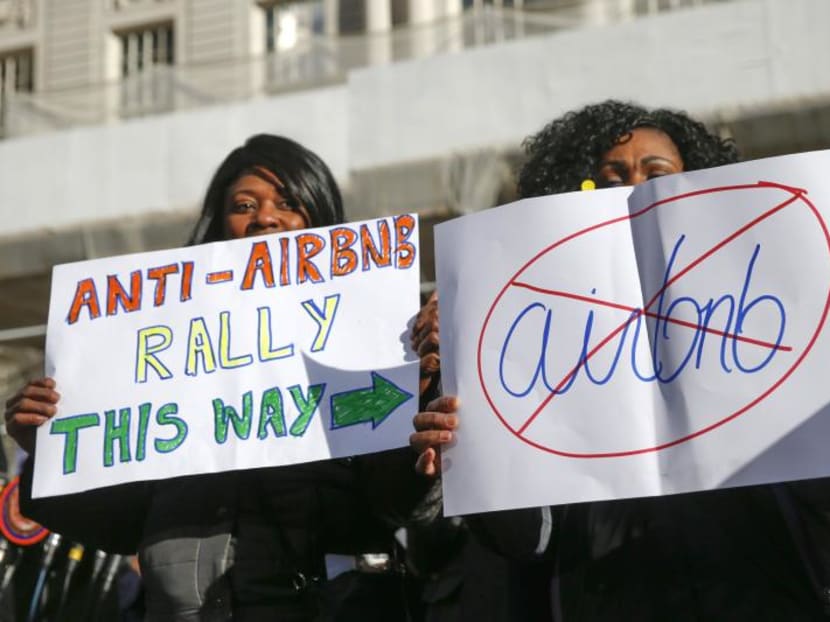
Residents in New York, United States who lobbied against short-term home rentals. A reader here says that the authorities in Singapore are right to impose tough restrictions on home-sharing activities, to protect the interest of the majority of homeowners.

It has been more than five years since the likes of Airbnb and their advocates started campaigning for a light-touch or no regulation of their business activities, and it seems not much has changed (“Lower income Singaporeans can benefit from Airbnb rentals, with a catch”; April 25).
Their objective remains: Gain access to the entire housing stock in Singapore without much thought to the repercussions that their business activities have on participants and non-participants alike.
This is despite purportedly recognising that the market is made up of different players with different needs and goals.
Airbnb's self-serving enterprise and quest to be validated is a big turn-off not just to me, but increasingly so, in Singapore and elsewhere in Japan, for example.
The authorities are right to impose tough restrictions on home-sharing activities, to protect the majority of homeowners who wish to treat their home as a home and not a hotel.
Unfortunately, these measures have proven to be futile, at least based on reports of a fledgling and "informal” or, should I say, "illegal" home-sharing economy abetted by errant companies.
If these companies cannot be trusted to play by the rules, I cannot imagine what would happen if they get their way.
Hotels spend millions every year on human and other resources to take care of their guests in a self-contained space that does not inconvenience others, namely non-participants.
On the other hand, home-sharing companies such as Airbnb outsource responsibilities to their hosts or the estate managers of condominiums, who have to devote resources managing the conflicting interests of hosts and non-hosts.
All these activities will inevitably result in increased maintenance costs and other intangibles such as a loss of privacy and overcrowding at condo facilities, or in some cases, even crime.
Who bears all these costs? More often than not, the home-sharing companies or their hosts are happy to pass the buck as they focus on their profit margins.
And even if they choose to take on some of these liabilities, can they ever cover all the costs such as the loss of privacy at private housing estates?
In the commentary mentioned above, the writer claims that there is no compelling evidence that the vast majority of Singaporean homeowners are opposed to home-sharing.
He mentioned that “formal research attempts commissioned by Airbnb to study what Singaporeans think of home-sharing show that 70 per cent of Singaporeans are in favour of it”.
Perhaps we could get a detailed breakdown of the profiles of these Singaporeans in these studies.
I also urge the authorities to get hold of the full range of data about home-sharers from Airbnb and similar companies.
Do these hosts own the properties that they lease illegally?
How many of these hosts are tenants, owner-occupiers and owner-investors?
These are valid questions for Airbnb to answer squarely in the interest of all, before it continues with its quest to get the authorities to change regulations.
Related topics
home-sharing Property tourists privacyStay in the know. Anytime. Anywhere.

Subscribe to our newsletter for the top features, insights and must reads delivered straight to your inbox.
By clicking subscribe, I agree for my personal data to be used to send me TODAY newsletters, promotional offers and for research and analysis.






