
To raise volunteerism rates, better to understand volunteer motivations and patterns
Ms Grace Fu, Minister for Culture, Community and Youth, said last year that the Government would want to see the national volunteerism rate double from 35 per cent in 2016 to 70 per cent in 2023.
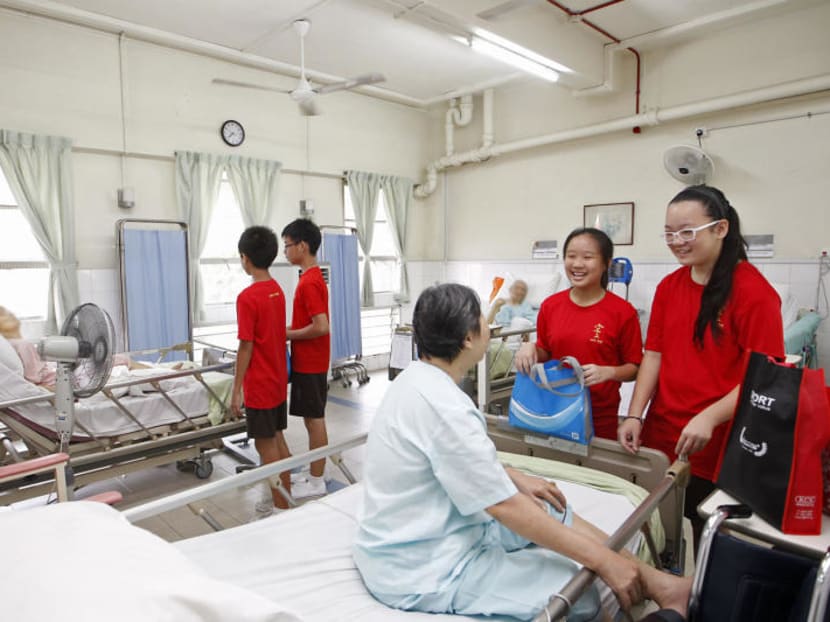
Children visiting patients at Kwong Wai Shiu Hospital as part of their school’s programme. A reader says that the low national volunteerism rate in Singapore is curious in a country where school-based community service is mandated.

Ms Grace Fu, Minister for Culture, Community and Youth, said last year that the Government would want to see the national volunteerism rate double from 35 per cent in 2016 to 70 per cent in 2023.
However, looking at the findings of the Individual Giving Survey by the National Volunteer and Philanthropy Centre (NVPC), it feels like we are taking an unfortunate step backwards.
The study showed that only 29 per cent of Singaporeans volunteer, compared with 35 per cent in 2016 — marking a drop of six percentage points.
What seems to remain limited are our understandings of what motivates volunteers, the changes in volunteer patterns, and especially the explanations for the recent dips in 2014 and 2018, as well as of the actions needed to shift individuals who want to volunteer to actually doing it.
The low national volunteerism rate is even more curious in a country where school-based community service is mandated.
NVPC’s conclusion that small acts of kindness or service — such as returning trays and giving up seats on public transport — is “catalyst to much more significant, sustainable and impactful giving behaviour” is not surprising.
However, volunteerism decisions are likely to be more complex.
In figuring out how to get more Singaporeans to volunteer, apart from knowing demographic and socio-economic factors such as age, religion, and income or wealth, it would be helpful to find out what are other individual reasons that could motivate them, such as one’s past involvement in school, familial relationships, and personal choice of causes or organisations.
Starting with the NVPC study’s observation of the growing trend of former volunteers stopping their involvement, for instance, could offer greater analytic depth.
And given that we appear to have hit a ceiling of national volunteerism in 2012 and 2016 — when the rate was 32 and 35 per cent respectively — individual reasons should be studied with community or even cultural explanations.
In particular, beyond large-scale events that may have mobilised volunteers en masse, the study was not able to account for the subsequent dips in 2014 and 2018.
If we compare those who volunteer with those who do not — especially those who are within the same life stage or age group and, therefore, are more likely to share the same school, work, familial or life commitments — what in their environment could relate to their volunteer intent or involvement?
Changes in life events, priorities or expectations?
Mobilisation through community organisations, places of worship, or even the workplace?
Or just geographical proximity to social service agencies that (potential) volunteers care about?
Unless there is a clearer picture including individual and community traits, most interventions to raise volunteer rates would struggle.
Related topics
volunteer Charity social services Grace FuStay in the know. Anytime. Anywhere.

Subscribe to our newsletter for the top features, insights and must reads delivered straight to your inbox.
By clicking subscribe, I agree for my personal data to be used to send me TODAY newsletters, promotional offers and for research and analysis.