
Mystery over San Francisco crash; engine failure ruled out
SAN FRANCISCO — An Asiana Airlines passenger plane travelling from Seoul crashed while landing on Saturday morning (yesterday morning, Singapore time) at San Francisco International Airport, smashed into pieces and caught fire, killing at least two people and injuring more than 180 others.
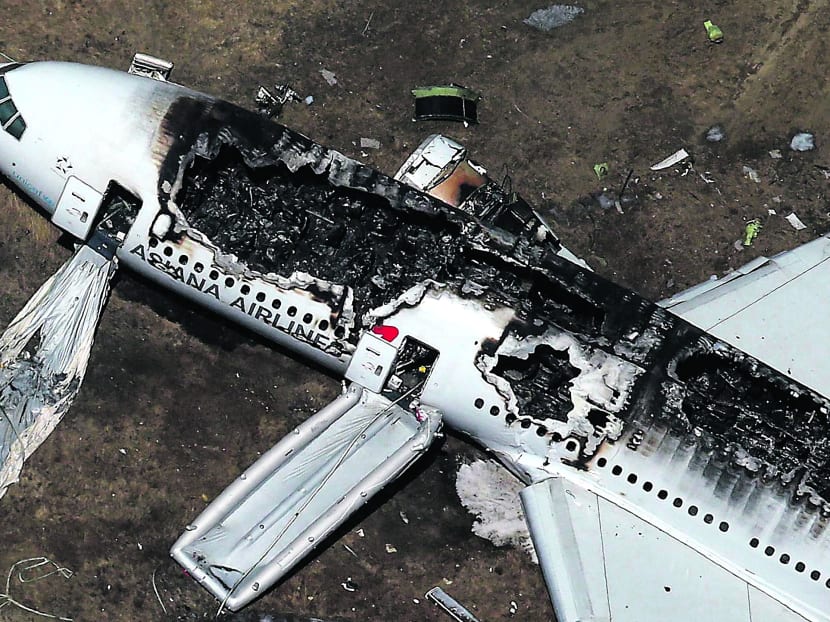
The remains of the Boeing 777 which crashed while landing at San Francisco International Airport yesterday. Photo: Reuters

SAN FRANCISCO — An Asiana Airlines passenger plane travelling from Seoul crashed while landing on Saturday morning (yesterday morning, Singapore time) at San Francisco International Airport, smashed into pieces and caught fire, killing at least two people and injuring more than 180 others.
Smoke billowed out of holes in the fuselage of the Boeing 777 as firefighters rushed to douse the wreckage and passengers scrambled to safety down inflated escape chutes. The plane’s tail, landing gear and one of its engines were ripped off.
“It hit with its tail, spun down the runway, and bounced,” said one witness, Ms Stefanie Turner, 32. Despite incredible damage to the plane, left dismembered and scarred, with large chunks of its body burned away, many of the 307 aboard were able to walk away on their own.
The flight originated in Shanghai, and the two people killed were Chinese women, the South Korean Ministry of Land, Infrastructure and Transport reported early yesterday.
China Central Television later said the two victims were 16-year-old students at Jiangshan Middle School in China’s Zhejiang province. They were identified as Ye Mengyuan and Wang Linjia and were believed to have been seated towards the back of the plane.
At least 70 Chinese students and teachers were on the plane heading to summer camps.
Ms Joanne Hayes-White, the San Francisco fire chief, said 182 people were injured and 123 were unhurt.
At least five people were listed in critical condition at hospitals. Ms Hayes-White said the two bodies were found on the runway and that several passengers were found in San Francisco Bay, where, she said, they may have sought refuge from the fire.
A total of 52 people were treated for burns, fractures and internal injuries at the San Francisco General Hospital, the city’s trauma centre, according to a hospital spokeswoman.
It was not immediately clear what caused the plane, which had been purchased in 2006, to lose control on a clear summer day. The jet’s flight recorders have been recovered and are being examined by investigators.
Officials said a navigation system called Glide Path, which helps pilots make safe descents, was turned off when the plane crashed. The system is meant to help planes land in bad weather and aircraft safety experts said it was not unusual for airports to take such systems offline for maintenance or other reasons.
“For now, we acknowledge that there were no problems caused by the 777-200 plane or (its) engines,” Mr Yoon Young Doo, President of Asiana Airlines, told a media conference yesterday at its headquarters.
The National Transportation Safety Board said it has despatched a team from Washington to investigate and declined to speculate.
However, witnesses said the plane approached the airport at an awkward angle and it appeared that its tail hit before it bounced down the runway. When it stopped, they said, passengers had scant time to escape before a blaze burned through the fuselage.
An aviation official who did not want to be identified said the plane was not making an emergency landing and that the situation had been routine until the crash.
The South Korean Transport Ministry yesterday said four crew members were assigned to the cockpit. It identified Lee Jeong Min, who has worked at Asiana since 1996, as the chief pilot. Co-pilot Lee Kang Guk joined Asiana in 1994 as a pilot trainee and earned his passenger jet pilot’s license in 2001.
Mr Yoon said three of the four pilots had each logged more than 10,000 hours of flight time and that the fourth had logged slightly fewer than that.
This is Asiana’s third fatal crash since it was established in 1988. It said in a statement that it would “cooperate with the related authorities”.
Among the 291 passengers, there were 141 Chinese, 77 South Koreans, 61 Americans, three Canadians, three Indians, one Vietnamese, one Japanese and one French passenger. A crew of 16 was also on board. Agencies
Related topics
Asiana crashStay in the know. Anytime. Anywhere.

Subscribe to our newsletter for the top features, insights and must reads delivered straight to your inbox.
By clicking subscribe, I agree for my personal data to be used to send me TODAY newsletters, promotional offers and for research and analysis.






