
Chinese wave swamps Thailand
BANGKOK — “Do you have a passport?” the patrol police bluntly asks a young Chinese man in his early 20s.
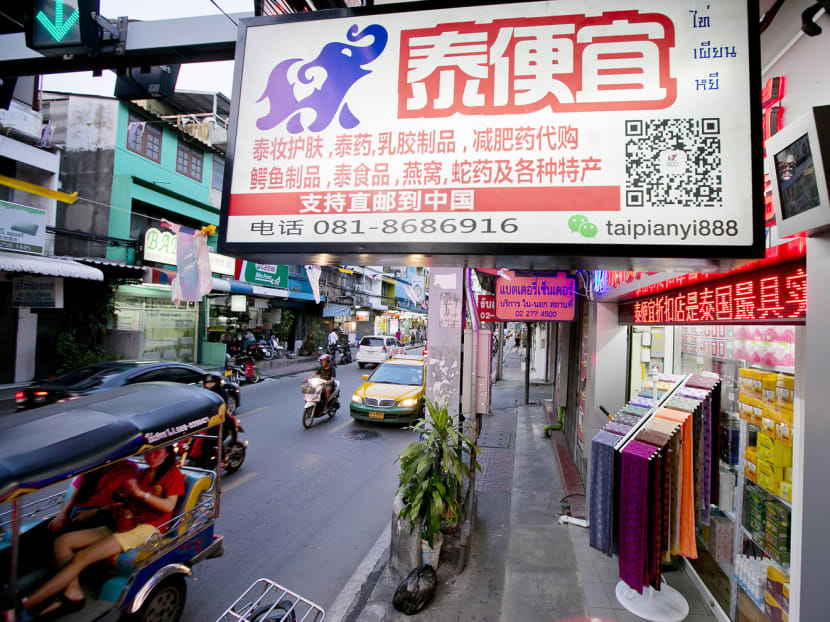
New Chinatowns are forming across Bangkok, including in Huai Khwang where the Chinese Embassy is located. In these communities, Yunnan cuisine restaurants, southern Chinese-style bakeries, Chinese beauty salons and retail shops sprout. Many apartments are also occupied by Chinese. Photo: Bangkok Post

BANGKOK — “Do you have a passport?” the patrol police bluntly asks a young Chinese man in his early 20s.
It is evening, and the confrontation is happening in a small shop on Pracha Rat Bamphen Road in Bangkok’s Huai Khwang district — an area nicknamed the city’s “New China Town”. Beauty products, dry goods and latex mattresses occupy most of the shop space.
The Chinese man, dressed in a green T-shirt and shorts, had entered the shop minutes before the police officers’ arrival.
“I have (a passport),” he answers in broken Thai, smiling.
“Then you show me,” one of the police officers says.
“It’s at my dorm.”
“What are you doing here?”
“Buying things.”
“What’s your job?”
“I don’t work.”
“You don’t work? How do you earn a living? Are you rich, huh?”
The conversation ends in silence, and the police turn to a young woman behind the cashier’s counter. She keeps her mouth shut.
Across the road, lights shine from a busy Chinese restaurant. A waitress serves dumplings and soup to customers. The waitress speaks Mandarin and says she is from Guangxi.
The proliferation of Chinese nationals and Chinese signs in New China Town has become a point of gossip among Bangkok people. Some say the Chinese are taking business opportunities away from Thais and living in isolated clusters, while others argue the new wave of Chinese migrants is bringing both business initiative and opportunity.
But most agree Thai policymakers will have to deal with the challenges the influx is bringing.
THE FOURTH WAVE
New Chinese migrants, or “Xin Yimin”, are considered the fourth wave, having emigrated after Deng Xiaoping launched the country’s economic reforms in 1978, which led to rapid growth and a more market-based economy.
The previous wave — the third — happened from the 1920s to 1940s, when Chinese migration was stopped by the Communist Revolution and the country closed its doors. Many Chinese fled the mainland anyway for a better life in Hong Kong, Singapore, Malaysia, Thailand and elsewhere.
Mr Sakkarin Niyomsilpa, a researcher at Mahidol University’s Institute for Population and Social Research, wrote in his study, The Fourth Wave: South-east Asia and New Chinese Migrants, that they left China seeking “economic opportunity” rather than “economic survival” as previous generations had.
Deng also tried to revive foreign relations under the “good neighbour policy” implemented in South-east Asia for closer political, economic and social ties. As a result, the populations of new Chinese migrants in the region increased significantly after the 1990s as China opened up further and the economy started booming.
South-east Asia now has an estimated two million “new” Chinese migrants. They are different from previous generations, the study says. Their place of origin is more diverse, they are more highly educated, and more are women.
They come for job opportunities, study and investment. While they might spend time in the region, their ultimate destinations are developed countries such as Australia, the United States, the United Kingdom and Europe.
Many Thai-Chinese living in Thailand are descendants of the third wave of Chinese migrants who have assimilated with Thais, such as the Chearavanont family which founded the Charoen Pokphand conglomerate. Their “legend” is of a Chinese voyage of hardship starting with little more than a “sheet and pillowcase”, and ending in wealth.
But while the study found previous generations assimilated into their new countries, the new wave of Chinese migrants are more attached to their homeland.
A separate survey by the Institute of Asian Studies’ Asian Research Centre for Migration at Chulalongkorn University found that many new Chinese migrants bring significant funds to invest in start-ups in Bangkok.
The survey, of 119 Chinese migrants living in Huai Khwang for over a year, found that 68.9 per cent had a bachelor’s degree. For 97.5 per cent, it was the first time they had lived outside China.
About 74.8 per cent came for employment such as white-collar jobs, Chinese-language teachers and tour guides, while 21 per cent came for study and 4.2 per cent to accompany their family.
However, they intend to return to China once they have derived “enough economic benefit”, researchers Supang Chantavanich and Chada Triamvithaya found.
As a result, new Chinatowns are forming across Bangkok, including in Huai Khwang where the Chinese Embassy is located. In these communities, Yunnan-cuisine restaurants, southern-Chinese-style bakeries, Chinese beauty salons and retail shops sprout. Many apartments are also occupied by Chinese.
GO SOUTH, YOUNG MAN
Over the past 30 years, China has been one of the world’s fastest-growing economies with an average annual growth of 10 per cent.
But some Chinese, like Mr Aaron Li, 28, have been sidelined.
Mr Li’s father is a wealthy businessman in south-western Yunnan province, which borders Myanmar, Laos and Vietnam. Mr Li’s low scores in China’s national examinations shut him out of Chinese universities, and he was sent to study in Bangkok 10 years ago.
At Bangkok’s Assumption University, he learned Thai, Japanese and English, and expanded his business connections. He set up a company with a Thai partner to export rubber, silk and other commodities back to China. He has also invested in condominium units, which he says he would not have been able to afford back home.
“If I hadn’t left, I wouldn’t have had all of these opportunities,” he said. “I won’t go back to China. I don’t like the system of doing business there. But I won’t live in Thailand for the rest of my life. If I find (an) opportunity somewhere else, I will move on.”
According to Mr Li, there is too much red tape doing business in China, which involves getting state permission.
China’s economic reforms have left a large gap between those doing well and those struggling at the bottom. Its National Bureau of Statistics reports that the unemployment rate has hovered around 4 per cent for the last five years. But a new report by Fathom Consulting, an independent research organisation, indicates that the jobless rate has tripled to 12.9 per cent from 2012.
Mr Li also believes China’s restrictions on freedom of speech are driving young Chinese out of the country. According to the Asian Research Centre for Migration study, the Chinese choose Thailand because of its affordable cost of living, friendly people and low competition.
SCHOOLED IN THAILAND
The latest generation of Chinese was born into an era of capitalism. They are familiar with digital technology and are highly individualistic, meaning it is more difficult for them to blend in than it was for previous generations.
Shanghai-born Dhu Xiu, 22, a fourth-year communications student majoring in advertising, is one of the younger generation hoping to transit through Thailand to a better life in another country. She plans to apply for a scholarship to study for a master’s degree in Australia, and perhaps get a job there.
“I was not a top student in China,” she said. “Scholarships there are only for the ‘really top’ students. Here, it is much easier and it’s cheap.”
Office of the Higher Education Commission statistics show that the number of Chinese students in Thai tertiary institutions has grown from 4,618 in 2011 to 6,157 in 2015. Over the same period, the number of Thai students has dropped as a result of the low birth rate. Thai private universities have also begun to sign agreements with Chinese institutions to bring in students.
eye on the future
The exact number of new Chinese migrants in Thailand is unclear.
The Department of Employment reported that 18,812 Chinese obtained work permits last year, almost double the 9,618 Chinese in 2011. The Immigration Department put the total number of Chinese nationals residing in Thailand last year at 91,272, however, academic studies have put the figure as high as 350,000-400,000 in the past decade.
The larger role Chinese are playing in the Thai economy is worrying locals. Local media recently focused on a Chinese banana farm in Chiang Rai operated under a Thai nominee.
The farm allegedly pumped a large amount of river water for its banana crops and used heavy chemicals. The bananas were exported to China via Laos.
Chinese visitors are also keeping the tourism sector buoyant. More than 7.9 million Chinese tourists visited last year, up 71 per cent from 2014 despite the slowing Chinese economy.
Tour operators have been forced to respond by hiring translators and providing signage and menus in Chinese. But the influx has also resulted in complaints about “zero-dollar tours” where cheap travel packages are pre-sold to Chinese who spend as little as possible while in Thailand.
China, too, is poised to replace Japan in the long term as the biggest foreign investor in Thailand. In the first quarter of this year, investment pledges from China jumped fivefold to 5.7 billion baht (S$223.3 million) compared with 1.1 billion baht a year earlier, making China the third-largest investor as firms raced to meet a tax-break deadline. However, the figure was still way behind Japan, which pledged 15.6 billion baht.
Chinese companies have emerged as potential investors in major development projects in special economic zones and high-speed rail projects.
As the expatriate Chinese community grows, it is also buying second homes in Thailand.
Mr Bundit Sirithunyhong, who runs the Suttangrak Group, is developing housing projects worth 5 billion baht to sell as time-shares to Chinese buyers.
“I think they are not just investing in real estate, but starting to use Thailand as a base for business in South-east Asia,” he said earlier this year. BANGKOK POST
Stay in the know. Anytime. Anywhere.

Subscribe to our newsletter for the top features, insights and must reads delivered straight to your inbox.
By clicking subscribe, I agree for my personal data to be used to send me TODAY newsletters, promotional offers and for research and analysis.






