
‘Lack of clear policy’ at root of KL worker fiasco
SINGAPORE — A week after Putrajaya’s sudden decision to freeze recruitment of foreign workers in Malaysia, confusion still reigns over how long the ban will be in place as employers scramble to adjust to the latest flip flop in labour policy by the government.
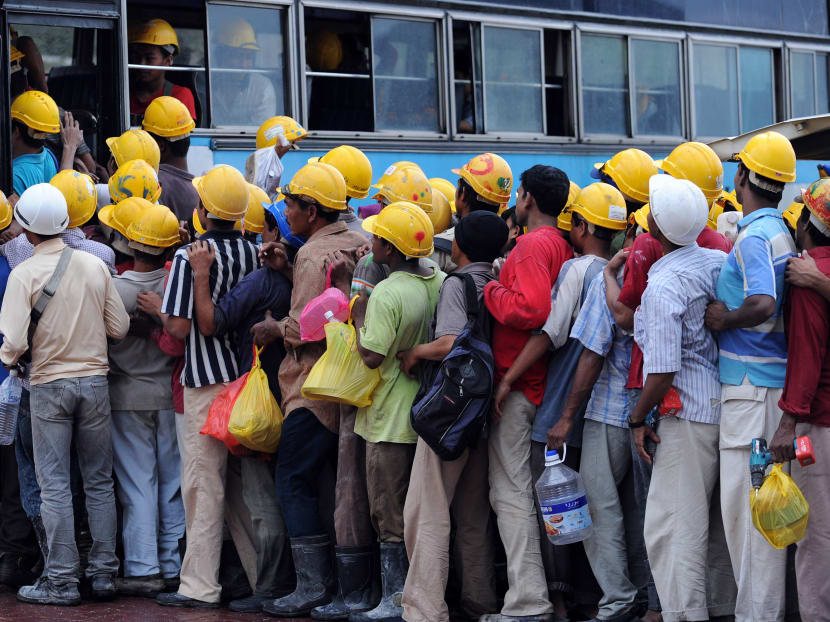
Foreign laborers mainly from Bangladesh board a bus at the end of first shift at a construction site in Kuala Lumpur on March 11, 2009. AFP file photo

SINGAPORE — A week after Putrajaya’s sudden decision to freeze recruitment of foreign workers in Malaysia, confusion still reigns over how long the ban will be in place as employers scramble to adjust to the latest flip flop in labour policy by the government.
What is clear though, according to stakeholders interviewed by TODAY, is that the government’s move underline the lack of a coherent long-term policy on foreign workers. And this, they say, makes Putrajaya prone to political pressure and embarrassing U-turns.
“This clearly shows a lack of clear and consistent long-term policy on foreign workers,” said Ms Aegile Fernandez, the director of Tenaganita, a non-governmental organisation that works towards protecting the rights of women and migrants.
“Malaysia does not have a comprehensive policy, we don’t have clear cut regulations to manage foreign workers. This is the problem that led to this whole mess.”
Putrajaya however, denied it was flip-flopping or succumbing to political pressure. Instead, it was just a “temporary measure to determine the total number of foreign workers needed by industries and to weed out the illegal foreign workers already in the country”, Malaysian Deputy Home Minister Nur Jazlan Mohamed told TODAY.
Nevertheless, critics argue that this is an example of the government succumbing to political pressure, following widespread unhappiness over Putrajaya’s announcement last year to take in 1.5 million workers from Bangladesh.
This after allegations surfaced that individuals close to ruling party United Malays National Organisation (UMNO) were trying to profit from foreign workers intake through ownership of companies to process these workers.
“The government is now under pressure because this issue has fuelled intense debate in the country and within UMNO as well,” said opposition Democratic Action Party (DAP) lawmaker Charles Santiago, who has raised the issue of foreign workers regularly in Parliament.
“This is raising a bit of pressure for the home affairs minister,” he said in referring to Mr Ahmad Zahid Hamidi, whose ministry governs the intake of foreign workers.
An UMNO member from Selangor, Mr Rushdan Mohamed, said the grassroots was unhappy with the government’s initial plan to take in the 1.5 million foreign workers from Bangladesh.
“We have been issuing press statements stating our opposition on the issue. There are already too many foreign workers in Malaysia, including illegals,” he said.
Malaysia already has 2.3 million legal foreign workers, besides the estimated two million illegal foreign workers. They are hired to work in “3D” - dirty, difficult and dangerous - jobs, which are shunned by Malaysians. These migrants, the majority from Indonesia, Bangladesh, Myanmar and Nepal, work in the agricultural, manufacturing and construction sectors.
Last June, Malaysia said it was planning to bring in 1.5 million Bangladeshi workers over three years, a move that did not go down well with people, who argued that instead, the government should register the existing illegal workers so that they can be absorbed into the workforce.
Between then and last week, Putrajaya stood by its plan, despite intense criticisms from various groups.
However, in a surprising turn of events, Malaysian Human Resources Minister Richard Riot clarified last Friday that the 1.5 million figure was merely the number of Bangladesh citizens registered with their government for employment and not all are bound for Malaysia.
Hours after Mr Riot’s explanation, Mr Zahid, who is also the Deputy Prime Minister, announced the freeze on foreign labour recruitment from all countries, including Bangladesh, to reassess the workforce needs. At the same time, a plan called Rehiring Programme for Illegal Workers will run from now until Dec 31 to legalise undocumented foreign workers and fulfil employers’ needs for labour.
In defending the government’s decision, Mr Nur Jazlan said that employers are to blame for their high reliance on migrant labour.
“The ones who flip-flopped are employers. One moment, they say ‘too many, don’t take the Bangladeshis’, and when we announce the freeze, they say they need workers,” he was quoted as saying by The Malaysian Insider.
However, Master Builders Association Malaysia President Matthew Tee told TODAY that there should be a “realistic understanding” of industry needs.
“We are employing foreign workers because even if every local is employed, there will still be demand-supply gap for manpower in the construction industry,” he said, adding that the problem is further compounded by the fact that locals are not keen to work in the construction industry.
Mr Larry Sng Wei Shien however, seemed resigned over the whole episode.
“Further clarification will come in the next few months, so we just have to wait for it. In the meantime, businesses will carry on as normal,” said the banana plantation owner who hires a few hundred foreign workers.
Stay in the know. Anytime. Anywhere.

Subscribe to our newsletter for the top features, insights and must reads delivered straight to your inbox.
By clicking subscribe, I agree for my personal data to be used to send me TODAY newsletters, promotional offers and for research and analysis.






