
Defending indigenous people may have led to activist’s death: PKR
KUALA LUMPUR — The Sarawak chapter of opposition Parti Keadilan Rakyat (PKR) suggested yesterday that the fatal shooting of one of its leaders, native-rights activist Bill Kayong, may be related to his fight to defend the customary rights of the indigenous people.
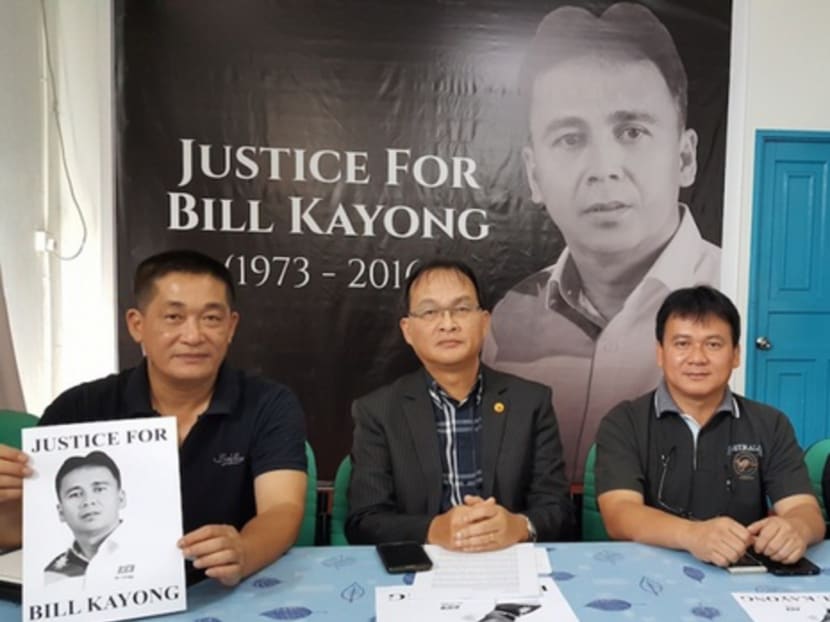
Sarawak PKR chief Baru Bian (centre), with vice-chairmen See Chee How (left) and Ali Biju, in Kuching yesterday. Mr Baru says Bill Kayong was warned not to get involved
in certain cases. Photo: Malay Mail Online

KUALA LUMPUR — The Sarawak chapter of opposition Parti Keadilan Rakyat (PKR) suggested yesterday that the fatal shooting of one of its leaders, native-rights activist Bill Kayong, may be related to his fight to defend the customary rights of the indigenous people.
“Kayong was involved in helping many longhouse residents having disputes over land (encroachment) with plantation and timber companies,” said Sarawak PKR chief Baru Bian.
Kayong, 43, was shot in the neck on Tuesday by an unknown assailant with a shotgun while stopped at a Miri intersection in his white pick-up truck. Kayong had stood for election, unsuccessfully, as a PKR candidate in last month’s Sarawak state election. He was found slumped in his Toyota truck, which still bore the PKR election logo.
He will be buried tomorrow.
His death sent shockwaves through the state, with the Malaysian federal police swiftly forming a special task force to find the killer.
Kayong, a father of two, was well-known for championing issues related to native customary land. As the secretary of Sarawak Dayak Association (Pedas), he had often fought for longhouse residents faced with land encroachment by timber and plantation firms.
Mr Baru claimed yesterday Kayong had received calls warning him not to get involved in cases involving land disputes between the indigenous people and plantation and timber companies.
Urging the Sarawak government to establish a land commission to prevent further violence and loss of life, Mr Baru also expressed concern that Kayong’s murder could be remained unsolved, citing many unresolved assault cases on longhouse chiefs who defend their lands.
The state government, meanwhile, does not want to speculate if the murder was related to Kayong’s work but Deputy Chief Minister James Masing said they wanted those responsible to face justice.
“We want to see concrete results from the police investigation and to see whoever committed this heinous crime brought to justice. We cannot speculate on whether this case is related to politics or land issue since this will be up to the police to find out. But one thing is for sure we do not want this sort of crime in our state,” he was quoted as saying by The Star.
Kayong’s murder has also given the state government impetus to speed up its plan to fence up the border between the state and Indonesian Kalimantan, reported the Borneo Post yesterday.
According to the report, the porous border could have contributed to the rise in firearms-related crimes in the state, a fact acknowledged by Sarawak Deputy Home Affairs Minister Masir Kujat.
Mr Masir said there has been a plan to fence up certain areas along the border, but the state government was forced to put the project on hold due to the current economic slowdown.
“The thing is we can’t implement it now due to the current economic slowdown,” he said. “Still, we hope that we will be able to implement it in the next five years to curb illegal activities, especially the smuggling of goods and human trafficking.”
However, the plan to fence up the border would not be cheap, said Mr Masir.
“It’s going to be costly. That’s why we can’t implement it now. However, the security along the border is not compromised because we have the Border Security Agency comprising the police, army, Customs and Immigration (personnel).
“However, even with the agency manning the border areas, we still need more personnel. On top of that, we need to put up the fences as well,” he added. THE MALAY MAIL ONLINE
Stay in the know. Anytime. Anywhere.

Subscribe to our newsletter for the top features, insights and must reads delivered straight to your inbox.
By clicking subscribe, I agree for my personal data to be used to send me TODAY newsletters, promotional offers and for research and analysis.






