
Stranded Indian elephant dies of heart attack, ending a wretched journey
NEW DELHI – A wild Indian elephant that attracted worldwide attention after being swept hundreds of miles down a flood-swollen river into Bangladesh died on Tuesday (Aug 16) of a heart attack, Bangladeshi officials said.
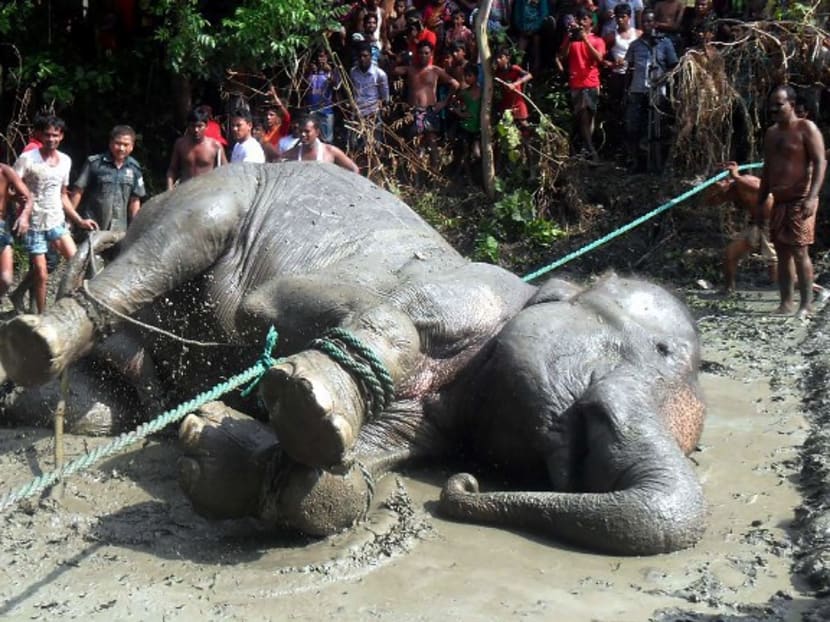
A tranquillised wild elephant on the ground on Aug 11, 2016, after being pulled from a pond in the Jamalpur district, Bangladesh. Photo: AP

NEW DELHI – A wild Indian elephant that attracted worldwide attention after being swept hundreds of miles down a flood-swollen river into Bangladesh died on Tuesday (Aug 16) of a heart attack, Bangladeshi officials said.
The animal's death was brought on by "a long period of stress, heat and humidity", said Dr Mustafizur Rahman, a veterinary surgeon who supervised the treatment of the elephant last week in northern Bangladesh.
The death brought an end to a sad journey.
Caught in the rising waters of the Brahmaputra River in late June, the elephant, a fully grown male, tried repeatedly to climb ashore in India, but villagers drove him back into the water, in some cases pelting him with stones, said Dr K K Sarma, a government veterinary surgeon from India who visited the animal.
"It tried to come up, but it was not allowed to," he said.
Officials said the animal had traveled 900 miles (1,450km).
Scrambling to land in a swampy district of Bangladesh on June 28, the elephant trudged through the marshes in search of food, becoming dehydrated. News crews flocked to the site, and so many curiosity-seekers trailed him through the swamps that the police were deployed to control them, the Press Trust of India reported.
On Thursday, the elephant was tranquilised repeatedly with a dart gun and collapsed, unconscious, into a swamp. Villagers helped haul him onto dry land, and he was bound with ropes and chains. Images from the scene showed the 9-foot (2.7m), 4-tonne animal lying in a field of mud, surrounded by onlookers.
Dr Sarma said he believed the elephant died of heatstroke after two unusually hot and humid days in Bangladesh. He said there was no choice but to chain the animal, lest he destroy the homes or crops of local residents.
"What to do? There was no alternative," Dr Sarma said. "You need to save people and property."
The animal's death was not for lack of attention: Bangladeshi newspapers dubbed the animal "Bangabahadur," which can be loosely translated as "Hero of Bengal," and Indian media had been pressing for the animal to be repatriated.
"Our media created a havoc for us," said Dr Sarma, whose team was sent by the Indian government to advise Bangladesh on how best to handle the elephant. "In Bangladesh, the media was asking us, 'Under what international act have you come to take the elephant to India?'"
His delegation spent three days on site with the elephant before returning to India after Bangladeshi authorities warned that there were security threats in the area.
After he was tranquilised, the elephant was given more than three gallons (11 litres) of saline water intravenously, but he crashed to the ground a second time on Monday, Dr Rahman said. He added that the elephant had dangerously high blood pressure and an imbalance of sodium and potassium in his body.
“It breathed its last at around 7am,” (9am Singapore time) the Bangladesh government’s chief wildlife conservator Ashit Ranjan Paul told AFP.
“We have given our highest effort to save the animal. At least 10 forest rangers, vets and policemen have constantly followed it for the last 48 days. But our luck is bad,” he said.
Forestry officials had hoped to use domestic elephants to guide the elephant to the nearest road, at which point he could have been loaded onto a truck and returned to the hill country of Assam.
“In the end it became too tired by travelling such a great length. It had been separated from its herd for some two months and did not get the nutrients that it needed,” Mr Ranjan said. THE NEW YORK TIMES WITH CONTRIBUTED REPORTING FROM ELLEN BARRY, AFP
Stay in the know. Anytime. Anywhere.

Subscribe to our newsletter for the top features, insights and must reads delivered straight to your inbox.
By clicking subscribe, I agree for my personal data to be used to send me TODAY newsletters, promotional offers and for research and analysis.






