
Foreigners keep business of Myanmar toys alive
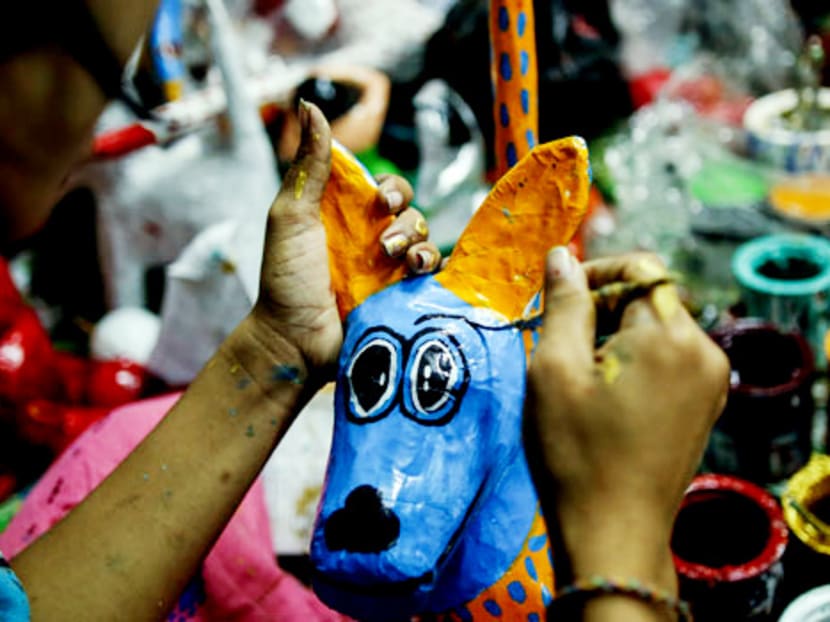
NAYPYIDAW — Where do old toys go when children do not want them any more? That is the question the craftsmen and women who still make hand-painted traditional Myanmar toys from papier-mache formed on carved wooden moulds may be asking themselves. In the shops that line Shwedagon and Yangon’s other pagodas, these traditional artists meticulously work to revitalise a dying craft.
A craftswomen sets a papier-mâché turtle out to dry. Photo: Myanmar Times

NAYPYIDAW — Where do old toys go when children do not want them any more? That is the question the craftsmen and women who still make hand-painted traditional Myanmar toys from papier-mache formed on carved wooden moulds may be asking themselves. In the shops that line Shwedagon and Yangon’s other pagodas, these traditional artists meticulously work to revitalise a dying craft.
Children today prefer Western-style playthings, say parents and craftsmen. Myanmar toys — the pyit taing htaung, phoewa yoke, zee kyut (the tigers, cows, giraffes, lions, elephants and horses), all painted in bright colours with sweet smiles — are becoming hard to find. And in the hands of growing boys and girls, the fragile paper toys do not last long.
The pyit taing htaung come in pairs, one male, one female, with hairstyles to match, and are hard to put down. However you throw them, they always come back up standing. The golden owl toys, the zee kyut, also made in matching pairs, are thought to bring good luck. The phoewa yoke is a happy and healthy young man. All of them take a couple of days to make by traditional methods, including drying in the sun.
Before Pokemon, Lego and Barbie, parents would buy such toys for their children.
Ma Hnin Wai said: “I buy traditional Myanmar toys for my three-year-old daughter from a shop in the stairway at the pagoda. She likes them very much, but the paper toys don’t last long. They’re not easy to find because there aren’t many shops that sell them.”
La Min toymaker Ma Than Than Nu first started making traditional toys seven years ago, after her husband made one for their son.
“First, he would sketch the model and carve the wooden mould. Then, he would coat strips of paper with glue and let them dry in the sun, and then cut them out of the mould. We started making more of them when other parents asked about them.”
But now, it is foreigners who buy these precious playthings — which cost anywhere between 1,000 kyat (S$1.07) and 25,000 kyat depending on the size and design — more than anyone else.
“Foreign children like our toys better than Myanmar children do,” Ms Ma Than Than added.
Mother-of-two Ma Zin Thu said, “I bought traditional Myanmar toys for my son and daughter at Shwedagon Pagoda because those were the toys I played with when I was young. I tell them stories when they play with the toys.”
Shwe Yamin Myanmar Traditional Toyshop owner Ma Aye Aye Thin said: “Traditional toys are always popular, but the number of toymakers has fallen over the past 10 years. A lot of Myanmar children prefer foreign toys these days.” MYANMAR TIMES
Stay in the know. Anytime. Anywhere.

Subscribe to our newsletter for the top features, insights and must reads delivered straight to your inbox.
By clicking subscribe, I agree for my personal data to be used to send me TODAY newsletters, promotional offers and for research and analysis.






