
Future leaders from ASEAN team up to sharpen skills, share insights
SUZUKA (JAPAN) — A group of young South-east Asian professionals demonstrated how to make Vietnamese coffee, carry out the Laotian Baci blessing ceremony and bake Malaysian kueh (cakes) last week in the Japanese automotive city of Suzuka as the local community looked on in interest — a modest biannual affair organised by the International Association of Traffic and Safety Sciences (IATSS) Forum.
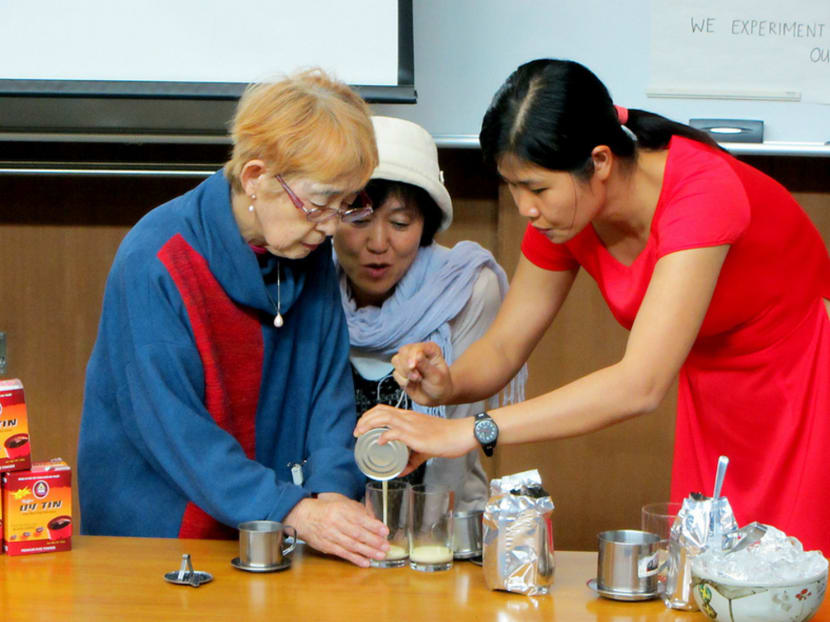
An IATSS Forum participant demonstrates how to make Vietnamese coffee. Photo: Albert Wai

SUZUKA (JAPAN) — A group of young South-east Asian professionals demonstrated how to make Vietnamese coffee, carry out the Laotian Baci blessing ceremony and bake Malaysian kueh (cakes) last week in the Japanese automotive city of Suzuka as the local community looked on in interest — a modest biannual affair organised by the International Association of Traffic and Safety Sciences (IATSS) Forum.
For the past 30 years, the IATSS Forum leadership training programme — the largest international training collaboration initiated by the Japanese private sector — has invested substantially in leadership training for young future leaders from South-east Asia, a reflection of the long history of technical cooperation between Japan and one of its most important trading regions.
More than 900 Association of South-east Asian Nations (ASEAN) professionals have participated in the programme in the last three decades.
The initiative — sponsored by auto giant Honda — began as a corporate social responsibility initiative and projection of Japanese soft power in the region, but growing ASEAN integration in the past few decades has altered the dynamics between the ASEAN participants and their Japanese hosts.
Speaking to TODAY, IATSS Forum general manager Seiji Kurafuji said that over time, it has become apparent that the programme is mutually beneficial for ASEAN and Japan. This is one of the reasons why the programme has continued to be run after 30 years with significant financial commitment from Honda, which spends about S$600,000 every year on the programme.
Mr Kurafuji noted that respect for ASEAN has grown as the programme has helped to connect Honda staff and local communities in central Japan to the broader region. “We in Japan need to learn diversity from ASEAN. We have a big domestic market in Japan and people were asking why we needed to communicate with foreigners.
“But the reality is that Japan has to join the global market. And the IATSS Forum has contributed to our growth and the development of Suzuka local society,” he said.
The leadership training programme was the result of discussions in 1985 between late Honda chairman Soichiro Honda and former Malaysian prime minister Mahathir Mohamad. The latter was keen on leadership training “the Asian way” and hoped to work with Japan. Mr Kurafuji noted that at the same time, Honda, having profited from the growing South-east Asian market since the 1960s, was keen to “return something back to ASEAN and contribute to the region”.
Although the leadership training institute is subsumed under IATSS — Honda’s transport research centre based in Tokyo — it functions with minimal interference from the auto giant. While the programme was initially extended only to Malaysian and Singaporean participants, all ASEAN countries were subsequently invited — with the exception of Brunei, which indicated that it did not require the training.
In the initial years, the focus of the programme was on cultural exchanges between Japan and South-east Asia, but the curriculum has since evolved to encompass more areas, including consensus building, politics, mobility, ageing and environment, among others.
Commenting on the evolution of the curriculum, Mr Kurafuji said: “After our 20th anniversary, we made some changes to the programme. ASEAN’s economy, especially Malaysia and Singapore, has achieved much growth. We have to meet with your (ASEAN) requirements, and make it more useful for the participants.”
SHARING JAPAN’S DEVELOPMENTAL EXPERIENCES
Held biannually, the programme takes place over almost 60 days. Two ASEAN future leaders per country under the age of 35 and with at least two years of full-time working experience, selected through a rigorous selection process, go through an intense curriculum comprising lectures, field trips, seminars and reflections.
The theme of the current 54th IATSS Forum cohort, which began on Sept 19 and will end on Nov 16, is “Sustainable Community Design”.
The participants come from a diverse range of backgrounds and include civil servants, academics, activists and the private sector.
Despite the disparities in background, the group has bonded in the short span of just over a month through communal living, raucous team-building games and field trips. There is a genuine sense of teamwork among the participants, from taking turns to raise the flags of ASEAN countries at the programme office every morning to preparing thank-you speeches for their hosts after the briefings and seminars.
The various learning points of the programme feed into a group presentation — a project proposal based on an area of interest (not limited to challenges faced by Japan but also ASEAN countries) identified by the participants. The programme office also provides seed money (US$2,000, S$2,800) for project implementation after participants return to their home countries.
Many of those in the current cohort interviewed by TODAY say an important component of the programme is Japan’s developmental experience.
Mr Yuri Pratama Widiyana, an Indonesian participant who is also the executive director of Urchindonesia — a trading exchange for aquaculture products — said: “Since I started my organisation, I have always looked up to Japan as a role model for the kind of development we want to achieve.”
Learning points on how to build consensus — an important facet of Japanese corporate and grassroots culture — can also be found throughout the various stages of the programme.
Ms Mariko Senokuchi, a coordinator at the institute, said that the concept of consensus building may not be very familiar to some of the participants who are more used to top-down management. “In Japan, consensus building is very important to every business and community … They (participants) learn the importance of consensus building, how to make everybody happy and motivate everyone. The key is to learn humility and accept other opinions,” she said.
Ms Amador Maybell Mariella Aguilar, a Filipina participant who works as a government research specialist, said the programme had helped her understand the importance of motivating people towards a common goal.
Mr Wu Sihan, a Singaporean participant who is a sales and operations executive in home product manufacturer Haller (Far East), added: “I appreciate the opportunity of coming here to work together with different ASEAN countries and to understand their cultures as well as working styles.”
Regular interaction with young ASEAN professionals has also helped the more than 200 Honda employees in the programme to develop a global business view, as well as the local communities who host the participants, said Mr Kurafuji of the IATSS Forum.
Mr Takuya Kamatani, who works in the IT Service Department in the Honda plant in Suzuka, said he signed up for the programme to improve his English language skills and gain more experience communicating with people from other countries.
Toba, a small city famed for its coastline, women divers and cultured pearls, has hosted the programme participants for the past few years.
The city government hopes that these South-east Asian visitors will help to create more international awareness for the city, as it gears up to be one of the locations in Mie Prefecture that will host the Group of Seven Summit next May.
“It is always a memorable experience when IATSS Forum participants visit Toba. The ASEAN participants bring something valuable here and, at the same time, they also take back what they have seen here to their home countries,” said Deputy Mayor of Toba City Kenichi Kinoshita, adding that the city aims to boost tourist arrivals from currently 23,000 people annually to 80,000 people annually in the next five years.
Albert Wai was invited to cover part of the proceedings for the 54th cohort of the IATSS Forum leadership training programme. (http://www.iatssforum.jp/en/).
Stay in the know. Anytime. Anywhere.

Subscribe to our newsletter for the top features, insights and must reads delivered straight to your inbox.
By clicking subscribe, I agree for my personal data to be used to send me TODAY newsletters, promotional offers and for research and analysis.






