
Golkar chief’s poor leadership prompted switch to Jokowi’s rival: Analysts
JAKARTA — Golkar chairman Aburizal Bakrie’s poor leadership and weak appeal are why he fails to feature in Indonesia’s presidential election and had to make a last-minute surprise switch in support from front-runner Joko “Jokowi” Widodo to his main rival, analysts say.
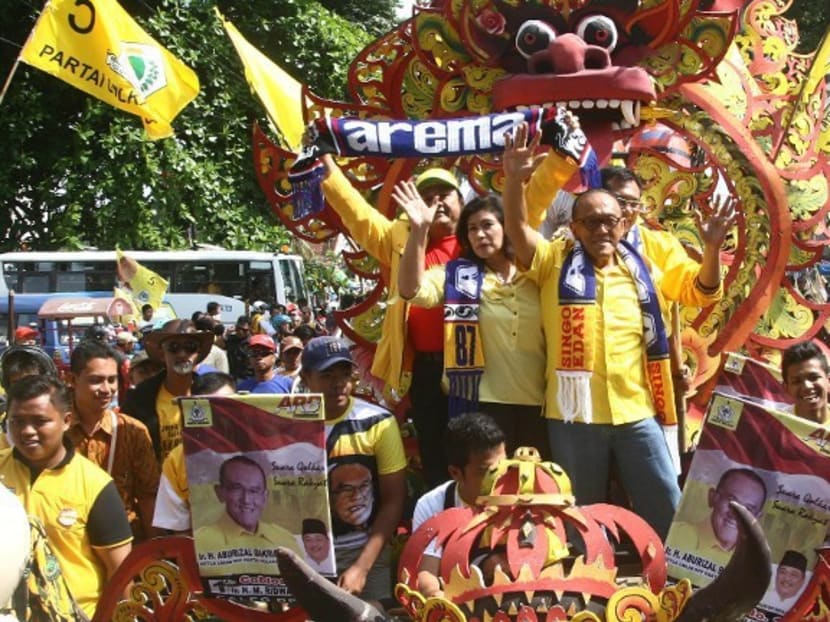
Indonesian presidential candidate and chairman of Golkar party Aburizal Bakrie (right) and his wife Tatty Bakrie (left) wave during a campaign in Malang ahead of elections. Photo: Channel NewsAsia

JAKARTA — Golkar chairman Aburizal Bakrie’s poor leadership and weak appeal are why he fails to feature in Indonesia’s presidential election and had to make a last-minute surprise switch in support from front-runner Joko “Jokowi” Widodo to his main rival, analysts say.
On Monday, Golkar unexpectedly announced that it would back former general Prabowo Subianto’s Gerindra coalition for the July 9 presidential election, only a week after Mr Bakrie suggested that he was throwing his support behind Mr Widodo.
Golkar finished second behind Mr Widodo’s Indonesian Democratic Party of Struggle (PDI-P) in the April 9 parliamentary election. Since then, Mr Bakrie has approached various parties to form alliances with the aim of running for the presidency or vice-presidency.
With no success and the deadline to nominate candidates looming, he decided to join the Gerindra party’s coalition, a move seen as desperate.
Mr Widodo named former Vice-President Jusuf Kalla as his running mate, while Mr Prabowo had earlier announced that his was former Chief Economics Minister Hatta Rajasa. Mr Bakrie, a business tycoon, has consistently trailed behind the two presidential hopefuls in popularity polls, with one survey in March showing him more than 30 percentage points behind Mr Widodo.
Dr Indria Samego, a political scientist from think-tank Habibie Center, said Mr Bakrie was left with no choice but to join Gerindra and leave himself out of the presidential race. “Golkar always looks for the safe bet and still wants to be close to power. Therefore, there was no way it would become an opposition party,” he said.
Analysts blamed Golkar’s failure on a series of bad decisions on Mr Bakrie’s part. “Golkar still has the ego of a big party and made its moves too late,” said political scientist Siti Zuhro from the Indonesian Institute of Sciences.
Mr Bakrie could also have been affected by his company’s alleged link to a mudflow disaster in East Java in 2006, in which 12 villages were submerged and 40,000 people displaced.
Mr Widodo, the favourite to win, is backed by four parties that will have 207 seats, or 37 per cent of the new 560-seat Parliament.
With Golkar’s support, Gerindra is backed by a five-party coalition that will control a combined 292 seats, or 52 per cent of the House.
But the support of Golkar, with 91 seats, is almost certain to be split, given that Mr Widodo’s running mate, Mr Kalla, is a Golkar stalwart and former chairman who is still hugely popular among party supporters.
“This is the one thing that’s splitting Golkar and it’s something that we need to address within the party,” Mr Agung Laksono, a Golkar deputy chairman and Deputy Speaker of the House, told the Jakarta Globe newspaper. Hera Diani
Stay in the know. Anytime. Anywhere.

Subscribe to our newsletter for the top features, insights and must reads delivered straight to your inbox.
By clicking subscribe, I agree for my personal data to be used to send me TODAY newsletters, promotional offers and for research and analysis.






