
How Japan exploits low-paid foreign workers
TOKYO — Ms Tang Xili came to Japan in 2013, hoping to earn enough in three years to build a new home for her daughter. Instead, she ended up in a labour-union shelter, after leaving an employer she says owes her about 3.5 million yen (S$43,000) in unpaid wages.
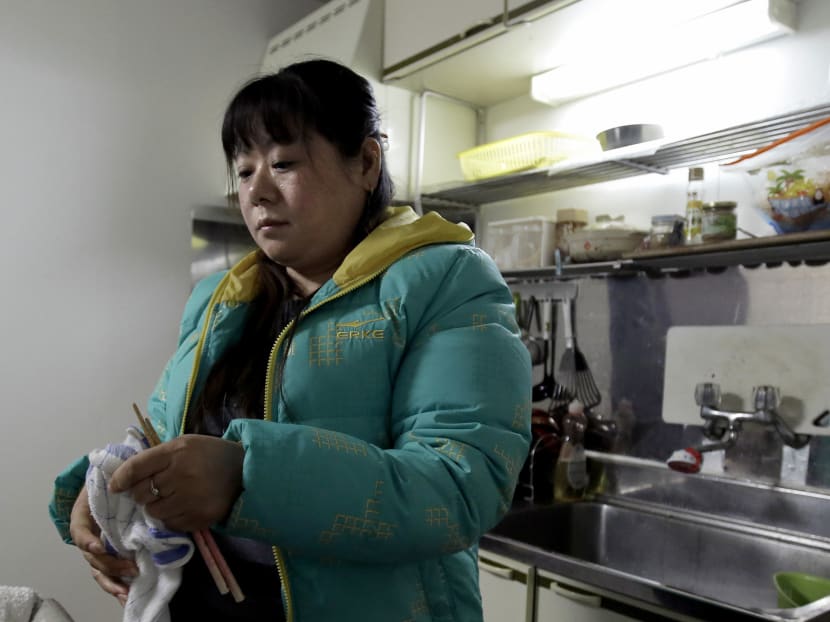
Tang Xili at a shelter for Chinese trainees in Hashima. Photo: Bloomberg

TOKYO — Ms Tang Xili came to Japan in 2013, hoping to earn enough in three years to build a new home for her daughter. Instead, she ended up in a labour-union shelter, after leaving an employer she says owes her about 3.5 million yen (S$43,000) in unpaid wages.
The 35-year-old from Yizheng City in China says she worked long hours, six days a week, was paid less than the minimum-wage rate for her overtime, and couldn’t change her employer because of the terms of her visa.
“I really regret coming to Japan,” she said at the shelter in Hashima, Gifu Prefecture in central Japan, where she is staying in an effort to get her back wages. “I won’t recommend that my friends come here to suffer.”
Ms Tang is among more than 180,000 foreign workers in Japan who gained employment permits as part of a government programme to train people from developing nations with skills they could use back home. Instead, the plan became a way for some Japanese companies to circumvent the nation’s strict foreign-labour rules and gain a supply of cheap workers, according to government documents and interviews with officials, employers and staff.
Ms Tang’s former employer, Takara Seni, is a textile-maker in Kagawa Prefecture in southern Japan. Managing director Yoshihiro Masago declined to discuss Ms Tang’s position, but said his company needs the overseas workers.
“We can’t make it with Japanese alone,” he said in a phone interview. “We can’t fill openings when we advertise them.”
Mr Masago wants Prime Minister Shinzo Abe to create a proper immigration program for foreign workers to do low-paid and semi-skilled work. Mr Abe, who just lost his economy minister over a graft scandal and is struggling to lift inflation from near zero, is unlikely to tackle that task.
“Abe’s administration isn’t pursuing an immigration policy,” said Mr Kazuteru Tagaya, professor of law at Dokkyo University in Saitama Prefecture who chaired a panel of experts to overhaul the so-called Technical Intern Training Programme. “It’s a taboo because of the premise that Japan is racially homogeneous. A majority of the general public won’t accept it.”
EXTENDED PROGRAMME
Instead, to counter Japan’s shrinking workforce and high wages, Mr Abe’s administration plans to extend the intern system, a back door into the country’s labour market that has seen increasing accusations of abuse. A bill in parliament aims to extend the programme to five years from three and create a new watchdog to prevent exploitation of trainees.
The bill would require domestic agencies to obtain a permit, while the watchdog would review training plans for interns, keep track of companies using the program, and investigate potential abuses. The bill also aims to define what constitutes “human rights violations against trainees” and decide on penalties for such violations as well as helping interns with consultation and information.
Mr Tagaya, 67, is concerned that, without proper oversight, an expanded programme would lead to continued abuses that include some companies paying agencies to supply workers and in effect deducting the costs from the workers’ wages. “We can no longer let it go rampant when it’s being used for what appears to be human trafficking,” he said.
Some workers in the program “experience conditions of forced labour,” the US Department of State said in its July 2015 Trafficking in Persons Report, which covers countries around the world. Japan has never identified a victim, “despite substantial evidence of trafficking indicators, including debt bondage, passport confiscation, and confinement,” the report said.
The US report said some interns “pay up to US$10,000 for jobs and are employed under contracts that mandate forfeiture of the equivalent of thousands of dollars if workers try to leave.” There were reports of excessive fees, deposits, and “punishment” contracts, the State Department said.
The United Nations Office on Drugs and Crime says human trafficking is the acquisition of people by improper means such as force, fraud or deception, with the aim of exploiting them, while the UN says forced labour can involve “migrants trapped in debt bondage”.
Documents from Japan’s Labour Ministry, Justice Ministry and the government panel appointed to examine the program, cite cases of companies paying less than the minimum wage, demanding deposits from workers and confiscating passports and mobile phones.
“Current regulations don’t work,” Mr Tagaya said. “We have to tighten the legal framework.”
The number of interns has grown about 20 per cent in the 2 1/2 years through June 2015, according to the Ministry of Justice.
“The reality is, a lot of those who come for training work under poor labour conditions rather than as real trainees,” Mr Shigeru Ishiba, Japan’s minister of regional revitalisation, said in an interview on Jan 25. “Before you talk about immigration policy, you first need to correct their treatment.”
The programme, started in 1993, recruits trainees for 72 occupations in areas such as agriculture, fishing, construction, food processing and textiles. They erect scaffolding, stuff sausages and make cardboard boxes, among much else. In most cases, agencies in Japan and abroad match workers with companies. As of January 2015, 31,320 companies used the program, according to the Ministry of Justice.
Ms Tang said she paid a recruiting agency in China more than 30,000 yuan to find a place for her after it promised she would come home with savings of 5 million yen. She left her daughter, now 9, behind and joined some 30 Chinese trainees at Takara Seni.
On weekdays, they worked from 7am to 8.35pm with an hour break, Ms Tang said. Hourly pay was 700 yen for nine hours of the day during the week — around the minimum-wage rate — with overtime and Saturdays paid at 400 yen an hour, she said. In a dormitory with up to five to a room, workers had the chance to earn extra money doing piecework, sewing buttons and cleaning lint, sometimes till 2am, she said.
LONG HOURS
Ms Tang said she was earning about 140,000 yen a month after her employer subtracted rent, utilities, benefits and Internet service. While that’s twice what she got in her hometown of Yizheng, it was also double the work hours. She said her boss banned her and colleagues from having a mobile phone and held their bankbooks when they visited home, preventing them from gaining access to their money.
Mr Masago, the managing director, said it’s getting harder to recruit Chinese workers with the minimum wage, but it’s difficult to raise wages because of competition from cheap imported garments.
“They should be allowed to come as unskilled workers” as part of a proper immigration programme, he said. “They come 100 percent for money. Japan lacks people. That’s the only mutual interest.”
Japan’s labour ministry investigated 3,918 companies with trainees and found 76 per cent of them broke labour rules in 2014. Violations included an hourly pay of 310 yen per hour — less than half the national average minimum wage — 120 overtime hours in a month, compared with 45 allowed under the law, and the use of unsafe machinery. It didn’t identify the companies.
In 2014, the Ministry of Justice banned 241 agencies and companies from accepting trainees for up to five years for violations.
INSPECTION WARNING
The Japan International Training Cooperation Organisation, which is partly funded by membership fees from recruiting agencies, often warns employers before inspecting them and has no authority to punish violations, according to Mr Akira Oike, a manager in the organisation’s planning and coordination division. He declined to comment on abuse or exploitation of trainees.
With tales of hardship from former interns and rising wages in China, the number of Chinese trainees has fallen 14 percent to 96,120 during the two and a half years to June 2015, according to the Ministry of Justice.
In Beijing, average monthly pay was 6,463 yuan in 2014, compared with about 124,800 yen a month for an eight-hour day in Japan at the national average minimum wage. The yen’s 21 per cent plunge versus the yuan since Abe took office in late 2012 has cut the value of wages in Japan when repatriated to China.
That has led some Japanese employers to seek recruits in Vietnam, the Philippines and Indonesia.
TSS Co, a maker of industrial machinery, accepted six trainees from Vietnam last year for the first time. It employs eight Chinese women with its group firm Toyama Seikensha Co, according to Mr Nobuyuki Arakawa, manager at TSS. They work on production lines in Toyama Prefecture in central Japan.
The two companies follow the rules and spend about 200,000 yen a month per trainee to cover base salary, overtime and agency fees, he said, adding that it’s hard to promote interns because they will only be with the company until their three-year visa expires.
“We want to invest in people who are committed to stay medium-to-long term,” Mr Arakawa, 35, said. “If they stay only for three years, we can’t make that investment.”
CAN’T CHANGE
While the proposed changes may extend that to five years, they won’t allow trainees to change jobs freely.
“It’s telling these people to shut up and work even if they get paid 300 yen an hour, even if they are sexually harassed,” said Mr Shoichi Ibusuki, a Tokyo-based lawyer who supports troubled trainees. He said many can’t leave because they borrowed money to pay agency fees to get the job. “If they can’t recover at least their initial investment, all they have will be debt.”
Even so, many flee. In 2014, 4,847 trainees went missing — almost two thirds of them Chinese — and the 2015 total is expected to increase, according to the Ministry of Justice.
In January, Ms Tang and eight other Chinese workers were staying in the shelter in a run-down part of Hashima, which calls itself “Textile Town”. Mr Zhang Wenkun, 36, had been there for months. He worked at Nobe Kogyo, a construction-waste recycling firm in Tochigi Prefecture, north of Tokyo, and had his hand injured by a wood grinder. He said he received insurance payments while he was off work for three months recovering. But when he returned to work his hand began to hurt again and the company threw out his belongings and told him to quit, he said.
“The programme is a big failure,” Mr Zhang said, showing his scarred wrist. “It’s dead and meaningless.”
Three of his former colleagues went missing from their jobs, said Mr Zhang, who used to work in Dalian, China. One of them, Mr Lin Xijun said he fled because his Japanese colleagues bullied him. He held temporary jobs hiding his identity in Japan, before making his way back to China, almost broke. He paid more than 60,000 yuan to an agency to come to Japan.
“They ruined my dream,” he said by phone from Wafangdian, a suburb of Dalian. “Reality turned out to be much more cruel.”
Nobe Kogyo, the company Mr Zhang worked for, declined an interview request and wouldn’t comment on the accusations.
Mr Motohiro Onda, who works for the labour standards bureau at the labour ministry, wouldn’t say whether there was an investigation into Takara Seni or Nobe Kogyo, because the bureau doesn’t disclose information about individual cases.
Industry in Hashima, the town where Tang is staying at the shelter, has been hollowed out as overseas competition caused mills to shut down. If it is going to survive, Japan needs to change its attitude toward foreign workers, said Mr Satoshi Matsui, Hashima’s mayor.
“We need to have people willing to work hard with us in the global society,” Mr Matsui, 64, said. “We need to make our community a place where those people can live with us, rather than huddling in their own group.” BLOOMBERG
Stay in the know. Anytime. Anywhere.

Subscribe to our newsletter for the top features, insights and must reads delivered straight to your inbox.
By clicking subscribe, I agree for my personal data to be used to send me TODAY newsletters, promotional offers and for research and analysis.






