
Indonesia’s anti-graft agency urged to intensify efforts, despite success
JAKARTA — With a record of putting corrupt high-ranking officials and well-connected politicians behind bars, the Corruption Eradication Commission has become Indonesia’s last bastion in the fight against graft, but activists have said there is a long road ahead before corruption can truly be eradicated from the country.
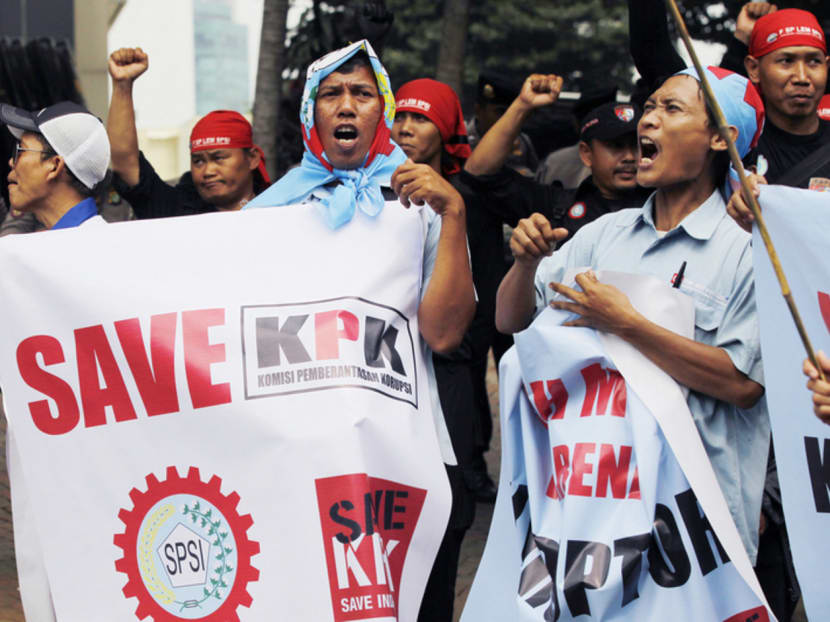
Supporters of the Corruption Eradication Commission at a rally in 2012. The KPK was established 11 years ago to handle high-profile graft cases, but has encountered many challenges. Photo: Reuters

JAKARTA — With a record of putting corrupt high-ranking officials and well-connected politicians behind bars, the Corruption Eradication Commission has become Indonesia’s last bastion in the fight against graft, but activists have said there is a long road ahead before corruption can truly be eradicated from the country.
The commission, known as the KPK, was established 11 years ago as an ad hoc body tasked specifically with handling high-profile graft cases, taking such cases away from the police and the Attorney-General’s Office, which have long been considered more corrupt than the institutions and people they investigate.
In its early days, the KPK was met with scepticism over whether it could truly do its job or would be like the many toothless bodies the government had created since the fall of the dictator Suharto in 1998 after a 32-year rule marked by deeply entrenched corruption and oppression.
After six months operating with only a handful of investigators and limited resources and without even its own office — at the time the KPK shared it with the State Secretariat — the KPK worked on its first case: The 12.5 billion rupiah (S$1.33 million) in suspected kickbacks in the purchase of helicopters by the Aceh administration under then Governor Abdullah Puteh.
He was later convicted of taking bribes and sentenced to 10 years in jail.
That was the first of hundreds of convictions, ranging from crooked politicians, governors, district heads, mayors, state firm bosses and party leaders, to judges, police generals, prosecutors and former ministers.
The KPK has survived attempts to undermine it, ranging from bogus criminal charges against two of its former deputy chairmen to efforts by the House of Representatives to limit its authority and veto plans for its expansion.
Mr Emerson Yuntho, a deputy coordinator of the country’s most prominent non-governmental anti-graft advocacy group, Indonesia Corruption Watch (ICW), said the KPK today was as powerful as ever, growing more efficient in its investigations and fearlessly probing some of Indonesia’s most powerful individuals.
“The KPK must remain a threat to all corruptors and their associates,” he said, adding that the KPK had now another weapon in its arsenal: The anti-money-laundering law.
The ICW noted that the KPK managed to recover 249 trillion rupiah in state losses from all the corruption cases it has handled to date.
While the KPK has succeeded in its enforcement efforts, with all those it has indicted eventually going to jail, its corruption-prevention role has been found wanting, said Indonesia Legal Roundtable researcher Erwin Natosmal Oemar.
Mr Erwin said the many corruption cases the KPK had handled should have prompted reform within the various ministries and institutions it had investigated. “However, this is not the KPK’s responsibility alone, because (reform efforts) are greatly linked to the executives’ own institutional politics,” he said.
But with the rise of the reform-minded Mr Joko “Jokowi” Widodo as the country’s President, some say the KPK should seize the moment to push the government to create a more transparent and accountable bureaucracy. “In the future, the KPK must increase prevention efforts compared with its enforcement efforts,” Mr Erwin said.
The KPK’s prevention programmes have focused mainly on education, including holding seminars on transparency and accountability for public officials and creating an anti-corruption curriculum for students.
“There needs to be more systematic and measurable efforts by the KPK in performing its corruption-prevention function,” said Mr Ahmad Basarah, a politician from the Indonesian Democratic Party of Struggle (PDI-P) — the party with the most members indicted and convicted by the KPK.
The failures of these prevention programmes have caused prevalent corruption, Mr Ahmad said, pointing to Indonesia’s marginally increased ranking on the annual corruption perception index released by Transparency International.
Indonesia ranked 133rd of the 146 countries surveyed in 2004, a year after the KPK’s founding, scoring 2.0 on a 10-point scale, with 10 being the cleanest. This year, it is 105th of 175, with a score of 3.4.
Mr Miko Susanto Ginting, a researcher from the Indonesian Centre for Law and Policy Studies, said the KPK should focus on strategic cases or those involving or implicating a multitude of sectors, such as the judiciary, tax office, natural resources and land management.
He said it should also get other law enforcement agencies involved.
KPK chairman Abraham Samad agreed that there was “much homework the KPK must finish in the future”, but added that the government, the House and other agencies must show the same commitment to fighting corruption.
“We need a strategy that involves all stakeholders because corruption eradication is a collective effort,” he said. “We will dedicate all of the KPK’s resources to stopping public officials from abusing their authority over the welfare of the people.”
Stay in the know. Anytime. Anywhere.

Subscribe to our newsletter for the top features, insights and must reads delivered straight to your inbox.
By clicking subscribe, I agree for my personal data to be used to send me TODAY newsletters, promotional offers and for research and analysis.






