
Japan tries to revive carpentry by luring grads
TOKYO — Heisei Corporation, a small construction company in Shizuoka Prefecture, central Japan, has a pool of 220 carpenters, many with graduate degrees from the country’s top schools, such as the University of Tokyo.
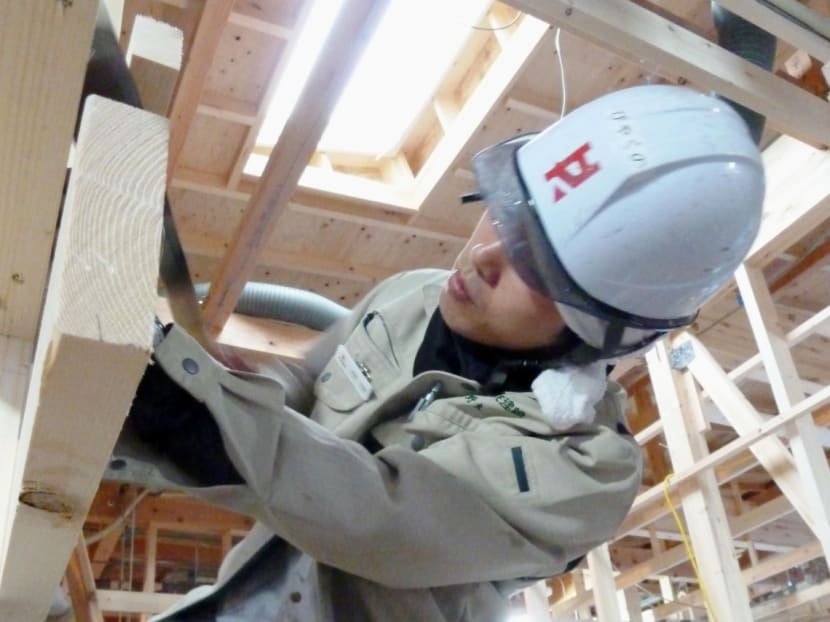
Taiyo Byakuno, a carpenter at Heisei Corporation, works on a construction site at Mishima, Shizuoka Prefecture. Photo: Kyodo

TOKYO — Heisei Corporation, a small construction company in Shizuoka Prefecture, central Japan, has a pool of 220 carpenters, many with graduate degrees from the country’s top schools, such as the University of Tokyo.
The company is a bright spot in the world of Japanese carpentry, where wages are generally low, the work can resemble an assembly line, and the workers are greying. The goal, said Mr Hisao Akimoto, the company’s 68-year-old president, is to bring back the master carpenter of yore, who can do everything from design to execution.
“Carpentry may well be called an endangered species,” Mr Akimoto told Kyodo News in an interview. “In one way or another, I just wanted to restore dignity to carpenters,’’ he said.
Heisei, based in the city of Numazu, had a turnover of around ¥1.5 billion (S$18.8 million) in fiscal 2015. Its projects range from wooden houses to 10-storey reinforced concrete buildings for apartments in the greater Tokyo area. It has 575 people on its payroll, including the 220 carpenters. Ultimately, Heisei plans to build a pool of 1,000 highly skilled carpenters.
“I wanted to lay down arrangements and build a company to prevent such professionals from becoming extinct from this world,” said Mr Akimoto.
The number of carpenters in Japan dropped to 400,000 in 2010 from roughly one million in the 1980s. They are projected to shrink further to 210,000 in 2020, when Japan hosts the Tokyo Olympics and Paralympics, a national event generating construction demand. Many are thought to be in their 50s.
Mr Akimoto’s father was a master overseeing around 30 carpenters at his shop, which eventually went bankrupt.
“Carpenters used to enjoy a solid reputation,” he said. “A master carpenter himself was engaged in designing, building, and the training of apprentices.”
But the profession lost its appeal when construction work became increasingly compartmentalised, and carpenters are assigned to assemble parts. “They sometimes don’t know what they are working on is used for. Besides, it is low-paying work.”
Mr Akimoto, a weightlifting enthusiast who once aspired to be an Olympic athlete, was a salesman with a home-building company before setting up Heisei in 1989.
“I took the trouble of going to numerous job-offer meetings by businesses in Tokyo, Osaka and Nagoya just to speak about what makes carpentry fascinating,” Mr Akimoto said.
In addition to such job promotion efforts, he also decided to offer salaries to new recruits matching those of major general contractors and to pay semi-annual bonuses. “Then, students themselves started coming to Heisei Corporation,” he said.
One of those postgraduate carpenters is Mr Taiyo Byakuno, who joined in April 2014 after finishing a postgraduate programme in architecture at Waseda University.
“I took up carpentry because I wanted to build stylish homes,” the 28-year-old said at a Heisei construction site in Mishima, Shizuoka Prefecture, where a set of pillars had just been assembled on a rainy day in December.
“I wanted to feel what it was like to build something by using my own hands on a site,” said Mr Byakuno, who was among the seven working on a two-storey home.
Mr Byakuno said he does not have the experience of working with nails or chisels, and learned how to use them in a training programme on a building site.
“I recently passed an exam for first-class architect,” he said of the premier certification by the Japan Federation of Architects and Building Engineers Associations. “In the future, I want to engage in comprehensive home building covering design to site work.”
Mr Kosuke Naito, 28, is also a first-class architect who joined Heisei in 2012 after completing a programme in architecture at the University of Tokyo’s graduate school.
After a stint in carpentry for two years and nine months, he now serves as a site supervisor. “When I was just thinking in my student days about what I would do in the future, I saw a Heisei carpenter who graduated from Kyoto University on a TV programme,” he said. “It grabbed my attention and I just joined the company without thinking too much.”
Ms Hanae Kawakami, 28, completed studies in architecture at Tokyo University of the Arts’ graduate school and joined Heisei three years ago. Certified as a first-class architect, she also did her share of carpentry work before being assigned to designing in September last year.
“In my student days, design was a world made up of only lines,” she said. “What is fascinating about my current work is this sense of experiencing a narrowing distance between lines on a drawing and what is actually being built.”
Mr Akimoto is a believer in general education. “It’s necessary to have a cultured mind to come up with quality buildings that incorporate customer needs,” he said.
Heisei’s entrance exam challenges prospective employees in general knowledge ranging from politics, economics, law and real estate. The company also conducts a test to see if applicants have the physical strength and reflexes necessary in its business operations.
Finally, they are tested on their grasp of carpentry terminology. KYODO
Stay in the know. Anytime. Anywhere.

Subscribe to our newsletter for the top features, insights and must reads delivered straight to your inbox.
By clicking subscribe, I agree for my personal data to be used to send me TODAY newsletters, promotional offers and for research and analysis.






