
Low-income Thais priced out of prosperity
BANGKOK — Shortly after the bell sounds, the open-air canteen of the garment factory on the outskirts of Maha Sarakham town starts to fill up. The workers get in line as they chat and eye cheap eats, welcoming a moment of midday rest after working for four long hours in the morning.
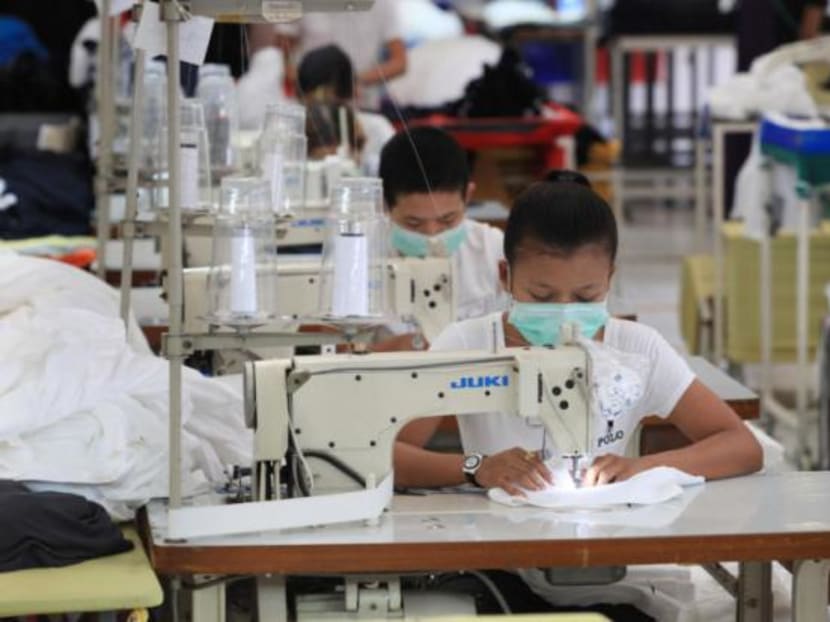
Workers in a garment factory in Mae Sot, Tak. Photo: Bangkok Post

BANGKOK — Shortly after the bell sounds, the open-air canteen of the garment factory on the outskirts of Maha Sarakham town starts to fill up. The workers get in line as they chat and eye cheap eats, welcoming a moment of midday rest after working for four long hours in the morning.
Thirty minutes is as much as Ms Lek Jittra, a 30-year-old factory worker, can manage for her lunch break.
“I don’t have time to go around doing other things during the day,” she says, munching down her food. “It’s not an easy job, not an easy life. But I no longer question my fortune. I will work in factories for my whole life.”
Her eyes never stray for too long from the canteen clock. Twice, she asks her friend seated next to her what time it is. The afternoon shift will start soon, followed by three hours of overtime. This means she’ll be out of work by 8pm.
Ms Jittra will need all her focus — she and the 57 workers in the garment-cutting department have a daily target to meet. They must spread and cut around 20,000m of fabric in length that will make 30,000 sport shirts for an international brand.
If she hits the daily target, she gets double the payment of the regular daily wage.
Failure to do so means earning only 305 baht (S$12.50) a day, a rate that barely allows Ms Jittra to cover all her expenses, from feeding her elderly mother and two children, and ticking off her long list of household expenses as well as her kids’ education and car maintenance.
On New Year’s Day of 2013, former prime minister Yingluck Shinawatra’s cabinet launched the “300-baht minimum wage policy” across Thailand, marking a historically high daily wage hike, with around 30 per cent to 80 per cent of wages rising across several provinces.
For nearly two decades before the hike, the wage rate was either frozen or even lowered at some points — this in spite of the steady rise of living costs seen across the country.
Ms Yingluck’s wage policy stirred a conversation about the truth of how workers’ low wages can easily expose them to poverty, while wealthy employers profit off their cheap labour.
But since the wage hike of four years ago, life has improved very little for many workers.
This is in part attributable to the global economic slowdown, which has seen Thailand’s exports plummet. Labour wages have barely budged, with only five baht added to Ms Jittra’s daily wage over the past four years. Meanwhile, household debt has risen to a 10-year high.
But the country GDP is still increasing, even with a flat rate of 3.2 per cent last year. Government representatives speak of “successful growth” in spite of its lack of translation on the ground.
“Economic digits look very positive from how the top (government leaders) view it,” says a snack vendor who only wanted to be known as Mr Piboon.
The 45-year-old business have declined in recent years.
“But it’s actually getting worse for workers at the bottom of the production chain. I’m not sure if people at the top can see what’s really happening down here.”
The only way workers can secure a sufficient income is through hitting daily targets, doing overtime and minimising expenses. Some female workers are reportedly suffering from cystitis, a form of bladder inflammation, from holding in urine to avoid disrupting productivity.
When calculating the time spent not only working but commuting from home to the factory, Ms Jittra estimates that she spends an average of 14 hours working every day.
She has never worn a piece of clothing she has made herself. They cost nearly half of her monthly income.
The gap between the rich and poor continues to widen in Thailand in its quest to rebuild the economy, once the high-achieving Asian tiger.
HITTING THE LIMIT
“There’s no need to tell you what (Thailand’s) GDP growth digits will be,” said Mr Somkid Jatusripitak, a former economist, speaking at the opening ceremony of Digital Thailand Big Bang, a digital and technology exhibition, on Sept 22. “It will certainly improve. We must be confident. There is nothing to fear any more.”
His statement follows a reported 13.2 per cent export growth recorded in August, here compared to the same period last year. This marks the highest export growth rate over the last four years. These years have been tough on Thai exporters as the export growth rate has remained stuck between 0.7 per cent and 2.1 per cent from 2015 to last year.
Equality is also worsening in Thailand. Last year’s Global Wealth Report ranked Thailand as the world’s third most unequal country after Russia and India.
A total 58 per cent of Thailand’s wealth is controlled by one per cent of its people.
In a report released by Oxfam Thailand early this year, 10 per cent of the country’s richest people were found to earn 35 times more than 10 per cent of society’s poorest people.
On Oct 2, in a step towards closing this gap, the government of Prime Minister Prayut Chan-o-cha launched the welfare card scheme for 11.7 million low-income earners. With the card, they can get free bus and train rides, and purchase basic goods between 200 and 300 baht per month.
But the plan has been criticised for failing to disclose a more long-term solution to address the country’s inequality, while overlooking the fact that the wealth gap is caused by broader economic structures that do not distribute inclusive growth.
According to the World Bank’s 2015 figure, around 68.93 per cent of the Thai GDP depends on the export of goods and services.
A high level of dependency on exports puts Thailand at risk in the global economy. The Thai economy never did recover from the 1997 financial crisis, debilitated by not only faltering growth but a political climate marked by instability.
Mr Somkid’s economics strategy team are attempting to tackle the issue by shifting the economic structure away from weak industrialisation towards digital innovation.
The government’s new economic vision, referred to as Thailand 4.0, is focused on developing the country’s capability as a digital innovator to drive it out of the middle-income trap. Heavy technological investment in the robotics and aviation industries, as well as mega infrastructure projects, have been strongly promoted under this new plan.
But industralisation relies on cheap labour.
Several wealthy companies still depend on cheap labour in the export sector. Profits tend to go largely towards company heads, while low-paid workers risked remaining in poverty.
According to a 2015 figure of the National Statistic Office, more than 3.7 million people who are working in the manufacturing sector receive a minimum wage rate.
“Labour is perceived in terms of production factors rather than human being terms,” says Ms Cholnapa Anukul, research manager for Just Society Network. “So they must come with a cheap cost.
“When labourers have to work overtime every day to earn enough to live, they lose the chance to improve their skills and capacity, and miss many opportunities in life. This is why the competitive capacity of Thailand is low. We only focus on keeping production factors cheap rather than getting into real competition.”
Despite the promise of the new plan, Ms Cholnapa says that large companies’ preference for cheap labour will not go away any time soon.
MINDING THE GAP
Ms Boa Chantana, a 28-year-old low-paid factory worker from Maha Sarakham province, is like many of her peers. She wears a face full of make-up and blue-coloured contact lenses.
She owns a mid-range smart phone, though she is still paying it off in monthly installments.
Her husband, a factory worker at a different facility, pays for the couple’s car. They have two children, aged two and five.
“My wages is currently only enough to cover daily food expesnses, but it is hardly enough to cover our monthly family expenses,” says Ms Chantana who works overtime six days a week.
“Things have become more expensive in recent years. My wages can’t catch up.”
Ms Da Rattana, a 44-year-old single mother and low-wage worker, said half the mothers in the factory where she worked spend roughly 50 per cent of their expenses on funding their children’s education.
“No one wants their children to face the same hardships they are facing,” said Ms Rattana. “Most of them worked low-paying jobs their whole lives because their parents couldn’t afford to fund their studies.”
She added: “I’m aware that it’s almost impossible to get a better wage. But if we can have good social welfare, like free education until tertiary level, then perhaps our children can have better opportunities (than us).”
For many workers, their precarious financial situation means turning to other informal sources to obtain loans.
At the end of a work day, money lenders wait for workers outside the factory where Ms Chantana works and try to persuade workers to take up loans with them, which carries a hefty interest rate of 20 per cent.
Ms Chantana accepts the high interest rates as she has no credit to take loans from banks.
She is currently in debt, having to shoulder a loan taken by her parents from a bank, but also from money lenders to support the operations of the family’s farm.
The socioeconomic gap between Bangkok and the rural areas is widening, particularly in measures of household income, consumption, skills, education and productivity levels.
With prospects for a pay rise looking dire, low-paid workers are looking for alternatives to stay financially afloat, with some hoping that Lady Luck will smile on them.
“I spend about the equivalent of my one-day wage to buy the lottery s once a month. I can only depend on luck now,” said Ms Chantana. BANGKOK POST
Stay in the know. Anytime. Anywhere.

Subscribe to our newsletter for the top features, insights and must reads delivered straight to your inbox.
By clicking subscribe, I agree for my personal data to be used to send me TODAY newsletters, promotional offers and for research and analysis.






