
Myanmar people hooked on booming online food shops
YANGON — Myanmar’s online food shops have become the rage among the country’s millions of Internet users, giving restaurants and street food shops a run for their money.
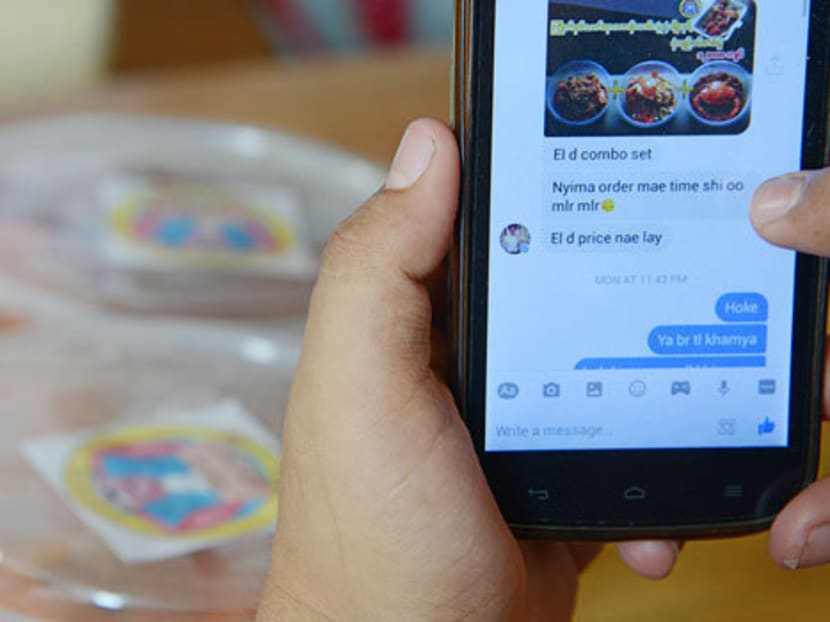
More people have taken to online shopping in Myanmar as Internet usage in the country becomes widespread. Photo: Myanmar Times

YANGON — Myanmar’s online food shops have become the rage among the country’s millions of Internet users, giving restaurants and street food shops a run for their money.
As the Internet has become widespread in Myanmar, people have taken to online shopping, importing clothes and accessories mainly from Thailand and Singapore, as well as buying food and recipes using social media.
According to a survey by the Myanmar ICT Development Organisation (MIDO) conducted in June, almost 14 million Myanmarese aged 18 to 64 use Facebook. International reports note that the number of Internet users in South-east Asia is expected to rise from 260 million now to 480 million by 2020, according to research by Google and state-owned investor Temasek Holdings. The research also suggests that that the value of e-commerce in the region will soar to US$88 billion (S$119.7 billion) by 2025, from US$5.5 billion in 2015.
This trend has proven to be a source of income for Ms Khine Su Wai, who has sold hotpot and crab recipes online for the past year and a half. “Of course the number of food sellers on social media has increased. Crab recipes are selling like hotcakes,” she said.
Ms Yuzana Khin, an avid online shopper who started purchasing knick-knacks in 2014, said buying food online is similar to buying food at a restaurant. She enjoys trying different online food shops. “For example, Mote Hin Khar – the traditional Myanmar soup sold in almost every shop – does not always taste good, even in a well-known shop,” she said. “It’s the same when you order food online. I try once, and I continue ordering and sharing with friends if it is good. If not, I don’t order again.”
Some Internet users, such as Ms Yuzana Khin, rely on customer reviews and feedback for an online shop before placing an order. “I’ve received many defective things when I order online, but not food. Most of the food I order online is good and tasty,” she said.
But others prefer to visit brick-and-mortar restaurants for a more complete experience. An example is 46-year-old Richard. “Ordering food online is similar to testing my luck. I prefer to eat outside where I can see and smell the food being cooked. Reviews? Some people may write reviews in exchange for something,” he said.
Food blogger Show Show Aung also prefers to eat out rather than order food online. “Online shops cannot maintain the quality of the taste and cannot take the pressure when they have a lot of orders. I have never heard of online shops being run by an organisation, most are run by families. It is a good business for a family but not for a long-term business,” he said.
Despite the mixed reactions, Ms Htike Aung, executive director of MIDO, said there is a big potential for online food sales. “The cost of opening an online shop is low, so the price of food will be cheap, and they can offer door-to-door delivery, which is an added convenience for customers who do not want to go out to enjoy their favourite food. It also supports family businesses. Consumers can check the feedback easily via Facebook, which provides more incentive for online food shops to offer better service,” she said.
Mr Zin Min Htet, who operates an online food shop, said it is not necessarily true that prices at restaurants are higher than at online shops, as labour costs are not cheap for online food shops. Customers also need to order more online in order to justify the extra charges.
“Both online food shops and restaurants have to charge 5 per cent sales tax and between 5 and 10 per cent service fee on top of the price of food,” said Mr Kywe Ohn. “It is really bad that the cost of delivery is the same amount as the price of the food I want to eat. The deal is only (justified) when you order a lot.” MYANMAR TIMES
Stay in the know. Anytime. Anywhere.

Subscribe to our newsletter for the top features, insights and must reads delivered straight to your inbox.
By clicking subscribe, I agree for my personal data to be used to send me TODAY newsletters, promotional offers and for research and analysis.






