
Myanmar returnees bet on future of frontier economy
YANGON — Former Google executive Nay Aung was philosophic as a crisis brewed at the Yangon headquarters of his Oway online travel-services firm.
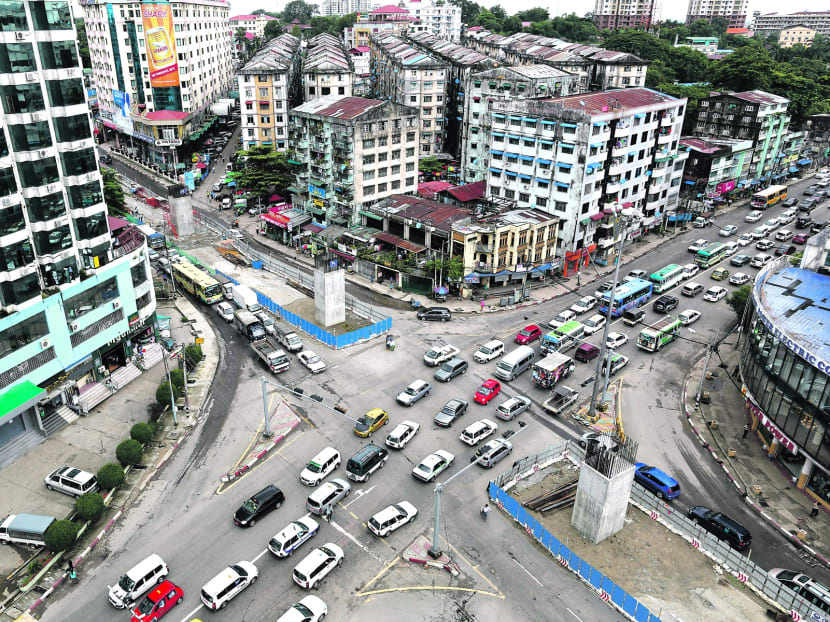
As a developing economy, Myanmar faces problems related to infrastructure, transport and logistical capacity. Photo: Reuters

YANGON — Former Google executive Nay Aung was philosophic as a crisis brewed at the Yangon headquarters of his Oway online travel-services firm.
“I’m still struggling,” the 34-year-old said as he apologised for interruptions at a meeting in his sparsely furnished office. “What I have, 60 per cent is what I want; 40 per cent, I just have to cope with it. It is what it is.”
Like China, which relied heavily on overseas Chinese in Hong Kong and elsewhere to finance its own industrial boom, Myanmar has high hopes its diaspora will help rebuild its economy and lift millions out of poverty.
Mr Nay Aung, a 34-year-old Stanford graduate and former business operations and strategy manager at Google, is among a vanguard of overseas-trained professionals who have returned to Myanmar to find opportunities and challenges. Many are setting up firms in niches that bridge the chasm between the city’s antiquated hardware and the 21st-century world of Wi-Fi and online business.
Trends suggest the heavy lifting for investment, especially in manufacturing, will depend more on overseas Chinese who prospered from China’s ascent as an industrial power and are now seeking fresh opportunities.
Data show foreign investment reaching US$46.3 billion (S$58 billion) as of March 31, the lion’s share of it from China, Thailand and Hong Kong. The total amount invested by Myanmar citizens was equivalent to about US$4.7 million.
After 15 years in California, Mr Nay Aung said he felt he had enough corporate experience for a project of his own. “It seemed like Myanmar was about to reopen, so I decided to take a risk and come back,’’ he said at his office in Junction Square, a new commercial complex in Yangon.
Myanmar’s leaders are banking on investment in export manufacturing and services to help the country emerge from the poverty and isolation that deepened under Western sanctions against its former military-led regime in the 2000s. The goal is to create factory jobs for the more than two-thirds of the population that are still working in the country’s once-prosperous but long-neglected farm sector. Along with money, Myanmar needs skilled manpower to lead its economic revival. An area it is forging ahead in is telecommunications and technology, where there are fewer vested interests to obstruct newcomers.
Many working in the IT field are returnees such as Mr Nay Aung and business partners Minn Thein, Godfrey Tan and Michelle Winn, high-school acquaintances who left Myanmar as teenagers and earned technology and business degrees in the United States before returning to Yangon in late 2012.
Mr Minn Thein worked as an IT consultant for 13 years at Avanade, a joint venture between Microsoft and Accenture, earning six figures and settling down in Seattle with his family.
The firm he founded with Mr Tan and Ms Winn, Frontiir, set up a Wi-Fi network between two universities that has expanded into a technology support company employing dozens.
“We want to bring what we think is Silicon Valley’s best to Myanmar. That’s our dream,’’ said Mr Minn Thein.
While returnees are active in Myanmar’s technology and finance industries, they have had little impact in other areas, said Ms Rachel Calvert, senior consultant at IHS in Singapore. “All the young Burmese returnees I’ve met have been in the financial sector, investment, international development agencies and telecoms,’’ she said. “You’re part of the foreign investment, rather than community figures shaping things from the inside out.”
An earlier returnee, software firm Myanmar Information Technology (MIT) CEO Tun Thura Thet, returned in 1997 and waited 17 years for business to pick up, while struggling to avoid running afoul of the whims of the authoritarian leadership. “I’ve seen ups and downs, and false hopes,’’ he said. For MIT, the break came in the form of cooperation with global software firms such as Oracle, he added.
But, there is still huge room for improvement: Less than 1 per cent of Myanmar’s residents have bank accounts. Fewer than 1 in 10 have Internet access. “This has to be fixed,” he said.
Then, there is the problem of infrastructure, such as power capacity to keep lights on and machines working without disruption, and training, public transport and logistical capacity.
Mr Tun Thura Thet said he and others in IT work mostly at night, when pressure on limited bandwidths is less intense. AP
Stay in the know. Anytime. Anywhere.

Subscribe to our newsletter for the top features, insights and must reads delivered straight to your inbox.
By clicking subscribe, I agree for my personal data to be used to send me TODAY newsletters, promotional offers and for research and analysis.