
New bridge in Cambodia a hit with locals
NEAK LOEUNG (Cambodia) — The latest and largest Japan-funded suspension bridge across the Mekong River has become a popular tourist site, attracting Cambodians from all walks of life.
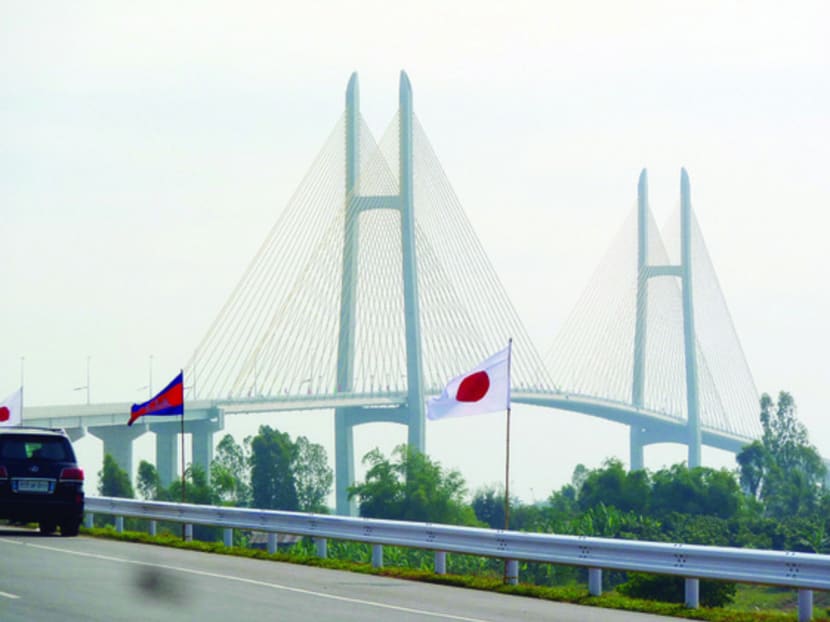
The Tsubasa Bridge has seen thousands of visitors since its opening. Photo: Facebook page of Bun Rany

NEAK LOEUNG (Cambodia) — The latest and largest Japan-funded suspension bridge across the Mekong River has become a popular tourist site, attracting Cambodians from all walks of life.
One month after Tsubasa was inaugurated, people from across the nation are still flocking to the 2,215m bridge, taking photos with friends and family, and posting them on social media.
Ms Bun Rany, the wife of Cambodia’s Prime Minister, recently uploaded to Facebook a photo of her with her relatives at the bridge, which is located in Neak Loeung — about 60km east of the capital Phnom Penh.
The bridge, connecting Cambodia’s Kandal and Prey Veng provinces, is part of links in the so-called “southern economic corridor”, a roughly 1,000km-long stretch of road linking Ho Chi Minh City with Bangkok via Phnom Penh.
During the April 6 inauguration ceremony, Cambodian Prime Minister Hun Sen says the bridge is a “dream come true”.
He added that it replaces the costly and time-consuming boat and ferry transport across the Mekong River, one of Asia’s biggest rivers.
That same day, Japanese Prime Minister Shinzo Abe sent a message from Tokyo saying he hopes the bridge will contribute not only to Cambodia’s economic development but that of the wider Mekong region.
A visitor to the bridge, 89-year-old Mak Ngov, said she had never been to such a bridge.
“I’d heard about the bridge for about a month but didn’t have an opportunity to come and see it until my children brought me here today. I want to stand here as long as possible or until security police chase me out.”
When asked why it is so special, she replied: “It’s very high, very long and of modern construction, with very beautiful scenery on all sides and very breezy. It’s the best bridge in Cambodia.”
Mr Keo Dara, head of the traffic police unit guarding the bridge, said thousands of travellers stop and take photos on it every day, especially in the late afternoon, while the number skyrockets on weekends and holidays.
He said that with so many vehicles descending on the bridge at once, he and his colleagues have their work cut out for them. But they have been patiently asking tourists to leave the bridge as soon as they can to ease traffic congestion.
A Kyodo News reporter yesterday witnessed the occupants of two luxury cars paying small “coffee money” to the police after being allowed to stop briefly on the bridge to take photos.
The almost carnival atmosphere at the bridge, which links National Route 1 at both sides of the Mekong River, has prompted Mr Hun Sen to voice concerns. He recently ordered the Ministry of Public Works and Transport, together with the local authorities and traffic police, to take immediate action to ease congestion, such as by cracking down on people who stop their cars on the bridge to take photos as well as on mobile fast-food vendors.
Appearing more contented than concerned was Japanese Ambassador Yuji Kumamaru, who told Kyodo News he is “so happy that the Tsubasa Bridge has become an attraction spot for everybody in Cambodia”.
“It is indeed good to learn that so many people are coming to see the bridge and taking pictures of it,” the envoy said. He added that the construction of the bridge is probably the most successful Japanese project in Cambodia, “in terms of both winning people’s popularity and making huge impact to the Cambodian economy”.
The Tsubasa Bridge, the third large-scale one donated by Japan so far, was constructed at a cost of 119.4 million yen (S$21,397) in Japanese grant assistance.
“It was indeed a very costly project,” Mr Kumamaru said, noting that there had been debate in Japan on whether it should be a grant project or a concessional loan project.
“It is extremely rare to provide assistance of this scale and cost in the form of grant assistance. But after long and difficult consideration, the Japanese government decided to make it a gift to Cambodian people as a token of friendship. Looking back, I feel my government has made a right decision,” the ambassador added.
The other two large-scale bridges donated by Japan are the Cambodia-Japan Friendship Bridge across Tonle Sap River in Phnom Penh and the Kizuna Bridge that spans the Mekong River in the country’s eastern province of Kompong Cham. KYODO NEWS
Stay in the know. Anytime. Anywhere.

Subscribe to our newsletter for the top features, insights and must reads delivered straight to your inbox.
By clicking subscribe, I agree for my personal data to be used to send me TODAY newsletters, promotional offers and for research and analysis.






