
Year-long mourning in Thailand as King dies
SINGAPORE — King Bhumibol Adulyadej, the world’s longest-serving monarch and a unifying symbol for Thailand since the 1950s, died on Thursday (Oct 14) at the age of 88. The royal palace said that he died “in a peaceful state” at Siriraj Hospital in Bangkok at 3.52pm, but it did not give the cause of death.
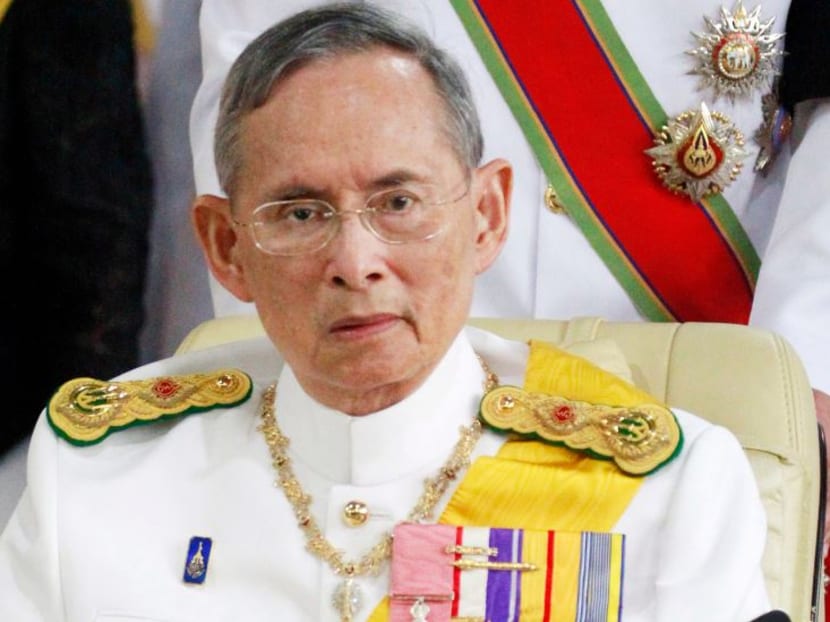
Thai King Bhumibol Adulyadej in 2012. He was the world’s longest-serving monarch. AP file photo

SINGAPORE — King Bhumibol Adulyadej, the world’s longest-serving monarch and a unifying symbol for Thailand since the 1950s, died on Thursday (Oct 14) at the age of 88. The royal palace said that he died “in a peaceful state” at Siriraj Hospital in Bangkok at 3.52pm, but it did not give the cause of death.
Thai Prime Minister Prayuth Chan-ocha said the appointment of a successor would be made later, and Crown Prince Maha Vajiralongkorn, 64, had asked for time to mourn with the Thai people. “Let us wait for the right time,” Gen Prayuth told reporters.
Crown Prince Vajiralongkorn has been designated since 1972 to be the heir.
In a statement broadcast on Thai television earlier, the Premier said government officials would observe a one-year mourning period, and no government events would be held for one month. Flags would fly at half mast at all government buildings and schools for 30 days starting on Friday. “He is now in heaven and may be looking over Thai citizens from there,” said Gen Prayuth.
Revered by Thais from all walks of life with near-religious fervour — his portrait hangs in homes, shops and offices across the country — King Bhumibol’s death after a seven-decade reign comes at a sensitive time for Thailand. Anxiety over the King’s health and an eventual succession have formed the backdrop to more than a decade of bitter political divisions in Thailand that has included two military coups and violent street demonstrations.
Crown Prince Vajiralongkorn has not inherited his father’s popularity, and the King’s death raises questions about the future of the monarchy itself.
“There will be an enormous vacuum in Thai society, politics, and psyche,” said Dr Paul Chambers, director of research at the Institute of Southeast Asian Affairs in Chiang Mai.
“His Majesty was not any Thai King. He overshadowed Thailand for many decades. His passing will affect politics and the economy. I think Thailand will never see again such a monarch who embodies the nation so deeply and for so long.”
A royal cremation is expected to take months to prepare and the heir’s coronation will not take place until the mourning period is over.
As news broke of the King’s death on Thursday (Oct 13), there was a huge outpouring of grief among Thais, most of whom know no other sovereign.
King Bhumbibol was born in the United States on Dec 5, 1927, to Prince Mahidol Adulyadej and Princess Srinagarindra, the youngest of three children. When a childless uncle, King Prajadhipok, abdicated in 1935, it was King Bhumibol’s brother, Ananda, then aged nine, who stepped up as King. Ananda ruled for 11 years as King Rama VIII before he died from a gunshot wound, under circumstances that remain unclear till today.
King Bhumibol ascended the throne in 1946 at 18 years old, but his reign did not begin immediately. He first returned to Switzerland to complete his studies, and later met and married Queen Sirikit. They have four children — Princess Ubolratana Rajakanya, Crown Prince Vajiralongkorn, Princess Maha Chakri Sirindhorn and Princess Chulabhorn Walailak.
A week after his marriage, he was crowned King of Thailand on May 5, 1950. He pledged to “reign with righteousness for the benefit and happiness of the Siamese people”.
By the late 1990s, the King was at the apogee of his great reign, with an enormous moral force earned through his civic work and political astuteness. He had also presided over an expansion of the royal family’s now vast business holdings. A 2015 New York Times article noted that the Crown Property Bureau controls more than US$37 billion in assets, including stakes in Siam Commercial Bank, Siam Cement and the Kempinski hotel group.
The emergence of Thaksin Shinawatra as a political force, however, changed the equation. The former telecom and media tycoon quickly gained enormous popularity in the rural north and north-east regions, partly due to his populist policies, which included subsidised healthcare and poverty reduction programmes. In February 2005, Thaksin became not only the first Thai prime minister to serve a full term, but also led his party to a landslide win in the general election.
But his network of patronage had threatened to supplant that of the Bangkok-based political, business and military elite arrayed around the royal palace.
In 2006, after months of demonstrations for Thaksin’s resignation amid allegations of corruption and electoral fraud, the King endorsed a bloodless military coup that ousted Thaksin. But Thailand continued to be rocked by more political turmoil that has stunted growth and seen often deadly street protests. In 2014, the army yet again ousted an elected government, this time led by Yingluck Shinawatra, Thaksin’s sister.
Analysts say the military sees its role in ensuring stability as the country prepares for the succession of Crown Prince Vajiralongkorn.
In August, the junta won overwhelming approval in a referendum of a new Constitution that aims to reduce the power of political parties and extend the influence of the military.
Thaksin, however, retains strong influence despite living in self-imposed exile after he was convicted in absentia in 2008 of violating conflict-of-interest rules in a land deal. This fractured state of affairs persists, but now without the moderating presence of a long-revered king. WITH AGENCIES
Stay in the know. Anytime. Anywhere.

Subscribe to our newsletter for the top features, insights and must reads delivered straight to your inbox.
By clicking subscribe, I agree for my personal data to be used to send me TODAY newsletters, promotional offers and for research and analysis.






