
Thai coup has little effect on economic growth
Channel NewsAsia’s current affairs editor Augustine Anthuvan interviewed Mr Boontuck Wungcharoen, chairman of the Thai Bankers’ Association, in Bangkok last week.
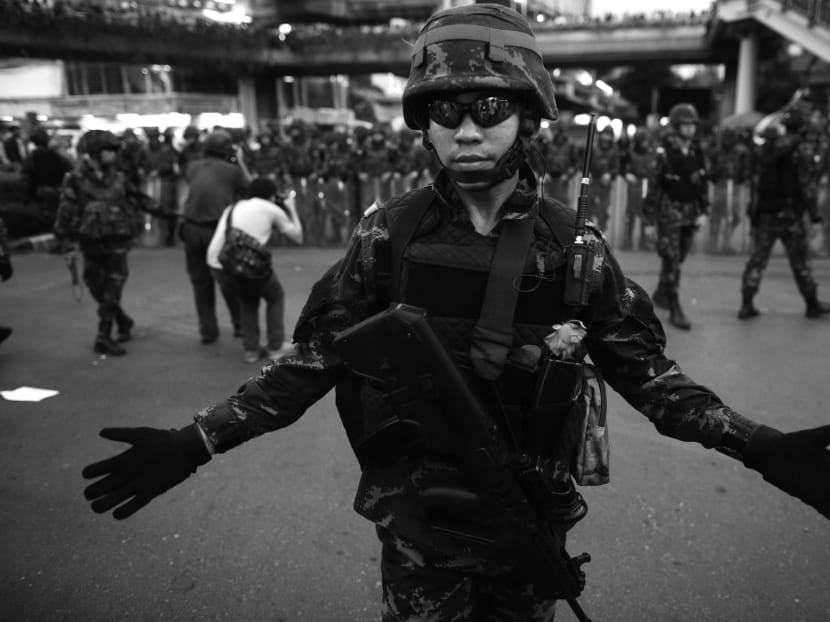
The coup is necessary to avoid the escalation of the political conflict to the point of bloody confrontations, but what is more important is that all the economic policies remain about the same, says Mr Boontuck Wungcharoen. PHOTO: AP

Channel NewsAsia’s current affairs editor Augustine Anthuvan interviewed Mr Boontuck Wungcharoen, chairman of the Thai Bankers’ Association, in Bangkok last week.
Mr Boontuck, who is also the chief executive officer of TMB Bank, a publicly listed company formerly known as the Thai Military Bank, spoke about why the military coup of May 22 may not be bad for Thailand and its economy. Below is an excerpt of the interview.
As someone from the financial industry, what’s your view on the coup in Thailand?
I think everyone probably agrees with me that the coup is (necessary) to avoid the escalation of the political conflict to the point of bloody confrontations, but I think what is more important is all the economic policies remain pretty much the same. We still support the free market economy, the free flow of capital and welcome and promote foreign direct investments.
So do you echo some people’s sentiments that this intervention by the military is different from previous interventions?
While it’s different in the sense that the situation has become more complex and the violence could get out of hand, the military intervention is something that people deem necessary. And it has also helped the economy to move forward. With a fully functioning government, we believe the Thai economy would grow at least 2 per cent this year, despite the fact that we had a contraction of more than 2.1 per cent in the first quarter.
You’ve (just recently become) president of the Thai Bankers’ Association. Congratulations ... but at the same time, challenging times?
Yes, it is challenging times. Well, to begin with, the Thai economy is quite resilient. We have a very strong balance of payments, a strong foreign currency reserve — more than US$200 billion (S$251 billion) of foreign currencies — and low inflation. The banking system is very strong and healthy. So with a fully functioning government, I think immediately what will benefit (the economy) is government spending, government investment or the payment to the farmers, more than 100 billion baht (S$3.81 billion) — all the money that the government owes. And that itself will help revitalise the economy.
The international media seem to heavily emphasise that the military coup is not good, that there is uncertainty, tourism is being affected. Some countries have even put out travel advisories. So what message do you want to send to the international community?
Well, I think the message to the international community is, even with the coup, Thai economic policy remains unchanged. And in the past three decades, we have had 12 coups and, as it’s proven statistically, the coup in a sense has … very little or no effect on the growth of the economy at all. And for the Thai people, I think we embrace democracy and we are still learning. I think democracy is not simply elections. I think we have to create a stronger culture of accountability, respect the right of other people and the opinions even if they are different from ours. And I think what is most important is the strong sense of responsibility to the communities. There’s still a long way for us to go, but looking back, we have come a long way as well.
So picking up on that point — what went wrong and what do you want to see set right moving forward, if you had to pick an example?
I think what went wrong is that accountability is not that clear. For elected positions and those running the economy, the sense of accountability has to be stronger than that. And that would address the issue of corruption, which is one of the major concerns of the public.
What about the concerns that have been floating in the media that the military wants, as part of its ongoing reform process, to introduce changes to the boards of public listed companies?
The military needs to stabilise the whole situation, but I think, in the longer term, the military is quite aware of the challenge that the country is facing and has a clear picture of what reforms we need to have.
General Prayuth Chan-ocha is director of the TMB board?
He’s only on the board (of directors) of this bank.
Does this (being a director of TMB) create any complications for the public?
I think the situation would be properly handled — but it (the military coup) just happened so quick.
What about when you have conversations with other financial institutions? I understand ING owns part of TMB Bank and you have other investors and as the chairman of the Thai Bankers’ Association, I’m sure you have, behind closed doors, very robust discussions where they ask you what’s really happening. How do you respond to these people? They want honest answers as well?
Yes, and the honest answers for those people who are quite familiar with Thailand would be that … we have had 12 coups d’etat in the past three decades and every time, the economic situation, the economic policy remain unchanged and it has no impact on the economy at all.
And in terms of investor confidence, you seem quite confident that the country will be able to ride out this current situation and move on, and you have statistics to support that?
Yes, I think it’s reflected in the movement of the baht. Right after the coup d’etat, the baht depreciated 0.6 per cent and then at the closing, on the closing day, it was only 0.4 per cent. After the coup d’etat in 2006, the baht depreciated 1.2 per cent. (This time) the stock index dropped only 0.6 per cent, whereas in 2006, the stock market dropped by 1.3 per cent.
So is the coup the saviour for Thailand or is it a scourge?
(sighs) I will look at it as a safety valve. When we are learning democracy, it’s a safety valve that would prevent us from entering bloody (situations).
But there is also resistance where some people feel that the military has stifled freedom of speech and there is social media where young people and Thais can express themselves freely. Where do you stand on that because business and the private sector need that space and freedom also to operate right and if there is over-regulation, it can also stifle growth and development?
From Thai history, after a coup d’etat, all the freedom of the information would come back very fast. But people must have the responsibility not to put out rumours or inflammatory messages. This is something that Thai society is still learning how to (manage), as you mentioned, how to deal with social media. We have a lot of information and very few facts.
If you had a chance to go on social media and put a message out, what would you like to tell your friends, the Thai people and, in particular, perhaps even young Thai people?
I think what I would like to tell (them) is the future of Thailand is in their own hands. And I totally believe that every single Thai person has responsibility for the future of the country. I also believe in their potential, that everyone can really make the difference.
Stay in the know. Anytime. Anywhere.

Subscribe to our newsletter for the top features, insights and must reads delivered straight to your inbox.
By clicking subscribe, I agree for my personal data to be used to send me TODAY newsletters, promotional offers and for research and analysis.






