
Australia's Great Barrier Reef hit by record bleaching
SYDNEY — Australia's spectacular Great Barrier Reef is experiencing its worst bleaching event on record, the country's reef authority reported on Wednesday (April 17).
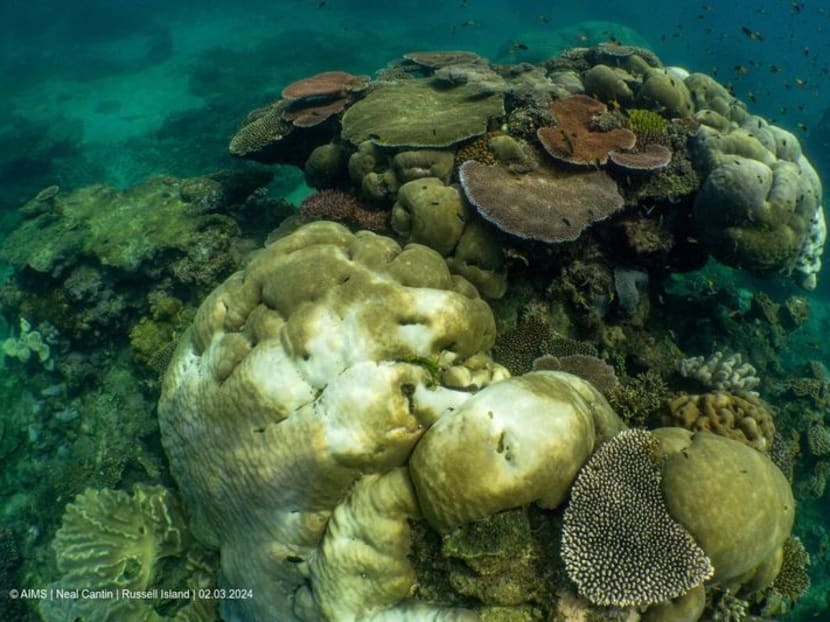
Coral reefs bleach in the Great Barrier Reef as scientists conduct in-water monitoring during marine heat in Russell Island, Australia, on Feb 3, 2024 in this handout picture obtained by Reuters on April 12, 2024.

SYDNEY — Australia's spectacular Great Barrier Reef is experiencing its worst bleaching event on record, the country's reef authority reported on Wednesday (April 17).
Often dubbed the world's largest living structure, the Great Barrier Reef is a 2,300km long expanse, home to a stunning array of biodiversity including more than 600 types of coral and 1,625 fish species.
But aerial surveys conducted by the scientists show about 730 out of more than 1,000 reefs spanning the Great Barrier Reef have bleached, the authority said.
"The cumulative impacts experienced across the reef this summer have been higher than previous summers," the federally funded Marine Park Authority said in a statement.
This event is the fifth mass bleaching on the reef in the past eight years.
Bleaching occurs when coral expels microscopic algae, known as zooxanthellae, to survive. If high temperatures persist, the coral can eventually turn white and die.
The Reef Authority’s chief scientist Roger Beeden said climate change posed the biggest threat to reefs globally.
"The Great Barrier Reef is an incredible ecosystem, and while it has shown its resilience time and time again, this summer has been particularly challenging," he said.
RECOVERY IN DOUBT
AFP journalists visited one of the worst-impacted areas of the Great Barrier Reef this month.
Lizard Island, a small slice of tropical paradise off Australia's northeast tip that is usually teaming with vibrant coral life, resembled a watery grave.
Marine biologist Anne Hoggett, who has lived and worked on Lizard Island for 33 years, said when she first arrived, coral bleaching only occurred every decade or so.
Now, it is happening every year, she said, with about 80 per cent of vulnerable Acropora corals on the Lizard Island reef suffering bleaching this summer.
"We don't know yet if they've already sustained too much damage to recover or not," Dr Hoggett told AFP.
Australia has invested about A$5 billion (S$4.4 billion) into improving water quality, reducing the effects of climate change, and protecting threatened species.
The country is one of the world's largest gas and coal exporters and has only recently set targets to become carbon neutral.
Whether these efforts will be enough for the reef to keep its World Heritage Status will be examined by Unesco later this year.
Related topics
Australia Great Barrier ReefStay in the know. Anytime. Anywhere.

Subscribe to our newsletter for the top features, insights and must reads delivered straight to your inbox.
By clicking subscribe, I agree for my personal data to be used to send me TODAY newsletters, promotional offers and for research and analysis.






