
Behind the scenes, communist strategist presses China’s rise
BEIJING — He was a brilliant student during the dark days of China’s Cultural Revolution. He visited America, and left unimpressed with democracy. Plucked from academia, he climbed the ladder of Beijing’s brutal politics.
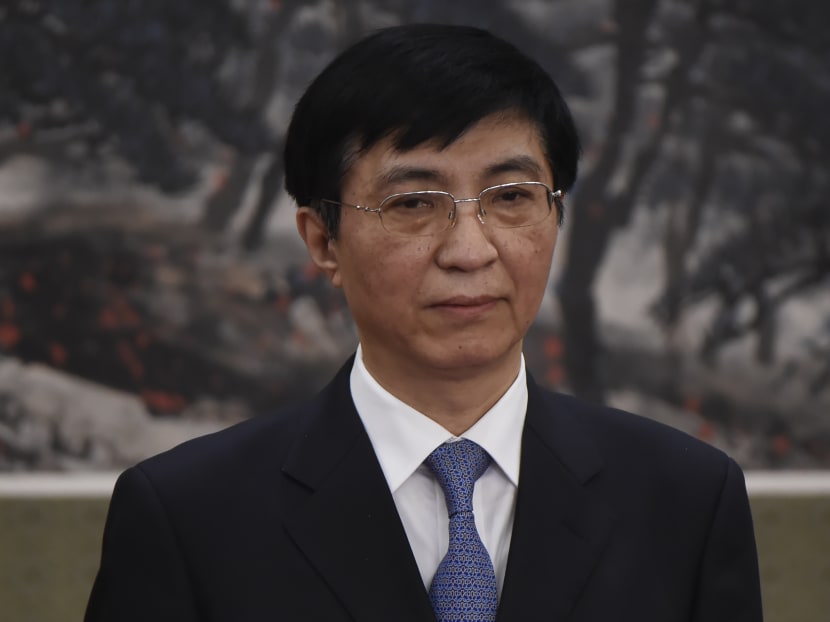
Mr Wang Huning is a shrewd strategist who has served three Chinese presidents from behind the scenes. Photo: AFP

BEIJING — He was a brilliant student during the dark days of China’s Cultural Revolution. He visited America, and left unimpressed with democracy. Plucked from academia, he climbed the ladder of Beijing’s brutal politics.
He did not attend United States President Donald Trump’s meeting with his Chinese counterpart Xi Jinping last week, but his ideas and advice almost certainly helped shape it. Few in the Communist leadership have pressed China’s effort to surpass the United States for as long as Mr Wang Huning, a shrewd strategist who has served three Chinese presidents from behind the scenes.
As Mr Trump pits his advisers against each other and sows doubt about America’s future in Asia, Mr Wang has emerged as one of Mr Xi’s most influential confidants, one who has brought a steadiness of vision and purpose to China’s rivalry with the United States.
A college professor-turned-party theoretician, Mr Wang, 63, has long argued that China needs a strong, authoritarian state to restore it to national greatness after a century of humiliation by foreign powers. He has helped cast Mr Xi as leading China into a “new era” of global ascendance by keeping society under the party’s tight control.
His efforts were recognised last month when he was elevated into the all-powerful seven-man Politburo Standing Committee despite never having governed a province or run a state ministry. He is now the party’s top ideologue and the chief interpreter of Mr Xi’s new style of authoritarian rule.
Some liken his shadowy role – though not his ideas – to that of Mr Trump’s former adviser Stephen K. Bannon.
But Mr Wang moved from leader to leader, shaping the outlook not only of Mr Xi but also his two predecessors, Mr Hu Jintao and Mr Jiang Zemin. In doing so, he has played a key role in justifying one-party rule during China’s transformation into a geopolitical rival of the United States.
“People call him the brain behind three supreme leaders,” said Ms Yun Sun, a China expert at the Washington-based Stimson Center.
As a young professor in Shanghai in the late 1980s, Mr Wang won attention for advocating “neo-authoritarianism”, the idea that a nation as big and poor as China needed a firm hand to push through modernisation before it could consider becoming a democracy.
As others argued that China could never modernise without becoming democratic – a view that later gave rise to the ill-fated student movement based in Tiananmen Square – Mr Wang made the case in a 1988 article that an enlightened autocracy would be “highly effective in distributing social resources” in order to “promote rapid economic growth.”
“He believed in modernisation and that China needed strong political leadership,” said Mr Ren Xiao, a professor of international relations at Fudan University in Shanghai and a former student of Mr Wang. “That is still on his mind. It is his firm belief.”
Born in the eastern province of Shandong, the birthplace of Confucius, Mr Wang was a sickly teenager who, unlike many young people, was allowed to avoid heavy farm work during Mao Zedong’s destructive Cultural Revolution. He studied instead, learning French as his first foreign language.
Tutored by the prominent Marxist scholar Chen Qiren, Mr Wang gravitated toward the study of Western political thought. At 30, he became the youngest professor at Fudan University in Shanghai, and within just a few years had risen to head the law school.
“He taught Plato, Aristotle, the French Revolution, a little about the American Revolution, the Federalist Papers translated into Chinese,” said Mr Ren.
As the coach of Fudan’s debate team, he would stand during practice with a plastic stick to make a show of driving his students to strive harder, though he never struck them, according to a collection of essays about the team’s trip to a 1988 competition in Singapore.
His team defeated National Taiwan University, 5-0, by out-debating it on the subject: Is human nature kind or evil? (Mr Wang’s team argued for evil.)
Reflecting on the visit, he later wrote: “While Western modern civilisation can bring material prosperity, it does not necessarily lead to improvement in character.”
As a member of delegations of young political scientists, he toured more than a dozen US campuses, including Harvard, the Massachusetts Institute of Technology, and the University of Iowa.
“He was a very charismatic figure: young, articulate and adept at theoretical arguments,” said Mr Miles Kahler, a senior fellow at the Council on Foreign Relations, who first encountered Mr Wang in the early 1980s in Shanghai and later in California.
“He was definitely a skeptic of the wisdom of China moving toward a Western-style democracy,” Mr Kahler added. “Wang Huning did not pretend to share such idolisation of the United States.”
When the pro-democracy movement erupted on Tiananmen Square and spread to cities across the country in the spring of 1989, Mr Wang kept his distance from the demonstrations in Shanghai.
In a letter written two months after the bloody crackdown that followed, he informed Mr Kahler that one of his students had been “too active” in “recent affairs” to go to the United States but refrained from saying much more.
Soon afterward, Mr Wang was recruited into politics by Mr Jiang Zemin, the Shanghai party chief who became president of China after the crackdown. Mr Jiang brought Mr Wang to Beijing, where he stood out as a rare academic within a party leadership dominated by engineers and apparatchiks.
Mr Wang’s first post was as head of the politics group inside the Central Policy Research Office, the party’s in-house think-tank, which he was later promoted to lead.
When Mr Jiang retired in 2002, Mr Wang was promoted again, into the party’s influential Central Secretariat, the bureaucracy that serves the Politburo, even as he continued to run the research office.
After a decade serving Mr Jiang’s successor, Mr Wang transferred his allegiance to Mr Xi, becoming a loyal adviser to the ambitious new president and a key member of his entourage on overseas trips. THE NEW YORK TIMES
Stay in the know. Anytime. Anywhere.

Subscribe to our newsletter for the top features, insights and must reads delivered straight to your inbox.
By clicking subscribe, I agree for my personal data to be used to send me TODAY newsletters, promotional offers and for research and analysis.






