
Canada to sign new TPP deal, despite opposition from labour, auto sectors
MONTREAL — Canada will sign onto a revised 11-member Asia-Pacific trade pact after pushing to secure a better deal, underpinning a government drive to diversify exports amid doubts over the North America Free Trade Agreement (Nafta).
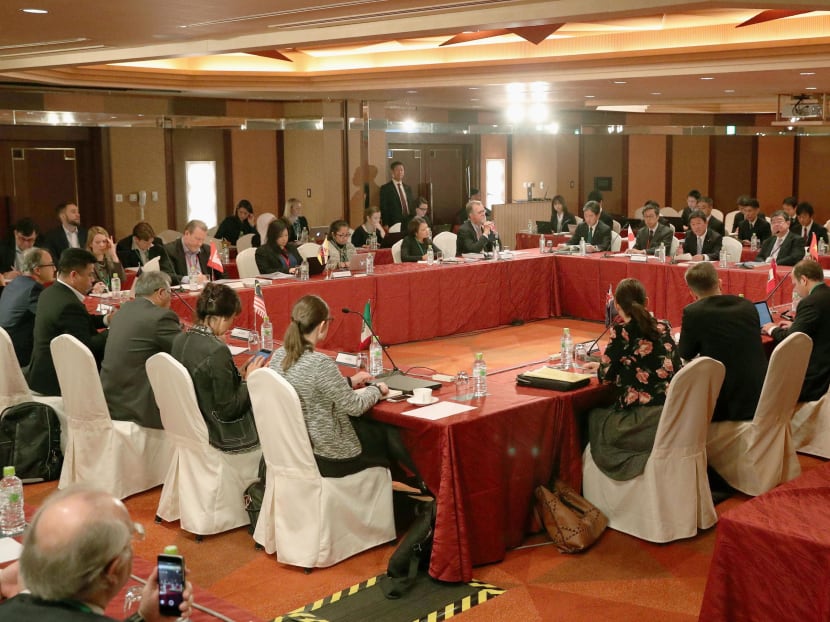
Chief negotiators from the 11 member states of the Trans-Pacific Partnership free trade pact meet in Tokyo on Jan 22. Photo: Kyodo

MONTREAL — Canada will sign onto a revised 11-member Asia-Pacific trade pact after pushing to secure a better deal, underpinning a government drive to diversify exports amid doubts over the North America Free Trade Agreement (Nafta).
Australian Prime Minister Malcolm Turnbull also welcomed on Wednesday (Jan 24) the agreement struck by the Trans-Pacific Partnership (TPP) member nations to sign a revised multinational trade deal in March.
Speaking at the World Economic Forum in Davos, Canadian Prime Minister Justin Trudeau called the agreement the “right deal” and told reporters that he helped push for an improved deal, showing how important the trade file has become for him personally.
But a major labor union and a group representing auto parts manufacturers said the deal would cause job losses.
Trade officials signed off on a final text on Tuesday (Jan 24) after a meeting in Tokyo to overcome challenges such as Canada’s insistence on protection of its cultural industries.
The deal agreed to the suspension of intellectual property and investment dispute provisions that had been a concern.
Trade Minister Francois-Philippe Champagne said the deal would also grant full access to Japan’s auto market for the first time.
“Diversification is key for Canada ... for us opening up markets is essential,” he told reporters in Toronto.
A previous round of talks last November ended in disarray after Canada objected to parts of the proposed text and Mr Trudeau was lambasted for missing a key meeting with Japan’s prime minister on how to secure a deal.
The breakthrough came on the same day that negotiators started the sixth and penultimate round of talks on the Nafta, which US President Donald Trump has repeatedly threatened to abandon.
The Unifor private sector union and Canada’s Automotive Parts Manufacturers Association complained Mr Champagne had not warned them at meetings earlier this week that the deal was about to be agreed.
Unifor head Jerry Dias said that at a time when Canada is facing US demands at Nafta to increase the North American content of autos from the current 62.5 per cent, the new TPP deal would allow the duty-free import of parts which contained a maximum of 35 per cent of components from member nations.
This would allow the greater use of cheaper parts from Asian nations, causing havoc in the domestic industry, he added.
“The simple reality is what happened with the TPP completely undermined what’s happening in Montreal over NAFTA,” said Mr Dias.
“They have just cut the legs off of the entire Canadian negotiating team here on NAFTA,” he told reporters.
The Canadian Agri-Food Trade Alliance welcomed the deal, saying it would help boost food exports to Japan.
The timing of the deal is significant for Canada, which is trying to diversify its exports. US, Canadian and Mexican negotiators opened a key week-long round of talks to modernise Nafta on Tuesday.
In Australia, Mr Turnbull called the revised deal, a “great outcome” for his country.
“It will mean billions of additional exports and thousands of additional jobs,” he said at a press conference in Brisbane.
Mr Turnbull, a staunch backer of the TPP, worked closely with his Japanese counterpart Shinzo Abe in reviving the deal after Mr Trump put it in jeopardy by withdrawing the US immediately upon coming into office last year.
“There have been some hills and hollows and some twists and turns along the way since the APEC meeting in Lima in 2016, after it was known that President Trump would pull out,” Mr Turnbull said.
“(But) we stuck with it. And with great support and great leadership with the countries in the TPP 11, especially of course Japan...we look forward to the legal documents, the treaty being signed in Chile.”
New Zealand Prime Minister Jacinda Ardern gave a more circumspect response to the deal’s resurrection, stressing that New Zealand’s participation in the 11-member TPP was not a reversal of her government’s policies.
Ms Ardern said her Labour government fought for “significant concessions” which have helped to create a “vastly improved” deal, according to local media.
Prior to taking office, Ms Ardern said she would not rule out withdrawing from the TPP if the other member countries would not incorporate Labour’s policy banning foreigners from buying New Zealand land.
The TPP pact, renamed the Comprehensive and Progressive Agreement for Trans-Pacific Partnership, encompasses Australia, Brunei, Canada, Chile, Japan, Malaysia, Mexico, New Zealand, Peru, Singapore and Vietnam. It will be signed on March 8.
In a statement on Tuesday, Singapore’s Ministry of Trade and Industry said that the outcome of the new deal reaffirms the “countries’ collective commitment towards greater trade liberalisation and regional integration”.
It adds that Singapore views the new agreement as the “key to unlocking the benefits of the original TPP”, and that other “willing and like-minded economies” can join it in the future.
Speaking to Singapore reporters in Sri Lanka on Tuesday where he was on a three-day official visit, Prime Minister Lee Hsien Loong noted that despite the agreement in Tokyo, potential sensitivities remain.
“We have to see how that develops, because it’s politically sensitive for some countries,” he said.
Without the US, the 11-party TPP’s share of world gross domestic product drops to 13 per cent, but trade experts say the deal will still create a free trade area with a high-standard of market liberalisation. AGENCIES
Stay in the know. Anytime. Anywhere.

Subscribe to our newsletter for the top features, insights and must reads delivered straight to your inbox.
By clicking subscribe, I agree for my personal data to be used to send me TODAY newsletters, promotional offers and for research and analysis.






