
China singles out US for criticism, after travel restrictions imposed by a raft of countries
BEIJING — China’s Foreign Ministry has criticised the United States for acting “in the opposite way”, contrary to the World Health Organization’s (WHO) advice against any travel restrictions.
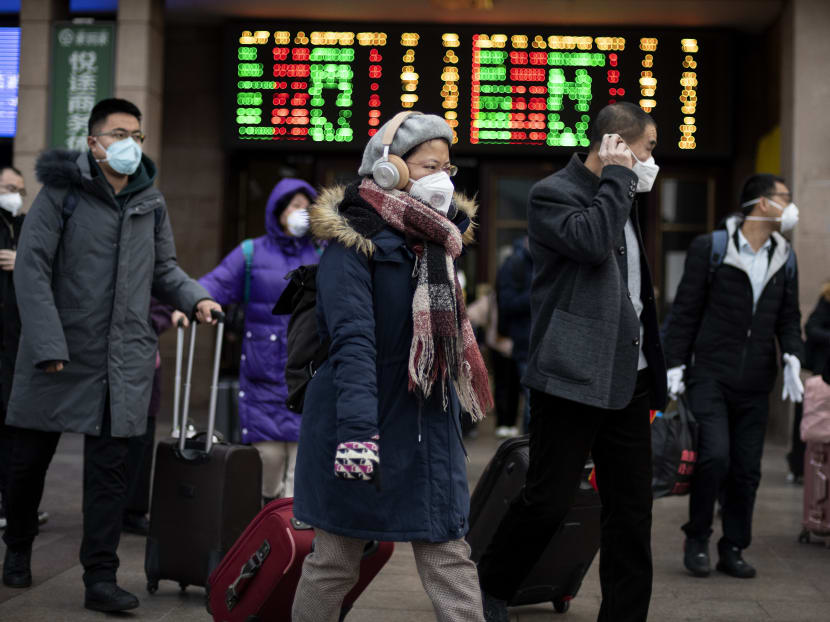
Passengers wearing facemasks arrive from different provinces at the Beijing Railway Station on February 1, 2020.

BEIJING — China’s Foreign Ministry has criticised the United States for acting “in the opposite way”, contrary to the World Health Organization’s (WHO) advice against any travel restrictions.
“This has set a bad example. It is certainly not a gesture of goodwill,” ministry spokesperson Hua Chunying said on Saturday (Feb 1) in remarks put up on the Chinese Foreign Ministry’s website.
On the same day, the ministry tweeted that in a phone call between Chinese Foreign Minister Wang Yi and Indian External Affairs Minister Subrahmanyam Jaishankar, Mr Wang noted that a “certain country has turned a blind eye to WHO recommendations and imposed sweeping travel restrictions against China”. “This kind of overreaction could only make things even worse. It's not the right way to deal with the pandemic,” the tweet added.
Earlier, the US joined several countries — including Russia, Japan, Pakistan, Italy and Singapore — in denying entry to any foreign national who has traveled within China in the last 14 days. Along with the US, Australia and Vietnam were among the latest to do so.
On Friday, Singapore moved to bar all new visitors who have been to China in the last 14 days from entering or transiting through the country. This was after the WHO declared a global health emergency on the virus.
Singapore also stopped issuing new visas to those with People’s Republic of China (PRC) passports, all new work pass applications for foreign workers from mainland China, and previously issued short-term and multiple-visit visas for those with PRC passports will be suspended.
Singapore’s Prime Minister Lee Hsien Loong said on Saturday that the restrictions were imposed because the country has to protect itself from the situation in China, where the spread of the virus is much wider. Other countries have also imposed similar restrictions, he noted.
Singapore is also a travel hub, and were the virus to spread to neighbouring countries in Southeast Asia and cause outbreaks there, there would be a big problem for Singapore, added Mr Lee, who also slammed the anti-Chinese sentiment that has bubbled up in the last few days in several countries.
Despite declaring a global health emergency, WHO director-general Tedros Adhanom Ghebreyesus has discouraged countries from imposing travel restrictions.
“The WHO doesn’t recommend and actually opposes any restrictions for travel and trade or other measures against China,” he said, while praising China’s response to the outbreak. “If anyone is thinking about taking measures, it’s going to be wrong.”
In response to the Chinese Foreign Ministry’s tweet, Mr Jorge Guajardo, Mexico’s former ambassador to China, pointed out that China had gone against WHO recommendation during the H1N1 outbreak in 2009, by cancelling direct flights to Mexico, stopping the issuance of visas to Mexicans and putting all Mexicans in China under quarantine, among other measures.
Mr Guajardo added: “I think the travel ban on China is (US President Donald) Trump acting like the Chinese government would. Wrong in both cases.”
On Saturday, Ms Hua said the Chinese people are “making their best efforts to fight against the outbreak”.
“The Chinese government has released information and shared data with the US and the rest of the international community in a timely, transparent and responsible manner.
“As the saying goes, a friend in need is a friend indeed. Many countries have offered China help and support through various ways. In contrast, the US comments and actions are neither based on facts, nor helpful at this particular time,” she added, in reference to remarks made by US officials including how the outbreak would help to accelerate the return of jobs to the US.
Related topics
Wuhan Wuhan virus coronavirus USA ChinaStay in the know. Anytime. Anywhere.

Subscribe to our newsletter for the top features, insights and must reads delivered straight to your inbox.
By clicking subscribe, I agree for my personal data to be used to send me TODAY newsletters, promotional offers and for research and analysis.