
China’s Ehang builds a drone to fly humans
LAS VEGAS — Stepping into a personal drone that will fly you to your destination seems like the stuff of science fiction, but one Chinese start-up proposes to do exactly that.
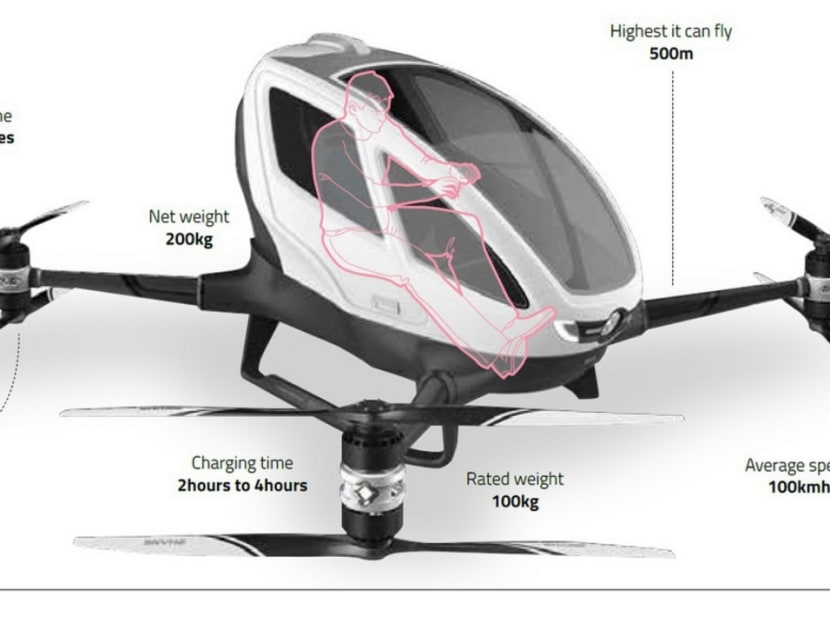
Drone maker Ehang released the new “184” drone, a self-flying vehicle that can carry a human passenger.

LAS VEGAS — Stepping into a personal drone that will fly you to your destination seems like the stuff of science fiction, but one Chinese start-up proposes to do exactly that.
In one of the most ambitious — some might say outlandish — launches at the Consumer Technology Association (CES) 2016 event in Las Vegas, drone maker Ehang released the new “184” drone (picture), a self-flying vehicle that can carry a human passenger.
Regulators have not yet approved the vehicle for human use, however, and all drones are restricted in Las Vegas, meaning CES attendees will not be able to see the 184 fly.
Guangzhou-based Ehang has raised more than US$50 million (S$72 million) from venture investors and is taking on China’s leading drone maker DJI at a time when drone sales worldwide are soaring.
Chinese drone makers have gained pole position in the global industry, thanks in part to China’s rules on testing and flying drones, which are more permissive than in the United States. DJI made the first mass-market camera drone — the Phantom — and is now the biggest consumer drone company in the world by sales.
Sales of drones, many of which are made in China, will more than double this year in the US, hitting nearly US$1 billion, said the Consumer Technology Association.
However, drone regulations continue to pose a challenge for recreational and commercial drone users around the world.
In the US, the Federal Aviation Administration announced last month that all drones weighing more than half a pound (0.27kg) would have to be formally registered.
Ehang said it was in the process of applying for certification to fly the 184 drone, and has already completed testing with passengers in China.
Mr Hsiao Shang-wen, co-founder and chief financial officer, told the Financial Times he was optimistic that the drone would be adopted by cities seeking to solve congestion issues.
The company has had discussions about launching a pilot programme with city government officials in its native Guangzhou, as well as in Auckland and Los Angeles.
Ehang plans to operate a fleet of vehicles that could pick up customers on-demand “just like a taxi”, said Mr Hsiao.
It will also sell to individuals and hopes to begin commercial sales during the first half of this year.
“You don’t need to have a pilot licence,” said Mr Hsiao. “Once you sit inside the vehicle you will see a screen with a map, and all you need to do is select the location you need to go to.”
The vehicle has four propellers that are capable of folding up when not in use, so that the parked drone takes up roughly the same space as a car. FINANCIAL TIMES
Stay in the know. Anytime. Anywhere.

Subscribe to our newsletter for the top features, insights and must reads delivered straight to your inbox.
By clicking subscribe, I agree for my personal data to be used to send me TODAY newsletters, promotional offers and for research and analysis.






