
Duterte wants to create ‘balance’ by sending troops to China for training
MANILA — Philippine President Rodrigo Duterte has said he wants to send troops to China for training to combat terrorism, despite worries resurfacing over Beijing’s build-up in the contested South China Sea.
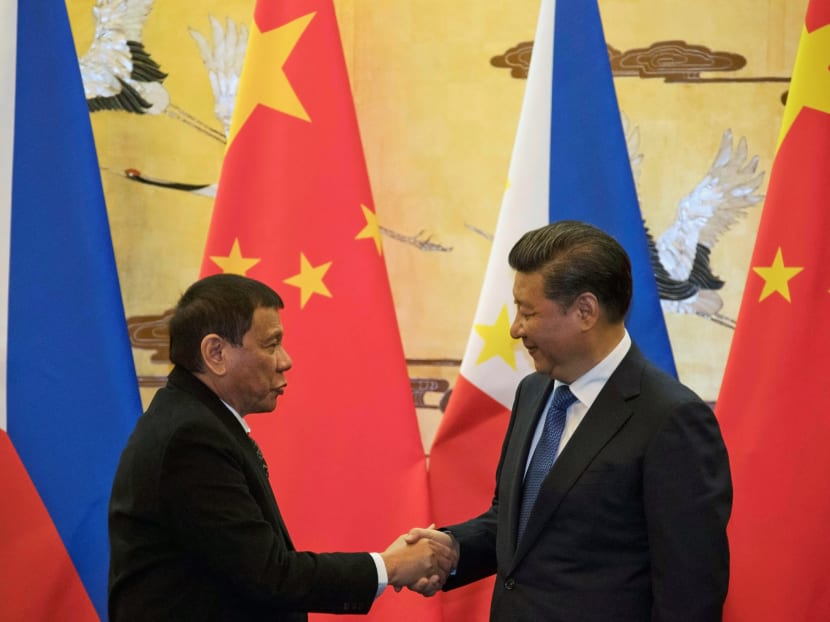
Mr Duterte, seen here with President Xi Jinping of China, said that his proposal to send Filipino soldiers for training in China did not mean Manila would cut ties with its traditional ally, the US. Photo: Reuters

MANILA — Philippine President Rodrigo Duterte has said he wants to send troops to China for training to combat terrorism, despite worries resurfacing over Beijing’s build-up in the contested South China Sea.
Mr Duterte said there was a need to “balance” the training of Filipino soldiers, who have a strong bond with the United States military, The Philippine Star reported.
“Most of the Filipino soldiers … would immediately choose America. They have forged such a bond,” Mr Duterte was quoted as saying during an event marking the 20th anniversary of the Chinese-Filipino Business Club in Manila on Monday (Feb 19).
“My suggestion is the next batch should go directly to China ... so there would be a balance,” he said. “I’m sure there is an academy there to train good professional Chinese soldiers. Maybe China can accommodate them also and let them ... not really fight the Americans, but terrorism.”
Mr Duterte added that despite the ongoing installation of military facilities by China in South China Sea, the disputed waters are “really ours” and that the defensive structures are intended for the US.
“China is building structures and military bases, I must admit, but is it intended for us? I do not think so,” he said.
“[The military structures] are really intended against those who China thinks will destroy them and that is America. We are not included there.”
The President also downplayed the presence of Chinese vessels in the area, saying that the Philippines should “not be threatened.”
“Those [ships]are not intended for us,” he said, adding that the Philippines could only be “diplomatic” in dealing with China.
“Basing on facts, [South] China Sea is really ours. Insofar as the Republic of the Philippines is concerned, I am ready, almost ready to put my Presidency, my life and honour, that [it]is ours. I have stated that in black and white… no doubt about it,” Mr Duterte said.
He added that there was no reason to fight because China was willing to talk.
“When I can talk to them, why should I fight? China is willing to talk. As a matter of fact, there are now ongoing negotiations for joint exploration. Can you beat that?” said Mr Duterte, who added in jest that if Chinese President Xi Jinping would fire a cruise missile to the Philippines, the Filipino-Chinese community would be wiped out.
Mr Duterte said that he would “not sacrifice the lives of the Filipinos only to die.”
“I will not go into a battle, which I cannot win. How can I win it? [It is] China,” he added.
“We cannot go there, ride in our whatever, Navy, the gray ships, the Coast Guard and start waving our rifles. We cannot do that today. It is unrealistic.”
China claims almost the entire South China Sea, a strategic waterway where US$3 trillion (S$3.97 trillion) worth of goods passes every year. Brunei, Malaysia, the Philippines, Taiwan and Vietnam also have overlapping claims.
The US has criticised China’s build-up of military facilities on the islands and is concerned they could be used to restrict free movement along the trade route.
China and the Philippines have long sparred over the South China Sea, but relations have improved considerably under Mr Duterte, who has been courting Beijing in hopes of winning business and investment.
In 2014, Beijing started expanding the seven features it occupies in the Spratlys, reclaiming and building artificial islands which are now becoming military bases with airstrips, ports and anti-air and surface-to-surface missiles sites based on satellite and aerial photos.
Mr Duterte on Monday also played down concerns about the recent moves by China to assign Chinese names to several undersea features in Benham Rise, an area the size of Greece in the Pacific Ocean which the United Nations awarded to the Philippines as part of its continental shelf.
“That is ours, period,” he said. “I am not allowing any expedition anymore. China went there and put up markers. Those are just directions and of course, they can do it in Chinese, it’s their dialect.”
Before ending his speech, he cracked a joke offering the Philippines to become a province of China. “If you want, you can make us a province, like Fujian. Province of the Philippines, Republic of China,” he added.
Exiled Communist Party of the Philippines (CPP) founder Jose Maria “Joma” Sison said the President’s “these are ours” statement was a lot “ek-ek” from “a stupid guy who is a bloody bully to his own poor countrymen but an abject puppet and a coward to foreign interests.”
“In his subjective, he might even think that he is smart by enriching himself and his gang at the expense of the Filipino people,” Mr Sison told The Manila Times.
Mr Duterte's comments on the Philippines being a province of China was also roundly criticised by opposition politicians.
"It is absolutely unacceptable for the President, the top diplomat of the country, to joke about making the Philippines a province of China," Magdalo Representative Gary Alejano said.
"Such irresponsible banter is a slap in the face of the many Filipinos, including our soldiers stationed in our occupied islands, who work tirelessly to defend our territorial integrity from China."
Mr Duterte's proposal of training with China's troops was however met with optimism by Chinese military experts, who said it would help Mr Duterte’s push to rebalance ties between the US and China, as well as consolidate his control over the military.
“This is a show of trying to create a balance between these two powers that would serve the Philippines’ own interests,” Xu Liping, a researcher at the Chinese Academy of Social Sciences, told the South China Morning Post.
Prof Xu said the two countries could “start with cooperation on counterterrorism” before they expanded their military cooperation.
Military commentator and retired People’s Liberation Army colonel Yue Gang said the move would also help Mr Duterte consolidate his control over the military.
“Ever since Duterte started improving relations with China, the military has always expressed an opposing view,” Mr Yue said. “It seems that Duterte does not have very firm control over the military … working with China can strengthen his influence over personnel choices in the future.”
But Roilo Golez, a former Philippine congressman and National Security Adviser who oversaw the country’s counterterrorism and national security programme, was sceptical.
“The AFP [Armed Forces of the Philippines] doctrines and equipment are generally compatible with those of the US military, the US being our treaty ally since 1951,” he said. “That cannot be altered to adjust to the PLA.”
Mr Golez also said the language barrier and the Chinese military’s lack of recent experience in real combat may be obstacles.
The Pentagon in June announced it was providing Philippine forces with security assistance and training in the areas of intelligence, surveillance and reconnaissance in the fight against terrorism in conflict-torn Marawi.
It said it had an additional 300 to 500 troops in the country to support regular training and activities, on top of the regular 50 to 100 special forces troops in the south of the country on rotational exercises.
Also in June, China donated thousands of guns worth some 50 million yuan (SS10.43 million) to help Manila in its battle against Islamist gunmen in the southern city.
Chinese ambassador to the Philippines Zhao Jianhua said at the time that “the Chinese side would like to explore the possibility of joint training, intelligence sharing and joint military exercises in the area of fighting terrorism”.
Speaking at Monday’s event, Mr Duterte said the proposal did not mean Manila would cut ties with its traditional ally, the US, which he has previously accused of interfering with the Philippines’ internal issues.
“Let us be very clear on this – we are on good terms with America. Special terms, military alliance – that’s why we cannot enter into another military alliance with any country because there’s only one,” Mr Duterte said, referring to the Mutual Defence Treaty between Manila and Washington.
“The Philippines now is veering towards China. But we maintain good relations. We have this [Philippines-US] pact defence deal, we will honour it, I don’t know when. But if we go to war, everything wilts,” he said. AGENCIES
Stay in the know. Anytime. Anywhere.

Subscribe to our newsletter for the top features, insights and must reads delivered straight to your inbox.
By clicking subscribe, I agree for my personal data to be used to send me TODAY newsletters, promotional offers and for research and analysis.






