
Explainer: Why was Qin Gang ousted as China's foreign minister, and what does it mean for the nation's foreign policy?
SINGAPORE — Once a rising star handpicked by Chinese President Xi Jinping, the sudden ousting of Mr Qin Gang as China’s foreign minister on Tuesday (July 25) has left lingering questions about what led to his removal.
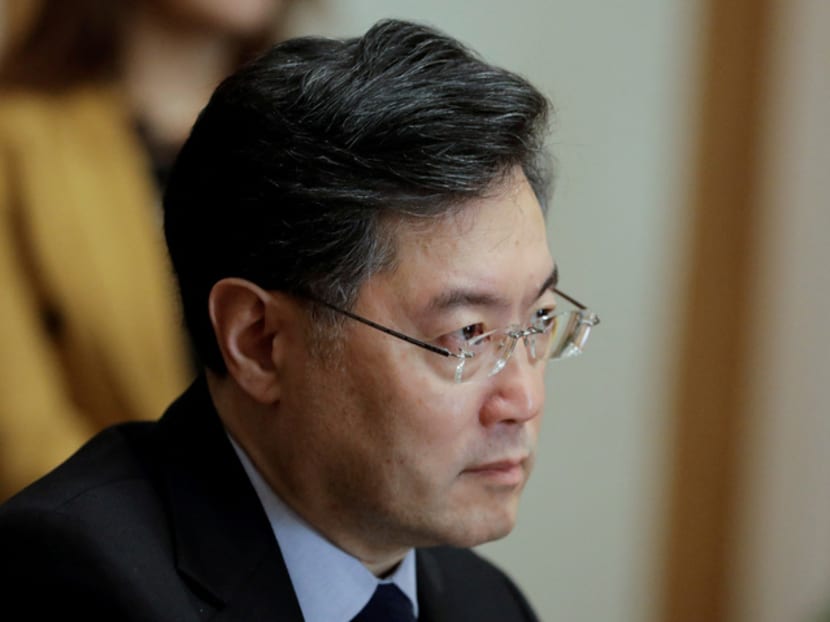
A file photograph of China's former foreign minister Qin Gang.

- Once a rising star handpicked by Chinese President Xi Jinping, Mr Qin Gang was removed as China’s foreign minister on Tuesday (July 25), a month after his last public appearance
- Experts said that while Mr Qin’s removal from office was not a first for the country, his case was “unprecedented” given his short tenure and global attention on his unexplained recent absence from public view
- They said the lack of an explanation for Mr Qin’s sudden exit would inevitably lead to speculation
- Some media outlets have reported unverified “rumours” that Mr Qin may have had an affair with a Hong Kong television presenter, who has recently taken a low profile
- Mr Qin is being succeeded by his predecessor and boss, Mr Wang Yi, whom experts call a safe and conservative choice


SINGAPORE — Once a rising star handpicked by Chinese President Xi Jinping, the sudden ousting of Mr Qin Gang as China’s foreign minister on Tuesday (July 25) has left lingering questions about what led to his removal.
Observers are also mulling over what the move will mean for Chinese foreign policy, with his predecessor Mr Wang Yi now reappointed in his stead.
Mr Qin’s removal from office comes after the Chinese government’s almost-radio silence on his absence for about a month, following his last public appearance on June 25 – which fanned much speculation about the former minister’s fate.
TODAY takes a closer look at the twists and turns of this political event, which observers say is “unprecedented” in the reform era that began in the late 1970s, given Mr Qin's brief seven-month tenure and the level of global attention over his unexplained absence in recent weeks.
WHO IS MR QIN GANG?
Considered a confidant of Chinese President Xi Jinping, Mr Qin, 57, became one of the country’s youngest foreign ministers when he was appointed to the office in December 2022.
Prior to this, Mr Qin, a fluent English speaker, served as Chinese ambassador to the United States from 2021 to 2023. He also held the position of China’s vice minister of foreign affairs between 2018 and 2021.
Mr Qin was twice foreign ministry spokesman, between 2006 and 2014, and chief protocol officer between 2014 and 2018, overseeing many of Mr Xi’s interactions with foreign leaders.
As ministry spokesman, he stood out for being one of the first diplomats to speak sharply in defence of China’s increasingly assertive foreign policy.
This earned him the reputation of being a “wolf warrior”, a term used to describe a new generation of Chinese diplomats who push back with often inflammatory rhetoric against Western criticism of Beijing.
Despite his bold support for China’s stance, Mr Qin also displayed a willingness to work with the US.
Upon his arrival in Washington DC in July 2021 to take up the post of US ambassador – after a period of public vitriol between US and Chinese officials – he said that relations between the two powers held “great opportunities and potential”.
WHAT LED TO MR QIN’S ‘METEORIC’ RISE?
Mr Qin’s rise in the Chinese Communist Party (CCP) has been described by Al Jazeera’s China correspondent Katrina Yu as “rapid and meteoric”.
“He was known to be close to Xi, having served as chief of protocol in the foreign ministry and overseen several of Xi’s overseas visits,” said Associate Professor Chong Ja Ian, a political scientist at the National University of Singapore (NUS).
Agreeing, Dr Benjamin Ho, assistant professor and coordinator of the China programme at the S Rajaratnam School of International Studies (RSIS), added that Mr Qin was “basically heavily favoured by President Xi”.
Dr Chen Gang, assistant director of policy research and senior research fellow at NUS’ East Asian Institute, said that Mr Qin was promoted because he was good at handling relations with Western countries.
He added that it was urgent for China to improve relations with the US and Europe after the CCP’s 20th National Congress in October last year.
Dr Ho of RSIS said it is “hard to say” how extensive Mr Qin’s influence was given the generally opaque nature of Chinese politics.
“It’s quite fair to say that Qin Gang has been very prominent internationally – from the days of the wolf warrior diplomacy in 2021, right up till just a month ago. You could very much say that Qin Gang was the face of Chinese diplomacy,” he said.
WHAT IS KNOWN ABOUT MR QIN’S REMOVAL FROM OFFICE?
Mr Qin made his last public appearance a month ago on June 25, when he held talks with officials from Sri Lanka, Russia and Vietnam in Beijing.
Since then, China remained tight-lipped about him, attributing his absence from a high-level Association of Southeast Asian Nations (Asean) summit in Indonesia in mid-July to “health reasons”.
On Tuesday, Chinese state media outlet Xinhua said that the country’s top legislature had voted to remove Mr Qin from office, replacing him with Mr Wang.
Foreign ministry spokeswoman Mao Ning also told journalists that she had “no information” to offer and insisted that “China's diplomatic activities are steadily moving forward”.
Some news outlets, including the BBC, have reported “rumours” of Mr Qin having an affair with a prominent Hong Kong television presenter, Cambridge-educated Fu Xiaotian.
The outlets said Ms Fu had recently taken a low profile. The Times of London reported that a social media user had posted a video of a TV interview of Mr Qin by Ms Fu in which, the poster asserted, they had engaged in “affectionate flirting”.
Notwithstanding the speculation, experts told TODAY that they had not noted anything Mr Qin did or said during his seven-month term which could have led to his ejection.
However, they added that the circumstances around his abrupt removal from office suggest that the decision was a result of a “serious” recent turn of events.
“Nothing in what he (has) said or done, at least publicly, would have indicated his impending removal from office – that is why there continues to be an information vacuum, which lends itself to plenty of speculation,” said Dr Dylan Loh, an assistant professor at the Nanyang Technological University’s (NTU) Public Policy and Global Affairs programme.
Still, he noted that Beijing’s convening of a session to remove Mr Qin would mean “something more serious in nature, such as a serious health issue, or a probe into his conduct or making a political misstep”.
Agreeing, Ms Jiayu Li, a senior associate at public policy advisory firm Global Counsel, said: “While the official reason given for his lack of public appearance has been health related, a prevailing theory which points at the erasure of Mr Qin’s bio and all mentions of him from the Ministry of Foreign Affairs’ website suggests that the reason behind his removal is likely to be discipline related.
“This is usually how cadres with misconduct are treated.”
Experts added that while Mr Qin’s removal from office was not a first for the country – citing Mr Yang Jing’s removal from position of state councillor in 2018 due to a corruption probe – Mr Qin’s case was “unprecedented”.
Ms Li from Global Counsel said that Mr Qin’s removal from office was unique because of his short term of service, the international attention on his disappearance, and Beijing’s prolonged silence in even responding to questions such as whether he is under investigation.
Dr Ho of RSIS added: “I don’t think the removal of a foreign minister is something common, and certainly not after seven months. I mean, if you remove your foreign minister after seven months, it reflects very badly on your political planning.
“It was probably because of more recent events, whatever those events may be. You don’t promote someone only to remove him intentionally.”
Still, as of the time of writing, Mr Qin continues to hold his more senior position as a state councillor – though experts cautioned that it does not mean he is “politically safe”.
Dr Ho from RSIS said that Mr Qin’s retention of his role as a state councillor suggests he is “state-influential”, just not in the arena of foreign policy.
Having said that, Dr Ho acknowledged that an alternative reading could be that the Chinese government did not want to “take away everything” at once, as that would “send a signal” that there were problems.
Dr Chen from NUS’ East Asian Institute suspects that Mr Qin may not hold the position of state councillor for long.
WHAT’S NEXT?
Experts said that Mr Qin’s ousting from office is unlikely to affect China’s diplomacy and foreign policy in the short term, or Singapore or the region’s relations with the country.
Dr Ho of RSIS does not foresee the move having a big significance. He also does not think that US-China relations will improve or worsen just because of Mr Qin’s removal.
“Foreign policy is just a subset of Chinese politics. No one is really indispensable in Chinese politics, short of the leader and one or two other members,” he said.
Having said that, experts acknowledge that the move will likely reinforce existing public perception on the ruling CCP’s opacity.
Assoc Prof Chong from NUS said: “It increases the sense of uncertainty in working with the CCP. How this affects the CCP is unknown as yet, which attests to its opacity.”
The experts said that Mr Wang’s reappointment as China’s foreign minister is a safe and conservative move, though they believe it is likely a temporary, stop-gap measure.
Dr Ho of RSIS said: “Wang Yi was the face of the Chinese foreign ministry for quite a number of years. His world view is very much aligned with that of the party and the leader.”
Dr Chen of NUS’ East Asian Institute believes that Mr Wang’s reappointment could slightly influence China’s foreign policy stance in this period.
“Wang’s reappointment as foreign minister is not only because he is experienced, but also his expertise on Asian affairs and his friendship with many Asian leaders, especially friends in Southeast Asia and East Asia,” said Dr Chen.
“So this personnel change may also indicate a shift in China’s foreign policy from focus on western countries to Asian and neighbouring countries.”
Related topics
China Wang Yi foreign policyStay in the know. Anytime. Anywhere.

Subscribe to our newsletter for the top features, insights and must reads delivered straight to your inbox.
By clicking subscribe, I agree for my personal data to be used to send me TODAY newsletters, promotional offers and for research and analysis.






