
First ISIS attack in South-east Asia leaves 7 dead, 17 injured
JAKARTA — Islamic State (IS) militants launched their first major strike in South-east Asia yesterday, using bombs and gunfire to stage an attack in the heart of Indonesia’s capital that echoed a similar siege in Paris in November.
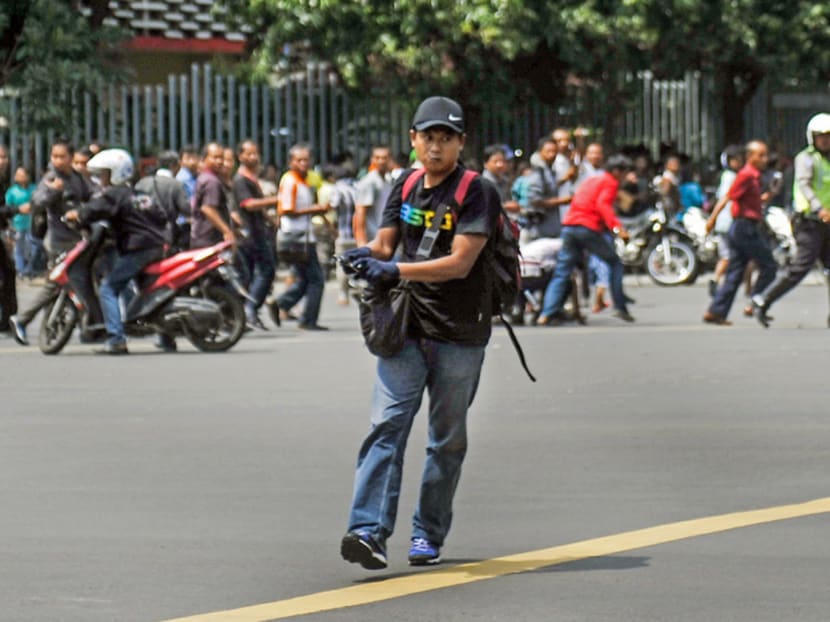
A man believed to be a suspect in the terror attack at Thamrin Street in Jakarta on Jan 14, 2016, according to Xinhua news agency. At least six blasts were heard in the Sarinah shopping mall, with gunfire exchanges between a terrorist group and police around the mall premises. Photo: AP

JAKARTA — Islamic State (IS) militants launched their first major strike in South-east Asia yesterday, using bombs and gunfire to stage an attack in the heart of Indonesia’s capital that echoed a similar siege in Paris in November.
The siege in Jakarta left at least seven people dead and scores injured. Five of the seven people killed were the attackers themselves.
It took security forces about three hours to end the siege near a Starbucks cafe and Sarinah, Jakarta’s oldest department store, after a team of around seven militants traded gunfire with police officers and blew themselves up.
A police officer and a Canadian man were killed in the attack, which, with the attackers, took the death toll to seven. Seventeen people, including a Dutch man, were wounded. Two of the militants were taken alive, police said.
“Islamic State fighters carried out an armed attack this morning targeting foreign nationals and the security forces charged with protecting them in the Indonesian capital,” Aamaaq news agency, which is allied to IS, said on its Telegram channel.
Jakarta’s police chief told reporters: “IS is behind this attack definitely.” He also named an Indonesian militant called Bahrun Naim as the man responsible for plotting it.
Indonesian President Joko Widodo called for calm and cut short a working visit to West Java, returning to Jakarta to deal with his biggest security challenge to date.
“This act is clearly aimed at disturbing public order and spreading terror among people,” Mr Widodo said in a televised statement. “The state, the nation and the people should not be afraid of, and lose to, such terror acts.’’
Malaysia and Singapore stepped up domestic security following the deadly attack in Jakarta. Singapore Prime Minister Lee Hsien Loong and other Singapore leaders condemned the attack, and expressed shock and dismay. No Singaporean casualties have been reported so far.
“Singapore condemns these attacks,” PM Lee wrote in a Facebook post. “We will give our full support to the Indonesian government to bring the perpetrators to justice.”
Indonesia has suffered several major bomb attacks since 2000. The last major terror attack was in July 2009, when seven people were killed and more than 40 injured when suicide bombers struck the luxury Ritz-Carlton and JW Marriott hotels in Jakarta.
A security crackdown after the 2009 attack weakened the most dangerous terror networks in Indonesia, leading to a long lull in large-scale strikes. But there have been growing concerns that home-grown extremists bloodied on the battlefields of the Middle East with IS could return to stage attacks on home soil – fears which were confirmed by yesterday’s attack.
The drama played out on the streets and on television screens, with at least six explosions and a gunfight in a movie theatre. Witnesses to the carnage said a powerful explosion ripped through a branch of US coffee giant Starbucks around noon.
At least one gunman later emerged and began shooting at bystanders, reloading his weapon as police flooded the streets. In chaotic scenes, security forces moved in behind the cover of moving vehicles, with regular bursts of gunfire and warnings of a sniper in the area.
“I heard a loud bang, boom. It felt like an earthquake. We all went downstairs,” said Ruli Koestaman, 32, who had been in a nearby building when the attack began.
Eyewitnesses said several explosions struck a Starbucks café and a police post near popular shopping centre, the Sarinah. The area is home to several embassies, including those of the United States, France and Spain. A number of United Nations agencies are also housed nearby.
Graphic photographs from the scene showed the bloodied bodies of bystanders lying on the ground. Starbucks shuttered all branches in the Indonesian capital. Several foreign embassies advised their nationals to avoid the area.
Indonesia has been on high alert since the police foiled several terror plots last month, with some believed to be linked to IS. Jakarta was placed on high alert after anti-terror police foiled what they said were plans for a New Year suicide attack.
The Soufan Group, a New York-based security consultancy, says that of the 500 to 700 Indonesians who travelled abroad to join IS’s self-proclaimed caliphate across swathes of Syria and Iraq, scores have since returned.
“We know that IS has the desire to declare a province in this region,” said Kumar Ramakrishna, a counter-terrorism analyst at the S. Rajaratnam School of International Studies in Singapore.
“The threat of returning Southeast Asian fighters radicalised in the Iraq-Syria region are also another factor of concern, together with the possibility of self-radicalised lone wolves appearing in the scene.”
Experts also worry that Indonesian laws are not adequate for tackling the new threat and that the region is failing to pull together.
“The governments in this region must work together to prevent the creation of a satellite of the caliphate because if such a satellite is declared, the threat in Southeast Asia will grow,” said regional terrorism expert Rohan Gunaratna. AGENCIES.
Stay in the know. Anytime. Anywhere.

Subscribe to our newsletter for the top features, insights and must reads delivered straight to your inbox.
By clicking subscribe, I agree for my personal data to be used to send me TODAY newsletters, promotional offers and for research and analysis.






