
Forest loss 'hotspots' bigger than Germany: World Wildlife Fund
PARIS — More than 43 million hectares of forest — an area bigger than Germany — have been lost in a little over a decade in just a handful of deforestation hotspots, conservation organisation World Wildlife Fund (WWF) said Wednesday (Jan 13).
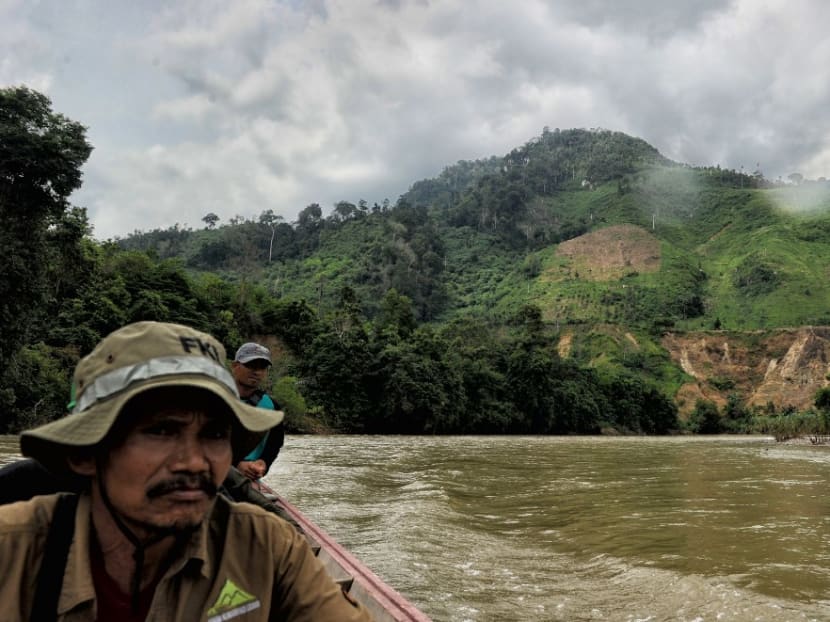
This file photo taken on May 7, 2017 shows a team of Indonesian forest rangers making their way along the Alas river, as signs of deforestation from illegal logging are seen in the background, in the Leuser ecosystem rainforest, located mostly within the province of Aceh on the northern tip of the island of Sumatra.

PARIS — More than 43 million hectares of forest — an area bigger than Germany — have been lost in a little over a decade in just a handful of deforestation hotspots, conservation organisation World Wildlife Fund (WWF) said Wednesday (Jan 13).
Swathes of forest continue to be flattened each year — mainly due to industrial-scale agriculture — as biodiversity-rich areas are cleared to create space for livestock and crops.
Analysis by WWF found that just 29 sites across South America, Africa and Southeast Asia were responsible for more than half of the global forest loss.
The Brazilian Amazon and Cerrado, the Bolivian Amazon, Paraguay, Argentina, Madagascar, along with Sumatra and Borneo in Indonesia and Malaysia were among the worst affected, it said.
In Brazil's Cerrado region, home to five per cent of the planet's animals and plants, land has been cleared rapidly for soy and cattle production, leading to a 32.8 per cent loss of forest area between 2004 and 2017.
The United Nations’ (UN) Intergovernmental Panel on Climate Change issued a groundbreaking report on land use in 2019, in which it outlined a string of looming trade-offs in using land.
In that same year, the UN's biodiversity panel said that 75 per cent of all land on earth had been "severely degraded" by human activity.
Forests are an enormous carbon sink, together with other vegetation and soil sucking up roughly a third of all the carbon pollution humans produce annually.
Yet they continue to disappear rapidly, threatening irreparable losses to Earth's crucial biodiversity.
‘HUMANITY’S BEST INTEREST’
And, as wild species find their living space shrinking further each year, the risk of a repeat of zoonotic diseases — such as the Covid-19 pandemic — jumping to humans is ever higher.
"We must address over-consumption and put greater value on health and nature rather than the current overwhelming emphasis on economic growth and financial profits at all cost," said Ms Fran Raymond Price, forest practice lead at WWF International.
"This is in humanity's best interests: The risk of new diseases emerging is higher in tropical forest regions that are experiencing land-use change."
Ms Price warned that if deforestation was not rapidly curbed, "we could miss out on our chance to help prevent the next pandemic".
There is also a huge threat to indigenous communities that have lived off what forests provide for centuries or longer.
Ms Ana Mota da Silva, a member of the Mumbuca community in the Cerrado — where deforestation rose 13 per cent in 2020 — said she feared for the future.
"Knowing that our rivers are drying up, that so many trees are dying... the certainty that my sons, cousins, my descendants will not see what I have seen," she said.
"We now face the Cerrado being devastated and us with it."
Recent research has shown that, beyond a certain threshold, deforestation in the Amazon basin could tip the region into a new climate regime, turning tropical forests into savannah.
The WWF report urged citizens to do their bit by avoiding products linked to deforestation such as some meat, soy and palm oil products.
It also urged governments to work to secure the rights of indigenous peoples and conserve biodiversity-rich areas. AFP
Related topics
World Wildlife Fund deforestationStay in the know. Anytime. Anywhere.

Subscribe to our newsletter for the top features, insights and must reads delivered straight to your inbox.
By clicking subscribe, I agree for my personal data to be used to send me TODAY newsletters, promotional offers and for research and analysis.






