
Home alone in Japan: Men especially face harsh times ahead
TOKYO — More people in Japan are living alone but what is particularly alarming is their identity: mainly Japanese men with loose ties to their local communities.
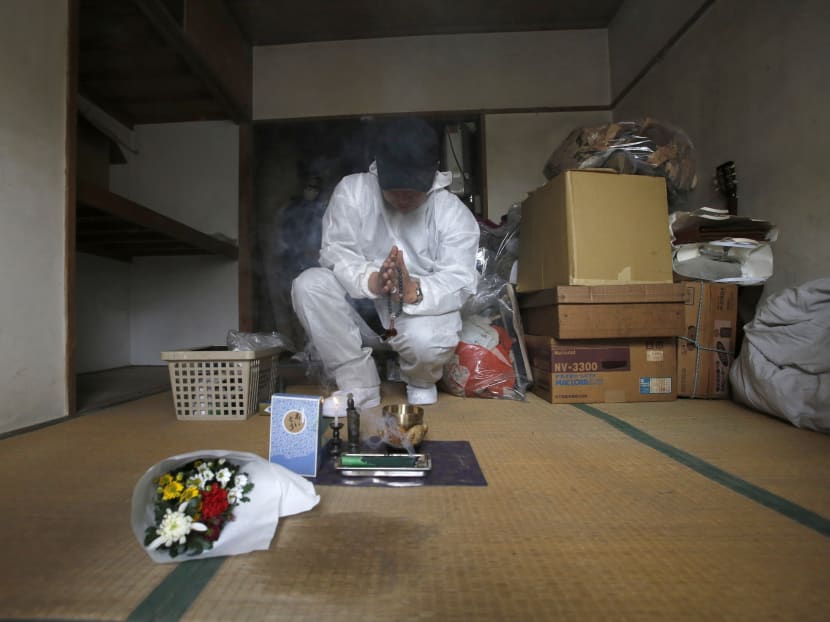
Mr Hirotsugu Masuda, a special cleaning worker prays in front of a stain on the floor in Tokyo where a body of an 85 year-old man was left for over a month. Many elderly Japanese men are now facing the unwitting prospect of growing old alone. Photo: Reuters

TOKYO — More people in Japan are living alone but what is particularly alarming is their identity: mainly Japanese men with loose ties to their local communities.
Many are elderly men in isolation, lacking any support, or those of the working generation who have delayed or shunned marriage, only now to find they are facing the unwitting prospect of growing old alone.
Indeed, Japan is in a predicament where it needs to create a social security network that stretches beyond the family as the basic household unit of society.
A Tokyo man in his 90s whose wife died nearly 10 years ago is a textbook example of what can happen to people left to their own devices: he began to show signs of dementia after five or six years living on his own.
Although he was formally recognised as “requiring support,” the man insisted that he be left alone when a facilitator at the local Community General Support Center recommended he receive nursing-care services.
He refused hospital visits, and even his pacemaker began to malfunction. He stopped attending neighborhood association meetings and other events he used to when he was healthy.
Having no children to care for him, the man found himself in virtual isolation. He had not taken a bath in years, nor changed his clothes.
Because of his erratic dietary habits, he failed to get proper nutrition, leading to a worsening of his dementia. The man finally entered a private residential nursing home last November.
Similar examples can be seen across the nation.
Yoko Shimazaki, who is in charge of the man’s case at the Community General Support Center, said keeping tabs on those living alone, especially at night, is difficult.
“For people living alone, we are in the dark sometimes, especially at night. It is difficult to get a comprehensive view of everything happening with them,” Ms Shimazaki said.
Isolation is an issue affecting many, even the working generation.
“When I think of getting old all I see in front of me is darkness,” an unmarried man in his 40s who lives in Tottori Prefecture, western Japan, said with a look of gloom.
The man graduated from a prestigious university in the Kansai region but was unable to secure a job at his company of choice during the so-called “employment ice age.”
He quit his job after working several years for a small manufacturer.
Afterwards he jumped around in part-time jobs, and he now works as a temporary employee for a local government office. He is seeking marriage, but when he tells potential partners his annual salary he is often rejected.
According to a survey conducted by the National Institute of Population and Social Security Research, the ratio of people who have never married before turning 50 -- the “lifetime unmarried ratio” -- continues to rise, reaching 23 per cent and 14 per cent for men and women, respectively, in 2015.
For people, like the aforementioned man, following the so-called second baby boomer generation (those born from 1971-1974) who went through the employment ice age as young adults, many have not seen income growth, and hence hesitate to marry because of financial difficulties.
For the man, the fear of dying alone cannot be ignored.
“If I get sick or become unemployed I would be cut off from society. It is scary to live alone but there’s nothing I can do,” he said.
People living alone will make up nearly 40 per cent of all households in 2040, according to a projection by the same national research institute.
Some companies see the rise of elderly people living alone as a unique business opportunity.
Venture startup PowerElec based in Nagoya, west of Tokyo, has developed a device already on the market that can gauge power consumption between home appliances, such as television sets, and a Wi-Fi plug.
For example, the device detects abnormal patterns in power from a TV that has been left on or off for an extended period, and the data is transmitted to the company’s cloud server. Family members or local government agencies are then notified either via email or with a cellphone app to confirm the person’s safety.
PowerElec says its new internet of things (IoT) service was deemed necessary to deal with the social problem of elderly people living alone.
The majority of service users are family members living apart from their elderly relatives, but the city of Nagoya has also incorporated the service to check the safety of elderly people living alone in municipal housing, and the service is expanding.
Katsuhiko Fujimori, a chief researcher at Mizuho Information & Research Institute, said that in the future a social network that expands beyond a family will be necessary to cope with the rise in mainly unmarried men living alone as they grow old.
“We won’t be able to rely on families to care for the elderly, unlike up to now. Along with a strengthening of social security with enhanced nursing-care services, it will be necessary that mechanisms be created to promote interaction among housing residents,” Mr Fujimori said. KYODO NEWS
Stay in the know. Anytime. Anywhere.

Subscribe to our newsletter for the top features, insights and must reads delivered straight to your inbox.
By clicking subscribe, I agree for my personal data to be used to send me TODAY newsletters, promotional offers and for research and analysis.






